
Your laptop is open. The coffee is still warm. And somehow, an hour has gone by and you have done almost nothing.
You checked your email. You replied to one message, then read three more that did not need you. You wandered into the kitchen. You sat back down, opened the document you were supposed to finish, and then — phone. One notification, then another, and the morning quietly slipped away.
If that sounds familiar, you are not lazy, and you are not alone. Learning how to stay productive working from home is mostly about fixing the setup around you, not fixing yourself. The office used to do a lot of invisible work for you: a start time, a desk that meant work, colleagues who noticed when you drifted, a building you left at the end of the day. At home, all of that is gone, and you have to build it yourself. This guide shows you how.
Written by Md Masud Rana based on published expert sources. This article has not been professionally reviewed. See our sources below.
Quick Answer
To stay productive working from home, give your day a clear start, a dedicated workspace, and a plan for your hours. Begin with a short morning routine, work in focused blocks using the Pomodoro Technique or time blocking, keep your phone out of reach, and batch email. Take real breaks, move around, and end the day with a shutdown ritual.

Contents
- Why Focusing at Home Feels Harder Than It Should
- Build a Start to Your Day That Isn’t Your Inbox
- Give Your Work a Physical Home
- Structure Your Hours: Pomodoro, Time Blocking and Deep Work
- Cut the Distractions That Eat Your Day
- Breaks, Movement and the Art of Switching Off
- Working From Home With Kids in the House
- What Recent Research Shows
- Common Mistakes to Avoid
- Final Recommendations
- Frequently Asked Questions
Why Focusing at Home Feels Harder Than It Should
Here is the part most productivity lists skip: your home is working against you in ways that have nothing to do with willpower. The office, for all its faults, gave you automatic cues. The commute was a transition — time that belonged to neither home nor work, during which your brain quietly shifted gears. The building itself was a signal: walk in, you are at work; walk out, you are not. Your desk was used for one thing only, and colleagues provided a gentle kind of accountability.
At home, none of that exists unless you build it. The commute is twelve steps from the bedroom. The desk might be the same table where you eat breakfast. The workday ends whenever you decide it ends — which often means it never quite ends at all.
There is a sneakier problem, too. Your home is full of unfinished tasks you can see: the dishes, the laundry, the parcel that needs returning. In an office, those things are out of sight. At home, each one holds a small open loop in your mind. Psychologists call this the Zeigarnik effect — unfinished tasks stay mentally active until completed or deliberately put aside — so part of your attention is always elsewhere.
Then there is the loneliness nobody warns you about. The first few weeks of working from home often feel peaceful. Then the quiet starts to feel heavy. Without the small social moments of an office — a chat while the kettle boils, a shared joke — motivation can sag. That is not a personal failing. It is a normal response to working alone.
The good news: all of this is fixable — not with a heroic new personality, but with structure. Spend two or three days noticing when your focus goes and what takes it; most people find three or four small leaks, not one big one. And remember, a focused six-hour day beats a distracted ten-hour day.
Build a Start to Your Day That Isn’t Your Inbox
The most common mistake in a home working day happens in the first ten minutes: rolling out of bed, picking up the phone, and reading email before your feet properly hit the floor. It feels like a head start. It is not — it hands the day to other people’s priorities before you have decided your own.
In an office, the commute did something useful that nobody appreciated: it gave your brain a buffer between home mode and work mode. You cannot recreate a train ride, but you can build a short “false commute” — a small ritual that tells your brain the workday has begun. A fifteen-minute walk around the block, coffee in hand. Ten minutes with a notebook, writing down the three things that would make today a good day. The specific ritual matters less than doing it every day.
Then pick a consistent start time and keep it. Flexibility is one of the best parts of working from home, and nobody is suggesting you punch a clock. But people who start at 8 one day, 10.30 the next and 7 the day after tend to report the most scattered weeks. A predictable anchor makes it far easier to protect everything that comes after it.
Choose your three things before you open anything
Once you sit down, before email, before messages, write down the three most important things for today. Not ten. Three. If you finish those three, the day was a good one. This is the simplest version of “eat the frog”: do the hardest, most important task first, while your energy is fresh.
Plan those three things the evening before, when the day’s work is still fresh in your mind. It takes two minutes, and it means you never start a morning staring at a blank to-do list. That wondering is where the phone usually wins.
Give Your Work a Physical Home
The fix for a drifting workday is simple: give work a defined place, and when you leave that place, leave the work too. Even a corner of a room counts, as long as it is yours and used for work only. The kitchen table is the hardest option — the same surface that holds your breakfast and your bills keeps pulling your brain in two directions.
If space is tight, a small desk against a wall, a fold-down surface, or a spot at the dining table that you set up and clear away each day can do the job. The ritual of setting up and packing away creates the start and the stop a separate room would provide. Our guide to setting up a home office in a small space walks through layouts that fit into a single corner.
Get the ergonomics right
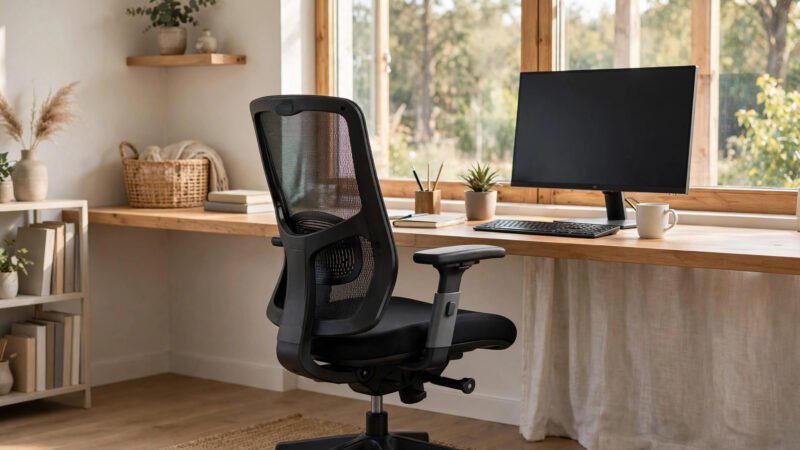
Your body is part of your productivity system, not separate from it. A chair that hurts your back by 3pm will cost you more focus than any phone notification. The Mayo Clinic’s office ergonomics guide recommends keeping your monitor about an arm’s length away, with the top of the screen at or slightly below eye level, your feet flat on the floor, and your wrists straight while typing. A laptop stand plus an external keyboard and mouse makes a real difference.
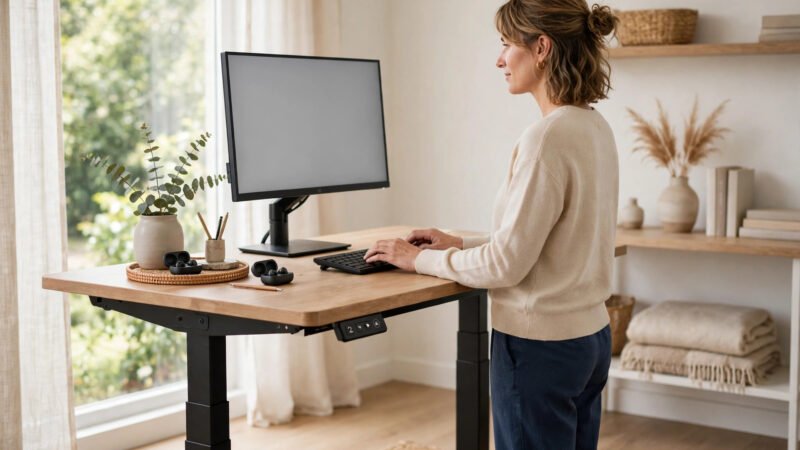
It does not need to be expensive: a cushion for lower-back support, a stack of books under the monitor. And whatever your setup, the Mayo Clinic’s advice is blunt — sitting in the same position for hours is not good for you, however good the chair. Our complete home office setup guide covers the whole room, and the standing desk guide explains how to alternate sitting and standing.
Light and sound
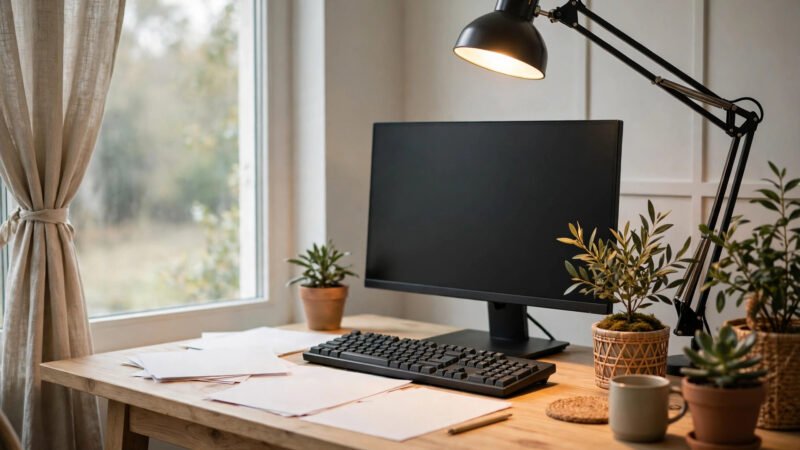
Natural light helps more than most people expect. If you can, put your desk near a window — to the side, not facing it directly, which causes glare. In a dark room, a decent desk lamp keeps your eyes from straining; our home office lighting guide explains how to get this right without spending much.
Sound matters too. Some people focus best in silence, others with soft background noise or music without lyrics. What rarely works is a television in the background. If noise is a problem, noise-cancelling headphones are one of the best investments a home worker can make — and they double as a visible “do not disturb” signal. Our guide to reducing noise in your home office has more options, and the eye strain guide covers the 20-20-20 rule for tired eyes.
Structure Your Hours: Pomodoro, Time Blocking and Deep Work
An unstructured day at home stretches like warm toffee. Tasks expand to fill the hours, and by 5pm you are not sure what you actually did. The answer is to give your hours a shape before the day begins.
The Pomodoro Technique: 25 minutes at a time
The Pomodoro Technique was developed by Francesco Cirillo in the late 1980s, using a tomato-shaped kitchen timer — pomodoro is Italian for tomato. The method is simple: pick one task, set a timer for 25 minutes, work on only that task until it rings, then take a five-minute break. After four rounds, take a longer break of 15 to 30 minutes. The official Pomodoro Technique site describes it as a complete system for dealing with time, not just a timer.
Why does something so simple work? A 25-minute window is short enough to start — even a task you have been avoiding feels manageable when the commitment is only 25 minutes — and the timer removes the constant decision of “should I stop now?” You stop when it rings. If something genuinely interrupts a session, restart the timer rather than counting the partial session, and use the five-minute breaks properly: stand up, get water, look out of the window.
If 25 minutes feels too short, try 50 minutes with a ten-minute break. The interval is a starting point, not a law. Experiment for a week and keep what fits your attention span.
Time blocking: decide when, not just what
A to-do list tells you what to do. It does not tell you when, which is why lists so often end the day half-finished. Time blocking fixes that: you put tasks on the calendar as appointments with yourself. Deep work from 9 to 11. Email from 11 to 11.30. Calls after lunch. When the block arrives, you do what the calendar says — and when it ends, you stop, even if the task is unfinished. Start small: block just the first two hours of tomorrow morning for your hardest task. And use the two-minute rule: if a task takes less than two minutes, do it now instead of writing it down.
Deep work: protect your best hours
Not all hours are equal. Most people have a two- or three-hour window in the day when their thinking is sharpest — often the morning, sometimes late at night. The writer Cal Newport calls the work done in that window “deep work”: focused, distraction-free effort on demanding tasks. Reserve your best hours for your hardest work, and push meetings, email and admin into the hours when your brain is running on fumes.
A time block that says “9 to 11: deep work, phone in another room” is one of the most productive things a home worker can do. Two genuinely focused hours in the morning will often produce more than a whole afternoon of half-attention. Defend that block like a meeting with your most important client.
Cut the Distractions That Eat Your Day
Here is an uncomfortable fact: you are probably not as good at multitasking as you think you are. Nobody is. The American Psychological Association’s summary of task-switching research explains that the brain does not run two demanding tasks in parallel — it switches between them, and every switch has a cost. Those costs are small per switch, sometimes just fractions of a second, but they add up fast when you switch all day. The APA notes that psychologist David Meyer has said the brief mental blocks created by shifting between tasks can cost as much as 40 percent of someone’s productive time.
That is the real price of “just quickly checking” something. It is never just the thirty seconds the check takes. It is the minutes it takes your brain to reload the task you left. So the most effective distraction strategy is not willpower — it is making the distraction harder to reach than the work.
Your phone is the main leak — treat it like one
Keep the phone in another room during focus blocks. Not face down beside you — in another room, on silent. Even a phone sitting on the desk divides attention. If you need it for two-factor codes or calls, put it across the room where reaching it takes a deliberate decision, not a reflex.
Turn off non-essential notifications entirely. Social media, news alerts, shopping apps — none of them need to reach you in real time. Check them at set times instead, during a break.
Batch your email and messages
Email is the classic example of a task that feels productive while quietly destroying productivity. Replying to messages all day means your attention is set by whoever emailed most recently. Instead, check email two or three times a day — mid-morning, after lunch, and before you finish — and process it in a batch: reply, file, or delete, then close it.
The same goes for team chat. Set your status to “focusing” during deep-work blocks, and check messages during breaks. Almost no message is so urgent that it cannot wait 25 minutes.
Deal with the chores honestly
The dishes and the laundry are real, and pretending they do not exist does not work — the open loop just keeps buzzing. Give them a time: a ten-minute tidy at lunch, laundry started before your first call. When a chore has its own slot, it stops hijacking your attention during focus time. If one pops into your head mid-task, write it on a scrap of paper and carry on.
Agree the rules with the people you live with
If you share your home, your productivity is partly a negotiation. Agree on the basics: your working hours, a signal that means “do not disturb” (headphones on, door closed), and what counts as an interruption worth making. People are usually happy to respect a boundary they helped set.
Breaks, Movement and the Art of Switching Off
It sounds backwards, but the people who take proper breaks get more done. Your brain is not a machine that runs at full power for eight hours; it works in cycles, and it needs downtime. A break that means scrolling through your phone is not a break. A real break means moving, looking away from the screen, and letting your mind idle for a few minutes.
Stand up at least once an hour. Walk to the kitchen, stretch, step outside for two minutes. If you have a standing desk, alternate between sitting and standing. Eat lunch away from your desk, properly. Working through lunch does not give you an extra hour of good work; it gives you an extra hour of tired work.
A short walk is the single best reset in a home worker’s day. Fifteen minutes around the block at midday clears the head better than another coffee, and many people find their best ideas arrive on that walk, not at the desk. Take it without headphones and without your phone if you can.
The shutdown ritual: how work ends
Just as the morning needs a start ritual, the evening needs a stop ritual. Without one, work leaks into the night — one more email after dinner, a document open on the sofa, a mind still half at work at 10pm. That leak is one of the main reasons home workers burn out.
Pick a finish time and a short closing routine, five minutes at most. Review what you finished today and write down tomorrow’s three things. Close every tab and every app, then physically leave the workspace. The ritual is small, but it draws a line your brain can recognise.
Keep your sleep regular, too. A steady wake time and a steady bedtime do more for next-day focus than any app or technique. If your sleep schedule has drifted, our guide to fixing your sleep schedule explains how to reset it gradually.
Working From Home With Kids in the House
Everything above assumes a reasonably quiet house. If you have children at home, the honest truth is that your day will look different, and pretending otherwise only adds guilt. The goal is not a perfect eight-hour day. It is a realistic one.
First, lower your expectations and measure the week, not the day. With children, any single day can be derailed by a bad night or a small person who needs you right now. A week usually balances out, so aim for weekly goals — and a bad Tuesday stops feeling like failure.
Second, work in the gaps, not against them. Small, well-defined tasks fit into the windows children naturally give you — a nap, a television programme, independent play. This is where the Pomodoro Technique earns its keep: a 25-minute session is short enough to fit a nap window, and it gives you a clear unit of progress to count.
Third, make the rules visible. Even young children can understand a simple signal: a closed door, headphones on, or a coloured sign on your desk that means “working — only interrupt for emergencies.” Agree what counts as an emergency. Children cope far better with a clear “I am busy until lunch, then I am all yours” than with a parent who is mentally elsewhere.
Finally, ask for help and accept it. Childcare support, a partner who takes the morning shift, an employer who knows your situation — none of this is weakness. Be honest with colleagues about what you are juggling, and give yourself the same grace you would give a friend: some days, “good enough” is the right target.
What Recent Research Shows
The evidence on working from home is more encouraging than the stereotypes suggest — but it comes with honest limits.
The best-known study remains Stanford economist Nicholas Bloom’s randomized experiment with Ctrip, a large Chinese travel company. Volunteers were randomly assigned to work from home four days a week or to stay in the office, and their performance was tracked for nine months. The home workers were 13% more productive — roughly an extra day’s work a week. About a third of the gain came from a quieter environment, and the rest from working more minutes. Resignations among home workers fell by half. Bloom describes the findings on the Stanford Graduate School of Business site and in an interview with the Harvard Business Review.
That is a strong result, but read it carefully. The study covered call-centre work — tasks that are easy to measure and easy to do remotely. Bloom himself says the benefits are likely smaller for creative work and teamwork, where the evidence is still thin. The volunteers also chose to work from home, and they had a quiet room and decent broadband. Your mileage may vary.
The task-switching research points the same way: focus is a real, measurable resource, spent every time you change tasks. The American Psychological Association’s review finds that people lose time on every switch, lose more when tasks are complex or unfamiliar, and make more errors. That is why the practical advice in this guide — single-tasking, batching email, phone in another room — follows directly from how attention works.
More recent research on hybrid working, which Bloom has continued to publish, suggests the sweet spot for many people is a mix: some days at home for focused work, some days together for collaboration.
Common Mistakes to Avoid
1. Starting the day with email. It hands your morning to other people’s priorities and guarantees a reactive day. Your three tasks come first.
2. Working from the sofa or bed. It feels comfortable for twenty minutes and costs you focus and posture for the rest of the day — and your brain starts associating the bed with work, which is bad news for sleep.
3. Treating every notification as urgent. Almost nothing is. Notifications are designed to feel urgent; that is their job. Your job is to decide when to look.
4. Skipping breaks to “get more done”. You get less done, worse, and you end the day exhausted. Breaks are part of the work.
5. Having no finish time. Without a shutdown ritual, work spreads into the evening and tomorrow starts already tired.
6. Trying to multitask through the hard stuff. Answering messages while writing a report means doing both badly. Single-task the important work.
7. Copying someone else’s system wholesale. A routine that works for a single person in a quiet flat will not work for a parent of two in a small house. Take the principles — start, place, plan, stop — and fit them to your own life.
Final Recommendations
- Build a 15-minute morning ritual — a walk, getting dressed, writing your three tasks — before you open email.
- Give work one place, even if it is only a corner, and set your monitor and chair up properly. Your body is part of your focus.
- Try the Pomodoro Technique for one week — 25 minutes on, 5 minutes off, longer break after four.
- Block your best two hours for your hardest task, phone in another room, and defend that block like a meeting.
- Batch email and messages to two or three set times a day instead of reacting all day.
- Take a real lunch break away from your desk and a short walk at midday.
- Create a five-minute shutdown ritual — review the day, plan tomorrow’s three tasks, close everything, leave the workspace.
- If children are at home, plan by the week, work in small sessions, and agree clear do-not-disturb signals.
- Stay connected on purpose — a quick call with a colleague, a walk with a friend — so the quiet of home working does not turn into loneliness.
- Review your week every Friday: what worked, what leaked your time, and one small change for next week.
Frequently Asked Questions
Start with a short morning routine, a dedicated workspace and a plan for your hours. Pick three priorities before opening email, work in focused blocks using the Pomodoro Technique or time blocking, keep your phone in another room during deep work, and batch email to two or three set times a day.
Usually because the structure the office provided is missing: no commute to mark the start, no separate room, no colleagues around, and visible household tasks competing for attention. Psychologists call the last part the Zeigarnik effect — unfinished tasks stay mentally active. The fix is structural, not willpower: a start ritual, a workspace and timed blocks.
The Pomodoro Technique, created by Francesco Cirillo in the 1980s, means working in 25-minute focused sessions separated by five-minute breaks, with a longer break after four sessions. It works because a short window is easy to start, the timer removes the decision of when to stop, and breaks prevent fatigue.
Motivation usually follows structure rather than preceding it. A consistent start time, three clear priorities, visible progress — such as counting completed Pomodoro sessions — and regular contact with colleagues all help. If low motivation lasts for weeks, or comes with low mood or poor sleep, talk to a qualified healthcare professional.
Plan by the week instead of the day, since any single day can be disrupted. Work in short, well-defined sessions that fit nap times or quiet play, and use a clear signal — a closed door or headphones — so children know when not to interrupt. Agree what counts as an emergency, and when you will be free again.
Research suggests it can be. In a Stanford randomized experiment at the travel company Ctrip, home workers were 13 percent more productive than office workers, mostly because the office is noisy and home workers took fewer breaks and sick days. But the study covered call-centre work, and the volunteers chose to work from home.
Create a shutdown ritual: pick a finish time, spend five minutes reviewing what you did and writing tomorrow's three tasks, close all work apps and tabs, and physically leave your workspace. Change your clothes and shut the door if you can. The ritual gives your brain a clear signal that the working day is over.
There is no single best routine, but a strong one has four parts: a morning start ritual, a dedicated workspace, planned focus blocks for your hardest work, and a shutdown ritual at the end of the day. Add regular breaks, a walk at midday and a consistent sleep schedule, and adjust the details to fit your household and your energy.
This content is for educational purposes only and does not replace professional advice. If work stress, low mood or burnout is affecting your health, speak to a qualified healthcare professional.
Conclusion
Staying productive working from home is not a talent, and it is not a matter of trying harder. It is a matter of design. The office used to provide the start, the place, the plan and the stop without you noticing. At home, you have to provide them yourself.
Start small. Tomorrow, try just three things: a fifteen-minute morning ritual before you touch your inbox, one protected two-hour block for your hardest task with your phone in another room, and a five-minute shutdown ritual at the end of the day.
Be honest with yourself about what is actually eating your time. For most people it is not laziness. It is a phone that never stops, an inbox that never closes, a house full of small unfinished jobs, and a working day with no edges. Each of those has a practical answer in this guide. Done well, working from home is not a compromise — the research says people can be more productive at home than in a noisy office, when the day has shape.
References
- Stanford Graduate School of Business — “Why Working from Home Is a ‘Future-Looking Technology'” (Nicholas Bloom, Ctrip experiment) — https://www.gsb.stanford.edu/insights/why-working-home-future-looking-technology
- Harvard Business Review — “To Raise Productivity, Let More Employees Work from Home” (Bloom, 2014) — https://hbr.org/2014/01/to-raise-productivity-let-more-employees-work-from-home
- Mayo Clinic — “Office ergonomics: Your how-to guide” — https://www.mayoclinic.org/healthy-lifestyle/adult-health/in-depth/office-ergonomics/art-20046169
- The Pomodoro Technique (official site, Francesco Cirillo) — https://www.pomodorotechnique.com/
- American Psychological Association — “Multitasking: Switching costs” (2006) — https://www.apa.org/topics/research/multitasking