
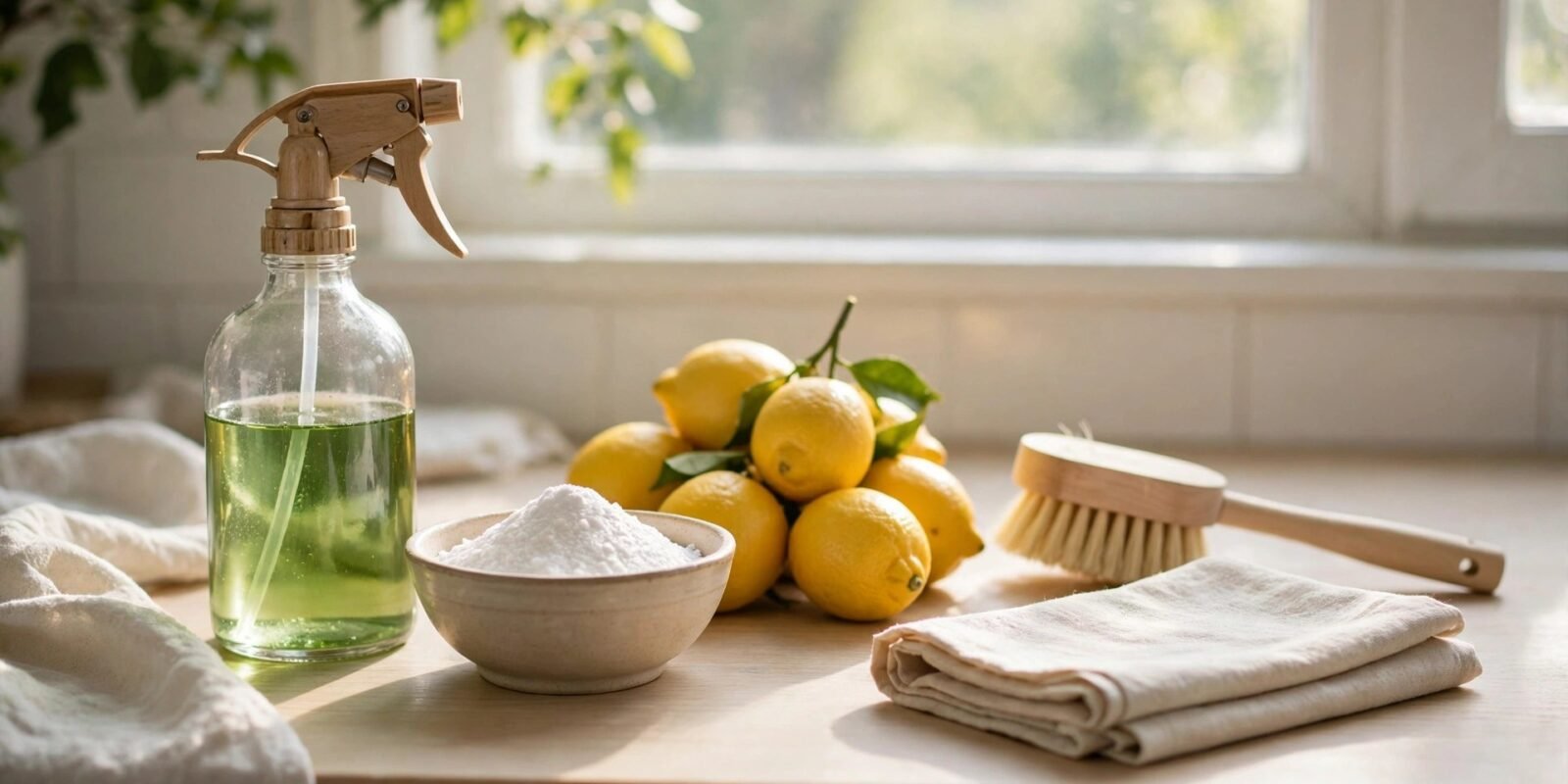
Imagine standing in the cleaning aisle, turning bottles over. One promises “plant-powered freshness”. Another says “natural” in green letters and lists almost nothing on the back. A third costs twice as much as the bleach spray next to it, and there is no way to tell whether it will shift the grime. If that scene feels familiar, this guide is for you.
Eco-friendly cleaning products can genuinely clean your home — but only if you buy the right ones and use them properly. The market holds honest, effective formulas, and it also holds greenwashing: vague claims, pretty leaves on the label, and the same harsh chemicals behind a “natural” scent. This guide cuts through that noise: what “eco-friendly” really means, which ingredients do the work, how to spot a trustworthy label, and how to make simple cleaners at home for pennies.
Written by Md Masud Rana based on published expert sources. This article has not been professionally reviewed. See our sources below.
Quick Answer
Eco-friendly cleaning products are formulas made with biodegradable, plant-based ingredients, without harsh chemicals such as chlorine bleach, ammonia, or synthetic fragrance, and usually sold in recyclable or refillable packaging. They work well for everyday cleaning when matched to the right job and given a few minutes of contact time. Look for third-party certification such as the EPA Safer Choice label, check the full ingredient list, and use DIY vinegar and baking soda recipes for the simplest jobs.
Contents
- What Does “Eco-Friendly” Actually Mean?
- Do Eco-Friendly Cleaning Products Really Work?
- Ingredients to Look For — and Ones to Avoid
- How to Read Labels and Spot Greenwashing
- Room by Room: What to Use Where
- DIY Natural Cleaners: 5 Recipes That Actually Work
- Pets, Babies, and Asthma: Cleaning Safely Around Vulnerable Lungs
- What It Costs — and How to Switch Without Wasting Money
- What Recent Research Shows
- Common Mistakes to Avoid
- Final Recommendations
- Frequently Asked Questions
What Does “Eco-Friendly” Actually Mean?
Here is the awkward truth: in most countries, nobody owns the phrase “eco-friendly”. In the United States, cleaning product makers are not even required to list all their ingredients on the label. The Environmental Working Group (EWG) points out that US law allows manufacturers of most cleaning products to use almost any ingredient they wish, and the government assesses the safety of very few of them before they reach shop shelves.
Used honestly, a genuinely eco-friendly cleaning product tends to share four traits.
First, its ingredients break down naturally. Biodegradable surfactants — the molecules that lift grease and dirt — decompose in water and soil instead of lingering in waterways.
Second, it leaves out the harshest chemicals: no chlorine bleach, no ammonia, no phosphates, and no synthetic fragrance. Medical News Today notes that green cleaning products should not contain hazardous chemicals, which makes them likely to pose fewer health risks and less harm to the environment.
Third, it is honest on the label. A trustworthy product lists every ingredient in plain language you can check. Vague words like “surfactant” or “preservative” with no detail are a warning sign.
Fourth, the packaging matters too. Refillable bottles, concentrated formulas, and recycled packaging all reduce waste — a gentle formula in a thick single-use bottle is half a job. Our guide to reducing plastic waste at home covers the packaging side in more detail.
None of this means a green product is automatically safe. Medical News Today makes the point plainly: a cleaning product is not necessarily safe for everyone just because people consider it green. Essential oils can trigger allergies, vinegar can damage stone, and borax can irritate skin. “Natural” and “safe” are not the same word.
Why bother switching at all?
Three reasons keep coming up in the research. The first is the air inside your home. Conventional cleaning products release volatile organic compounds (VOCs), which contribute to indoor air pollution. The US Environmental Protection Agency lists VOCs, eye and skin irritation, and pollution from chemicals disposed of in waterways among the risks of conventional products, as summarised by Medical News Today.
The second reason is your lungs. A long-running Norwegian study followed more than 6,000 people for over 20 years and found that women who cleaned regularly showed faster decline in lung function than women who did not. We look at that study properly in the research section below — the headlines oversimplified it.
Do Eco-Friendly Cleaning Products Really Work?
Yes — with one big condition: they work when the product matches the job and you give it time.
Plant-based cleaners work differently from the bleach-heavy formulas many of us grew up with. Bleach kills fast and smells like it is working. A citric-acid bathroom spray dissolves limescale quietly, over three to five minutes. If you spray and wipe immediately, you will conclude it does not work. Wait the full few minutes and the same spray handles the job with barely any scrubbing. Contact time — the minutes a cleaner sits on a surface before you wipe — is the single most important habit in green cleaning.
The same applies to the kitchen. An enzyme-based degreaser breaks down stovetop grease, but enzymes need a couple of minutes to do their chemistry. Spray, make a cup of tea, then wipe. Rushing that step is the most common reason people decide green products underperform, and the reviews back this up again and again.
What about germs? Cleaning and disinfecting are different jobs. Cleaning removes dirt and many germs; disinfecting kills germs and needs a registered disinfectant used exactly as its label directs. Most everyday eco-friendly cleaners are cleaners, not disinfectants. Vinegar has some antimicrobial action, but it is not a registered disinfectant, and DIY mixtures are not recommended for disinfecting against serious viruses — the University of Arkansas Cooperative Extension says so directly. For everyday life, soap, hot water, and a good wipe are enough. When someone is ill, or after handling raw meat, reach for a proper disinfectant — the US EPA maintains a searchable list of products that meet the Safer Choice Standard, including disinfectants.
One more thing trips people up: foam. Coconut-derived surfactants, the base of most green dish soaps, produce noticeably less foam than synthetic ones — but the dishes still come out clean. Suds are air, not chemistry.
Ingredients to Look For — and Ones to Avoid
Once you know what each ingredient does, choosing a product takes thirty seconds instead of ten minutes in the aisle.
Ingredients that earn their place
White vinegar (5% acetic acid). A mild acid that cuts mineral deposits, soap scum, and grease. Brilliant on glass, tile, and stainless steel, with some germ-killing ability — though it is not a registered disinfectant. Never use it on natural stone such as marble or granite: acid etches the surface.
Baking soda (sodium bicarbonate). A gentle abrasive and natural deodoriser. It scrubs sinks, tubs, and ovens without scratching, neutralises odours, and is safe on most surfaces, including stone.
Castile soap. A plant-based soap made from vegetable oils, usually olive or coconut. Diluted, it works as an all-purpose cleaner, floor cleaner, and dish soap. One caution: do not mix it with vinegar — the acid and the soap neutralise each other.
Hydrogen peroxide (3%). A mild alternative to bleach that disinfects, whitens grout, and tackles mould. Keep it in its dark bottle — light breaks it down — and rinse food-contact surfaces after use.
Citric acid. The ingredient that dissolves limescale around taps and shower heads — the reason good eco bathroom sprays work — and it is sold cheaply as a powder for DIY use.
Plant-derived surfactants and enzyme blends. Surfactants lift grease; enzymes break apart stain molecules. Look for coconut or corn-derived surfactants, and enzyme blends in laundry detergents and kitchen degreasers.
Tea tree and lavender oil. Tea tree oil has genuine antimicrobial properties, and lavender has mild antibacterial action. Use a few drops for scent and a modest boost — they are helpers, not disinfectants. Some essential oils can irritate skin or trigger allergies, so patch-test first and keep them away from babies and pets.
Ingredients to avoid
The main ones to avoid are chlorine bleach (harsh fumes, irritates lungs and skin), ammonia (irritates eyes and airways, and toxic if mixed with bleach), phosphates (feed algal blooms), synthetic fragrance listed only as “fragrance” or “parfum” (often contains phthalates and triggers asthma), quaternary ammonium compounds or “quats” (linked to asthma and skin irritation), 2-butoxyethanol, and triclosan. One rule covers most of this list: if the label hides its fragrance behind the single word “fragrance”, treat it as an unknown — one fragrance can contain dozens of chemicals. Choose “fragrance-free” or products scented only with named essential oils.
How to Read Labels and Spot Greenwashing
Greenwashing is the gap between what a label suggests and what a product actually is. A leaf logo designed in-house means nothing, and the words “natural”, “eco”, “green”, and “non-toxic” are largely unregulated in the US and UK — any brand can print them. So how do you tell the real thing from the marketing?
Trust seals, not slogans
Third-party certification is the shortcut. An independent body checks the ingredients, the performance, and sometimes the packaging before a product may carry its seal. The most useful ones are EPA Safer Choice (US) — the EPA reviews every ingredient against strict health and environmental criteria, and you can search the full list on the EPA’s Safer Choice product database — EWG Verified, which rates products A to F on ingredient hazard and disclosure using the Guide to Healthy Cleaning methodology (in its 2016 update, only about one in seven products assessed earned an A or B), and Green Seal and EU Ecolabel, which cover ingredients, performance, and packaging. A seal is not a guarantee of perfection, and a product without one is not automatically bad — small brands sometimes cannot afford certification. But when two similar products sit side by side and one carries a recognised seal, the seal is the tiebreaker.
The five-second label check
The Better Business Bureau’s advice on choosing eco-friendly cleaning products boils down to a short routine: read the ingredients, not the front of the bottle; look for a real certification rather than a home-drawn leaf; be wary of vague words, since “green” and “natural” are not regulated terms and the US Federal Trade Commission expects companies to prove specific claims; check the packaging for recycled content and refill options; and start small, patch-testing one product at a time, since some people react even to natural ingredients.
Watch out for labels that boast about what is missing while staying silent about what is present. “Bleach-free” tells you nothing if the product still contains ammonia and synthetic fragrance. A good label tells you what is in the bottle, not just what is not.
Room by Room: What to Use Where
There is no single cleaner for the whole house. Different rooms present different problems — grease in the kitchen, limescale in the bathroom, dust and footprints on floors — and eco-friendly cleaning works best when you match the tool to the task.
The kitchen
Grease is the kitchen’s main enemy, and enzymes and plant surfactants are the answer. Use an enzyme-based degreaser on the hob and range hood, give it two minutes of dwell time, then wipe. For worktops, a vinegar-and-water spray or a castile-soap solution handles daily cleaning; after raw meat, use a proper disinfectant or hot soapy water followed by a 3% hydrogen peroxide spray, rinsed after a minute.
For the fridge, wipe with baking soda dissolved in warm water and leave an open box inside to absorb smells. Grease on the oven door responds well to a baking soda paste left for 20 minutes. Wiping up spills promptly means less scrubbing later — one more reason our guide to reducing food waste at home starts in the kitchen.
The bathroom
Limescale and soap scum need acid, so citric-acid sprays and vinegar are your friends here. Spray the shower and taps, wait three to five minutes, then wipe. For grout, a baking soda paste with a splash of hydrogen peroxide whitens without bleach fumes. For the toilet, a citric-acid cleaner left for ten minutes does the job; scrub, flush, done.
What about mould? Small patches can be handled with undiluted 3% hydrogen peroxide, left for ten minutes, then scrubbed and rinsed — wear gloves and a mask. Larger or recurring mould usually points to damp or poor ventilation, and no cleaner will fix that. If it keeps returning, get professional advice.
Floors
Most hard floors need very little: warm water with a small amount of vinegar and a microfibre mop. For wood floors, use even less water — damp, not wet — and skip vinegar if the manufacturer warns against acids. Avoid “mop and shine” products that leave a residue you will eventually have to strip off.
Glass and laundry
For glass, mix one cup of water, one cup of white vinegar, and a tablespoon of cornstarch, then wipe with a microfibre cloth and buff dry. For laundry, plant-based detergents with enzyme blends handle everyday washing well; wash cold where the label allows, skip fabric softener, and treat stains with a baking soda paste or an oxygen-bleach soak.
DIY Natural Cleaners: 5 Recipes That Actually Work
Making your own cleaners is cheaper than buying them, and you know exactly what is inside. These five recipes draw on university extension guidance, including the University of Arkansas Cooperative Extension’s green cleaning guide and WebMD’s natural cleaning guide. Mix small batches, label every bottle, and never store a homemade cleaner in a food container.
1. All-purpose spray
Mix 1 cup water, 1 cup white vinegar, and 10–15 drops of tea tree or lavender oil in a spray bottle. Shake before each use. Good for worktops, bathroom surfaces, and appliances. Do not use on natural stone.
2. Glass and mirror cleaner
Mix 1 cup water, 1 cup white vinegar, and 1 tablespoon of cornstarch. Shake well, spray, wipe with a microfibre cloth, then buff dry. The cornstarch is the trick — it stops streaks.
3. Scrubbing paste for sinks, tubs, and ovens
Mix half a cup of baking soda with just enough castile soap to form a thick paste. Add a few drops of essential oil if you like. Apply, leave for ten minutes on stubborn marks, scrub, and rinse.
4. Floor cleaner
Add half a cup of white vinegar and ten drops of essential oil to a gallon of warm water and mop as usual. For wood floors, use a barely damp mop and skip the vinegar if your floor manufacturer advises against it.
For kitchen surfaces that need extra attention, heated vinegar (5%) or 3% hydrogen peroxide left on the surface for at least a minute can kill germs such as salmonella and E. coli, according to WebMD’s natural cleaning guide. Do not mix the two in one bottle. Remember: homemade mixtures are cleaners, not registered disinfectants.
DIY safety rules that are not optional
- Never mix bleach with anything but water. Bleach plus ammonia (found in many glass cleaners) creates toxic chloramine fumes. Bleach plus vinegar creates chlorine gas. Both can send you to hospital.
- Never mix castile soap with vinegar. They cancel each other out.
- Keep them away from children and pets. “Natural” does not mean safe to drink — borax, essential oils, and concentrated vinegar can all harm a small child or a curious dog.
Pets, Babies, and Asthma: Cleaning Safely Around Vulnerable Lungs
The people — and animals — most affected by cleaning chemicals are the ones closest to the floor. Babies crawl on it. Dogs and cats lick it. Anyone with asthma breathes it in at close range.
If you have a baby or toddler
Choose fragrance-free products and rinse food-contact surfaces after cleaning. Avoid disinfectant wipes on high-chair trays and toys unless the label says the surface is safe for food contact after rinsing. Store every cleaning product — green or not — in a locked cupboard, above a toddler’s reach.
If you have pets
Dogs and cats groom themselves, so whatever is on the floor ends up in their mouths. Avoid phenol-based cleaners (some pine-scented products), and be cautious with essential oils — tea tree oil in particular is toxic to cats and dogs if ingested in concentrated form. Use plain vinegar-and-water or castile-soap solutions on pet areas, rinse well, and let floors dry fully before letting pets back in. When in doubt, ask your veterinarian — this article is research-based guidance, not veterinary advice.
If someone in the house has asthma or allergies
Sprays are the worst format for sensitive lungs, because they put fine droplets into the air you breathe. Switch to liquids applied with a cloth, or spray onto the cloth rather than into the air. Choose fragrance-free formulas, open a window, and dust with a damp microfibre cloth instead of a feather duster.
What It Costs — and How to Switch Without Wasting Money
Eco-friendly cleaning products usually cost more per bottle than conventional ones — often 20–50% more. That is the honest answer. But the per-bottle price is not the whole story.
Concentrates change the maths. A bottle that dilutes into three or four spray bottles often works out cheaper per use than a ready-to-spray product, and refill stations cut the price further. DIY is cheapest of all: vinegar and baking soda cover most of the house for months.
Switch gradually. Do not throw out every product you own and buy a green cupboard in one trip — that wastes money and creates waste. Instead, replace products as they run out, one at a time, starting with the all-purpose spray and the dish soap. Keep one conventional disinfectant for the genuinely risky jobs (raw meat, illness) until you have found a certified green alternative you trust.
What Recent Research Shows
The most widely discussed study in this field is the Bergen study from the University of Norway, published in 2018 in the American Journal of Respiratory and Critical Care Medicine. Researchers followed 6,235 adults for more than 20 years, tracking their lung function and their cleaning habits.
The headline finding: women who cleaned at home or worked as professional cleaners showed faster decline in lung function than women who did not clean. Forced expiratory volume in one second (FEV1) declined 3.6 ml per year faster in women who cleaned at home, and 3.9 ml per year faster in women who worked as cleaners — an effect the researchers described as comparable to smoking somewhat less than 20 pack-years. Asthma was also more common among women who cleaned (12.3% at home, 13.7% at work) than among women who did not (9.6%). No such pattern appeared in men, possibly because very few men in the study worked as cleaners. The full abstract is available from Oxford Academic, and a plain-language summary from EurekAlert.
What the study did not show matters too. It did not test eco-friendly products against conventional ones, and it did not prove a specific chemical caused the damage — the authors speculated that repeated irritation of the airways causes persistent changes over time. It was also observational, though the researchers adjusted for smoking, body mass index, and education.
So the honest reading is this: frequent exposure to cleaning sprays is associated with faster lung decline in women, and reducing that exposure is sensible — but switching to a green label alone is not the whole answer. What likely helps is the combination: gentler products, less spraying into the air, better ventilation, and cleaning with a cloth rather than a cloud of aerosol.
Common Mistakes to Avoid
1. Spraying and wiping immediately. Green cleaners need contact time. Spray, wait three to five minutes, then wipe. Skipping the wait is the top reason people think eco products do not work.
2. Using vinegar on natural stone. Vinegar etches marble, granite, and limestone. One careless spray can leave a dull mark no polishing removes. Use a pH-neutral stone cleaner instead.
3. Mixing castile soap with vinegar. The acid un-saponifies the soap, leaving a cloudy liquid that cleans worse than either ingredient alone.
4. Mixing bleach with anything. Bleach plus ammonia makes toxic fumes; bleach plus vinegar makes chlorine gas. Never mix bleach with anything but water.
5. Trusting the front of the bottle. Leaves, earth tones, and the word “natural” are design choices, not certifications. Read the ingredient list and look for a real seal.
6. Buying a dozen products at once. Most homes need three: an all-purpose cleaner, a bathroom cleaner, and a dish soap — plus vinegar and baking soda.
7. Treating “green” as “safe to ignore”. Even gentle cleaners need gloves for long sessions, ventilation, and safe storage away from children and pets. And remember that cleaning is not disinfecting: using an all-purpose spray where a registered disinfectant is needed leaves the job half done.
Final Recommendations
- Start with three products: a certified all-purpose cleaner, a citric-acid bathroom spray, and a plant-based dish soap. Add vinegar, baking soda, and castile soap for DIY jobs.
- Let the label earn your trust: look for EPA Safer Choice, EWG Verified, or Green Seal — and a full ingredient list.
- Give every cleaner time to work: three to five minutes of contact time before wiping.
- Spray the cloth, not the air: especially if anyone in the house has asthma or allergies.
- Keep one real disinfectant for raw meat and illness, and use it exactly as its label directs.
- Never mix bleach with anything but water, and never mix castile soap with vinegar.
- Replace products as they run out, one at a time, rather than overhauling the whole cupboard in one expensive trip.
- Store everything safely: labelled, out of reach of children and pets, and never in a food container — and open a window while you clean.
- Cut the packaging too: choose concentrates and refills, and recycle empty bottles properly — our guide to recycling at home shows what your local rules actually accept.
This content is for educational purposes only and does not replace professional medical advice. Always consult a qualified healthcare professional if you have concerns about chemical exposure, allergies, or asthma.
Frequently Asked Questions
Yes, for everyday cleaning. Plant-based cleaners handle grease, limescale, and dirt well, but they need three to five minutes of contact time before wiping. The most common reason people think they fail is spraying and wiping immediately. For disinfecting after raw meat or illness, use a registered disinfectant instead.
Usually safer than conventional products, but not automatically safe. Avoid phenol-based cleaners and concentrated tea tree oil, which is toxic to cats and dogs. Use vinegar-and-water or castile-soap solutions on pet areas, rinse well, and let floors dry before pets walk on them. If your pet seems unwell after cleaning, switch products and ask your veterinarian.
No. Vinegar is excellent on glass, tile, and stainless steel, but it etches natural stone such as marble and granite, and it can damage some hardwood finishes. It also should not be mixed with castile soap or bleach. Use it where it suits the surface, and choose a pH-neutral cleaner for stone.
Read the ingredient list and look for third-party certification such as EPA Safer Choice, EWG Verified, or Green Seal. Words like natural, green, and non-toxic are largely unregulated. A trustworthy product lists its ingredients fully, avoids phosphates, bleach, ammonia, and synthetic fragrance, and offers recyclable or refillable packaging.
Almost always. White vinegar, baking soda, and castile soap cost very little and cover most cleaning jobs for months. The trade-off is convenience: shop-bought certified products are ready to use and tested for performance, while DIY mixtures must be made fresh in small batches.
Most everyday eco-friendly cleaners clean but do not disinfect — they remove dirt and many germs without killing them all. Vinegar and hydrogen peroxide have some germ-killing ability, but they are not registered disinfectants. When you need to disinfect, use a registered disinfectant and follow its label directions exactly.
Avoid chlorine bleach, ammonia, phosphates, synthetic fragrance listed only as fragrance or parfum, quaternary ammonium compounds, 2-butoxyethanol, and triclosan. These are linked to lung and skin irritation, asthma triggers, or harm to waterways. Check the full ingredient list, choose fragrance-free products when possible, and never mix bleach with anything but water.
Conclusion
Eco-friendly cleaning products are not a miracle, and they are not a marketing trick either. They sit in the honest middle: genuinely effective for everyday cleaning, gentler on your lungs and your waterways, and — when you choose certified products and use them properly — every bit as capable as the harsh formulas they replace. The catch is that they ask a little more of you. Read the label. Give the spray a few minutes. Match the cleaner to the room.
The bigger lesson from the research is not really about products at all. It is about exposure. The Bergen study did not blame a single chemical; it showed that years of breathing in cleaning sprays adds up. So the most useful change is cleaning in a way that puts less chemistry into the air: spray the cloth, open the window, use the gentlest product that does the job, and save the heavy chemicals for the rare jobs that truly need them.
Start small. Replace your all-purpose spray when it runs out, and try the vinegar and baking soda recipes this weekend. Notice how your home smells afterwards — clean, but not chemical. And when you are ready to go further, our guide to starting composting at home is a natural next step.
References
- US Environmental Protection Agency — Search Products that Meet the Safer Choice Standard — https://www.epa.gov/saferchoice/products
- Medical News Today — Green cleaning products: Benefits and recipes — https://www.medicalnewstoday.com/articles/green-cleaning-products
- Environmental Working Group — Spring Cleaning: EWG’s Tips on What to Use – and What to Avoid — https://www.ewg.org/news-insights/news-release/spring-cleaning-ewgs-tips-what-use-and-what-avoid
- Environmental Working Group — EWG’s Guide to Healthy Cleaning: Toxicity Datasets & Product Ratings — https://www.ewg.org/cleaners/content/toxicity-datasets/
- Svanes, Ø. et al. (2018) — Cleaning at Home and at Work in Relation to Lung Function Decline and Airway Obstruction, American Journal of Respiratory and Critical Care Medicine, 197(9), 1157–1163 — https://academic.oup.com/ajrccm/article-abstract/197/9/1157/8498721
- EurekAlert / American Thoracic Society — Women who clean at home or work face increased lung function decline — https://www.eurekalert.org/news-releases/677509
- WebMD — Natural Cleaning: How to Make Your Own Green Cleaners — https://www.webmd.com/a-to-z-guides/ss/cm/slideshow-guide-to-natural-cleaning
- University of Arkansas Cooperative Extension — Clean and Green Homemade Cleaners — https://www.uaex.uada.edu/environment-nature/water/quality/clean-green-homemade-cleaners.aspx
- Better Business Bureau — BBB Tip: How to choose eco-friendly cleaning products — https://www.bbb.org/article/news-releases/24493-bbb-tip-how-to-choose-eco-friendly-cleaning-products
- Bob Vila — The Best Natural Cleaning Products — https://www.bobvila.com/articles/best-natural-cleaning-products/