Your newborn is finally home, the tiny bath tub is sitting in the bathroom, and suddenly a simple wash feels like a high-stakes operation. How do you hold a slippery baby with one hand and wash with the other? How warm should the water be? And what about that umbilical cord stump — can it even get wet? If those questions are running through your head, you are in good company. Learning how to bathe a newborn is one of the first skills every new parent has to pick up, and almost nobody feels confident the first time.
Here is the reassuring part: newborns do not need much bathing at all, and once you know the steps, bath time becomes one of the calmest moments of the day. This guide covers the first bath, sponge baths, the move to a tub bath, water temperature, and what to do when your baby cries — all drawn from published guidance from the American Academy of Pediatrics, Mayo Clinic, and UCSF Benioff Children’s Hospitals.
Written by Md Masud Rana based on published expert sources. This article has not been professionally reviewed. See our sources below.
Quick Answer: How to Bathe a Newborn
Give sponge baths only until the umbilical cord stump falls off, usually within one to two weeks. Then move to short tub baths in about 5 cm (2 inches) of warm water at around 38°C (100°F), two to three times a week. Wash face first and the nappy area last, support the head and neck at all times, and never leave your baby alone in or near water, even for a second.
Key takeaways:
- Sponge baths only until the cord stump falls off; tub baths after that.
- Two to three baths a week is enough — daily baths can dry out newborn skin.
- Bath water should feel warm, not hot: around 38°C (100°F), tested with your elbow.
- Keep one hand on your baby at all times and gather everything before you start.
Contents
- When Should You First Bathe a Newborn?
- How Often Should You Bathe a Newborn?
- What You Need Before You Start
- How to Give a Sponge Bath, Step by Step
- How to Bathe a Newborn in the Tub, Step by Step
- How to Wash Your Newborn’s Hair and Handle Cradle Cap
- Bath Safety Rules Every Parent Should Know
- What to Do When Your Baby Cries During Baths
- What Recent Research Shows
- Common Mistakes to Avoid
- Final Recommendations
- Frequently Asked Questions
When Should You First Bathe a Newborn?
Many parents are surprised to learn that the first bath is no longer given in the first hour or two after birth. Hospitals used to wash babies almost immediately. Today, many have changed their policies — and the guidance behind the change is worth knowing.
The World Health Organization recommends delaying a baby’s first bath until 24 hours after birth — or waiting at least 6 hours if a full day is not possible for cultural reasons.
There are three solid reasons for the wait. Babies bathed too soon are more likely to become cold, and the stress can cause a drop in blood sugar. Taking the baby away for a bath interrupts skin-to-skin contact, bonding, and early breastfeeding — one study cited by the AAP found a 166% increase in hospital breastfeeding success after a 12-hour delay. And the white, waxy coating on newborn skin, called vernix, acts as a natural moisturiser that the AAP advises leaving in place rather than rubbing off.
That first bath will usually happen in the hospital or in the first days at home, and your midwife or health visitor may offer to show you how it is done. Ask to watch it once or twice before you try it yourself — that is exactly what the demonstration is for.
What about the umbilical cord stump?
The rule for your first one to two weeks: sponge baths only until the cord stump falls off, usually by one or two weeks of age. The AAP and Mayo Clinic agree on this — do not submerge the stump in water.
One note: UCSF Benioff Children’s Hospitals adds that unless your healthcare provider says otherwise, it is fine to bathe a baby with the cord stump still in place. If the stump has not fallen off after two weeks, mention it to your baby’s doctor.
How Often Should You Bathe a Newborn?
Newborns rarely sweat and do not get dirty the way older children do, so a full bath every day is unnecessary — and it can dry out their skin.
The AAP advises that three baths per week during the baby’s first year may be enough. Mayo Clinic agrees, and UCSF Benioff Children’s Hospitals suggests about three times a week, or every other day, for the first month, as long as the baby’s skin is healthy.
Between baths, a quick wipe with a damp washcloth takes care of the face, neck, and nappy area after feeds and nappy changes. Check the skin folds — thighs, groin, armpits, under the chin — where milk and moisture collect.
When a bath is needed sooner
A nappy blowout, a big spit-up, or a hot day are all good reasons for an extra wash. The rule is simple: bathe when there is a mess to clean. If your baby has eczema or very dry skin, bathing less often — and using soap only once or twice a week — may help; our guide to baby eczema causes, symptoms, and safe relief covers the skin-care side in more detail.
Morning or night?
Either works — pick a time when you are not rushed and will not be interrupted. Some parents prefer mornings, when babies tend to be alert; others make the bath part of a calming bedtime ritual. If you bathe after a feed, wait a little while for your baby’s tummy to settle first.
What You Need Before You Start
The most important rule: gather everything before the baby goes near the water. Once your baby is wet, you cannot step away — not to answer the door, not to grab a forgotten towel. If you forgot something, take the baby with you.
Set everything out within arm’s reach, in a warm room with the door closed to keep out draughts. Here is the kit:
- A baby bath, basin, or clean sink — a hard plastic baby bath with a sloped, textured surface or a sling is the safest choice. The US Consumer Product Safety Commission recommends an infant tub manufactured on or after 2 October 2017, so it meets current safety standards.
- Two soft towels — one to lay your baby on, one hooded towel to wrap them in afterwards.
- Two or three soft washcloths — one for the face, one for the body, and a spare.
- A bowl or jug of warm water for rinsing.
- Mild, fragrance-free baby soap and shampoo — for babies over one month old. Under one month, plain water is safer for the skin, according to Ireland’s Health Service Executive (HSE).
- A clean nappy and a change of clothes.
- A bath thermometer (optional, but reassuring for first-time parents).
- A soft baby brush or infant comb — useful if cradle cap appears later.
Keep the bath short at first, about five to ten minutes, so your baby does not get cold. And wash your own hands before you begin.
How to Give a Sponge Bath, Step by Step
For the first one to two weeks — while the umbilical cord stump is still attached — a sponge bath is the way to wash your baby. The rhythm is simple: face first, body second, nappy area last, uncovering only the part you are washing so your baby stays warm.
- Set up a warm, flat surface. A changing table, a firm bed, a counter, or a blanket on the floor all work. Pad hard surfaces with a thick towel. If your baby is on a raised surface, use the safety strap and keep one hand on them at all times.
- Fill a basin with warm water. Test it on the inside of your wrist or elbow. Have a washcloth, a dry towel, and all your supplies within reach.
- Undress your baby and wrap them in a towel. Lay your baby on their back, wrapped in the towel with only the head exposed — keeping the rest covered stops them getting chilled.
- Wash the face first, with plain water only. Wet the washcloth, wring out the extra water, and wipe each eyelid from the inside corner outward, then the rest of the face. Do not use soap on the face, and do not get water in the eyes or mouth. Wipe the outer folds of the ears too — never insert a cotton bud into the ear canal.
- Wash the body, one section at a time. Use plain water under one month; after that, a little mild baby soap is fine. Uncover one area, wash it, rinse, pat dry, and cover it again. Work from the neck down — under the arms, behind the ears, around the neck, between fingers and toes — and wash the nappy area last.
- Keep the cord stump dry. Avoid getting the umbilical stump wet while you wash around it, and follow whatever cord-care instructions your baby’s doctor gave you.
- Wash the hair last. Wrap your baby in a warm towel with the head exposed, support the head and neck, and wash the scalp with a little baby shampoo on a washcloth. Rinse so water does not run over the face, then comb the hair out with a soft brush. Never use a hairdryer on a baby.
- Wrap up warm. Dry your baby with a warm towel, then dress them straight away.
If your baby fusses, try the swaddled approach: wrap them in a towel with the head exposed and uncover only the part you are washing. Many newborns settle noticeably when they feel snug rather than bare.
How to Bathe a Newborn in the Tub, Step by Step
Once the cord stump has fallen off and the area has healed, you can move on to a proper tub bath. Slow, steady movements and a firm hold are the whole trick.
Getting the water right
Fill the tub before your baby goes in — never with the baby already in it. About 5 cm (2 inches) of water is enough, and it should cover your baby’s tummy when they are lying down.
Temperature matters most. A baby’s skin is thinner and more sensitive than yours, so water that feels pleasantly warm to you can be too hot for them. Aim for around 38°C (100°F) and never above it — Cleveland Clinic puts the safe limit at 100°F, while UCSF gives a range of 100–104°F, so 100°F is the safer target to remember. Test with your elbow or the inside of your wrist, not your fingertips, and swirl the water first so there are no hot spots. Turn the tap off before your baby goes in; running water can change temperature suddenly.
Set your home water heater thermostat to below 120°F (49°C). Mayo Clinic and the AAP both recommend this, because hot tap water is the top cause of scalds in babies and young children.
The bath itself
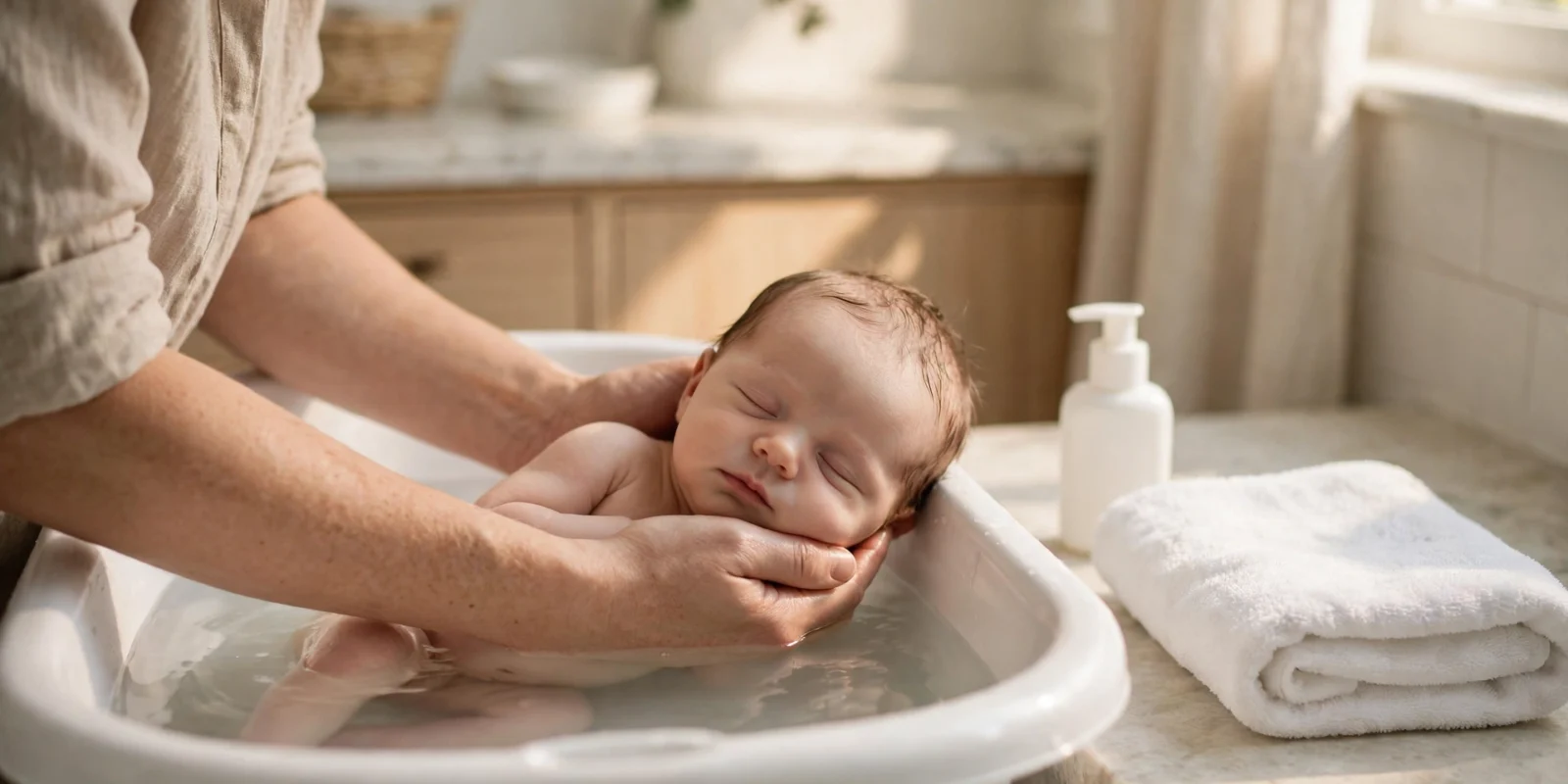
- Lower your baby in feet first. Use your non-dominant arm to support the head and neck and your other arm to guide the body, holding their far arm to keep them steady. Lower them slowly.
- Let the water come up to the shoulders. Most of your baby’s body and face should stay well above the water line. Pour warm water over them with your free hand or a cup to keep them warm.
- Wash face first, then body, then the nappy area. Start with a clean cloth and plain water for the face. Then use a small amount of mild, fragrance-free soap on the washcloth for the body, working from the head down — behind the ears, around the neck, under the arms, between fingers and toes — and the nappy area last. Rinse so no soap is left on the skin.
- Wash the hair. Wet the hair, massage in a drop of mild baby shampoo, and rinse with water running down the back and sides of the head. Cup a hand across your baby’s forehead to keep suds out of the eyes. Gentle massage over the soft spot (the fontanelle) is safe — just do not press on it.
- Keep it short and warm, then lift out and wrap up. Five to ten minutes is plenty for a newborn. Support the head and bottom, lift your baby onto a warm hooded towel, and pat — don’t rub — the skin dry, paying attention to the skin folds. Dress your baby promptly so they warm up again.
A warm, damp washcloth laid on your baby’s tummy, with one edge dipped in the water, keeps their chest warm — many babies find the weight of it soothing.
What kind of tub should you use?
A small plastic baby bath is the easiest option for the first months. A clean sink lined with a towel works too, but sinks are slippery and taps stick out.
How to Wash Your Newborn’s Hair and Handle Cradle Cap
If your newborn has hair and it needs washing, go ahead — there is no need to wait for a particular age. Use a drop of mild baby shampoo, massage it in gently, and rinse with a cup of water or a damp washcloth, cupping a hand across the forehead so the suds run to the sides rather than into the eyes. Two or three hair washes a week is plenty.
Many parents notice thick, crusty, yellowish scales on the scalp in the first weeks. This is cradle cap — a build-up of body oils and old skin. It is harmless, rarely itches, and usually clears up within the first few months. UCSF Benioff Children’s Hospitals suggests washing the scalp daily with mild baby shampoo and loosening the scales with a soft brush while the shampoo is on. For stubborn patches, apply an infant-safe lotion or oil for an hour before washing. If it spreads widely or looks inflamed, talk to your baby’s doctor.
Do not pick at the scales with your fingernails — it can break the skin, and the scales come away on their own with regular gentle washing.
Bath Safety Rules Every Parent Should Know
Bath time is gentle and bonding, but water demands respect. Babies under one are at the greatest risk of drowning in the bath, and it can happen in very little water, very quickly, and without noise.
- Never leave your baby alone in or near water, even for a second. Not to answer the phone, not to open the door — take your baby with you. The AAP calls this “touch supervision”: at least one hand on your baby at all times. Bath seats, slings, and rings do not change this rule.
- Keep the water shallow. About 5 cm (2 inches) is enough. Children can drown in as little as 7–10 cm of water if their face becomes submerged.
- Cap your water heater at 120°F (49°C). This is the single best protection against scalds, and it costs nothing to set once.
- Never bathe your baby in running water. Fill the tub, turn off the taps, and check the temperature before your baby goes in.
- Do not rely on bath seats. They are not safety equipment and can tip, letting a baby slip into the water.
- Keep the bathroom safe beyond bath time. Lock bathroom doors and add latches to toilets so a curious crawler cannot reach water unsupervised. Empty the bath as soon as you finish.
- Skip the bubbles and the sponges. Bubble bath can irritate sensitive newborn skin. Washcloths are better than sponges or mesh poufs, which can harbour bacteria if they do not dry out fully between baths. Wash your washcloths and towels regularly.
- Watch for signs to stop and call your doctor. If your baby develops a spreading rash, skin that looks infected, or a fever of 38°C (100.4°F) or higher in the first three months, skip the bath and contact your paediatrician. A fever in a baby under three months always warrants a prompt call.
What to Do When Your Baby Cries During Baths
Some newborns love the water from the first dip; others scream as if dropped into ice. Both reactions are normal. A crying baby is usually reacting to something specific — temperature, hunger, tiredness, or the sheer newness of it — and a small change often fixes it.
Check the usual suspects: water that has cooled, a cold room, hunger, or tiredness. A bath straight after a feed or at the end of a long wakeful stretch is much more likely to end in tears. Bathe when your baby is fed, rested, and calm, and keep it short.
Swaddled bathing is the trick worth knowing. Wrap your baby in a light towel with only the head exposed, then lower them into the water still wrapped, uncovering one part at a time as you wash it. The snug feeling mimics the womb, and many babies who cried through a bare bath settle completely when swaddled.
Dim the lights, talk softly, and lower your baby in slowly. If they still protest, go back to sponge baths for a week or two and try again.
Crying during baths is exhausting for you too. If bath time is consistently stressful, simplify it: a quick sponge bath is a perfectly good wash. There is no prize for a long routine — only a clean, warm baby. For more ways to calm a distressed baby, see our guide on how to soothe a crying baby.
What Recent Research Shows
The biggest shift in newborn bathing over the past decade has been the move to delay the first bath. The World Health Organization’s recommendation to wait at least 6 hours — ideally 24 — after birth is now reflected in hospital policies in many countries. Delayed bathing helps newborns hold their temperature and blood sugar steady, protects the vernix, and supports early breastfeeding. The 166% increase in hospital breastfeeding success reported after a 12-hour delay, cited by the AAP, comes from a single study, so read it as supportive rather than definitive.
On frequency, the evidence points the same way it has for years: less is more. Over-bathing strips the skin’s natural oils and can worsen dryness and eczema, which is why the AAP and Mayo Clinic both settle on around three baths a week for the first year. No research shows daily baths make a healthy newborn any cleaner — a washcloth handles the face, neck, and nappy area between baths.
Swaddled bathing has also been studied in neonatal units, where it calmed medically fragile and premature babies during bathing. For healthy babies at home it is a practical technique rather than a medical one — but the principle is the same: a snug, warm baby is a calmer baby.
One area where the evidence is still mixed: whether bath products matter much at all in the first month. Ireland’s HSE advises plain water only under one month, while the AAP allows a mild, fragrance-free cleanser for heavily soiled areas, used sparingly. Both agree on the core point — soap is optional, not essential, and less is better.
Common Mistakes to Avoid
1. Bathing every day. Daily baths dry out newborn skin and can make eczema worse. Three times a week is enough.
2. Using adult soap or shampoo. Adult products are too harsh for newborn skin. Use only mild, fragrance-free baby products — and no products at all in the first month, when plain water is the safest choice.
3. Guessing the water temperature with your fingertips. Your fingers tolerate heat your baby’s skin cannot. Test with your elbow or the inside of your wrist, or use a bath thermometer, and aim for around 38°C (100°F).
4. Filling the tub with the baby already in it. Running water changes temperature without warning. Always fill, turn off the taps, swirl, test — and only then lower your baby in, feet first.
5. Leaving the baby alone, even for a moment. A baby can slip under water silently in seconds. Gather everything beforehand, and take the baby with you if you must leave the room.
6. Submerging the cord stump. Until the stump falls off, stick to sponge baths and keep the area dry. Submerging it raises the risk of infection.
7. Scrubbing the soft spot. The fontanelle feels alarming, but gentle washing is safe. The mistake is pressing hard — or avoiding the area entirely, which lets cradle cap build up.
8. Using a bath seat as a babysitter. Bath seats and rings are not safety devices. They tip, babies slip out, and they create a false sense of security. Your hands are the safety device.
Final Recommendations
- Start with sponge baths; switch to the tub only after the cord stump falls off and the area heals.
- Bathe two to three times a week, and wash the face, neck, and nappy area with a damp cloth between baths.
- Keep bath water around 38°C (100°F) and no more than 5 cm (2 inches) deep; test with your elbow, not your fingers.
- Set your water heater below 120°F (49°C) so a tap can never deliver scalding water.
- Gather every supply before you undress your baby, and keep one hand on them for the entire bath.
- Use plain water for the first month; introduce mild, fragrance-free baby soap and shampoo only after that, and use them sparingly.
- Wash face first, body second, and the nappy area last.
- Try swaddled bathing if your baby cries in the tub — many babies settle immediately.
- Pat skin dry, never rub, and use a little fragrance-free moisturiser only if the skin is very dry.
- Make bath time part of a calm routine, ideally before bed, so it becomes something your baby looks forward to.
This content is for educational purposes only and does not replace professional medical advice. Always consult your paediatrician before making health decisions for your baby.
Frequently Asked Questions
Two to three times a week is enough for a healthy newborn, according to the American Academy of Pediatrics and Mayo Clinic. Daily baths can dry out newborn skin. Between baths, wipe the face, neck, and nappy area with a damp washcloth. Bathe more often only when there is a mess to clean, such as a nappy blowout or a big spit-up.
Once the cord stump has fallen off and the area has healed — usually by one to two weeks — you can give your baby a tub bath. Until then, stick to sponge baths and keep the stump dry. If it has not fallen off after two weeks, mention it to your baby's doctor.
Around 38°C (100°F), and never above that. A baby's skin is thinner and more sensitive than yours, so water that feels comfortable to you can be too hot for them. Test with your elbow or the inside of your wrist, not your fingertips, or use a bath thermometer. Set your home water heater below 120°F (49°C) to prevent scalds at the tap.
About 5 cm (2 inches) of water is enough — just high enough to cover your baby's tummy when they are lying down. Fill the tub before your baby goes in, turn off the taps, and check the temperature first. Never bathe your baby in running water, because the temperature can change suddenly.
Yes, if it needs washing. Use a drop of mild baby shampoo, massage it gently into the scalp, and rinse with a cup of water or a damp washcloth, cupping a hand across the forehead to keep suds out of the eyes. Two or three hair washes a week is plenty. Gentle washing over the soft spot is safe — just do not press on it.
For the first month, plain water is the safest choice for your baby's skin, according to Ireland's Health Service Executive. After that, use only a mild, fragrance-free baby soap or cleanser, and use it sparingly — soap can dry out newborn skin. Never use soap on the face, and rinse soap off the skin right away.
The most common reasons are water that is too hot or too cold, hunger, tiredness, or the shock of the new sensation. Try bathing when your baby is fed and rested, check the water temperature with your elbow, and lower your baby in slowly. Swaddled bathing — wrapping your baby in a towel before placing them in the water — calms many babies.
Either works — choose a time when you are not rushed and will not be interrupted. Many parents prefer mornings, when babies tend to be alert; others make the bath part of a calming bedtime ritual. If you bathe after a feed, wait a little while for your baby's tummy to settle first.
Conclusion
Bathing a newborn looks harder than it is. It comes down to a few habits: sponge baths until the cord stump falls off, short tub baths in shallow, warm water two or three times a week, face first and nappy area last, and one hand on your baby throughout. The rest — temperature, products, timing — you will get a feel for within a week or two.
The part nobody tells you is how quickly bath time changes. The first bath is nerve-wracking; by the tenth, you will be doing it one-handed while humming. And somewhere along the way it becomes one of the best parts of the day: a few quiet minutes of warm water, eye contact, and a baby learning that your hands are the safest place in the world. Take it slowly, keep it warm, and enjoy it.
For the next step, read our guide to baby sleep schedules by age — and our baby proofing checklist will help make the bathroom safe once your baby starts crawling.
References
- Mayo Clinic — Baby bath basics: A parent’s guide — Mayo Clinic — https://www.mayoclinic.org/healthy-lifestyle/infant-and-toddler-health/in-depth/healthy-baby/art-20044438
- American Academy of Pediatrics (HealthyChildren.org) — Bathing Your Baby — Dipesh Navsaria, MD, FAAP — https://www.healthychildren.org/English/ages-stages/baby/bathing-skin-care/Pages/Bathing-Your-Newborn.aspx
- UCSF Benioff Children’s Hospitals — Bathing Your Newborn — https://www.ucsfbenioffchildrens.org/education/bathing-your-newborn
- Cleveland Clinic — Baby’s Bath Temperature and Other Safety Tips — https://health.clevelandclinic.org/bath-safety-tips-for-your-child
- Health Service Executive (Ireland) — How to bathe your baby — https://www2.hse.ie/babies-children/parenting-advice/caring-for-a-new-baby/how-bathe-your-baby/