Your puppy is adorable. Your puppy is also, at this precise moment, sinking twenty-eight needle-sharp teeth into your hand — again. If you are wondering how to stop a puppy biting, you are not doing anything wrong, and your puppy is not aggressive. You are dealing with one of the most normal, most complained-about parts of raising a young dog — and the fix is kinder and simpler than most new owners expect.
This guide walks you through why puppies bite, the one skill that matters most (bite inhibition), and a calm step-by-step plan for hands, ankles, clothes, and the dreaded evening witching hour.
Written by Md Masud Rana based on published expert sources. This article has not been professionally reviewed. See our sources below.
Quick Answer
To stop a puppy biting, teach bite inhibition first: when teeth touch skin, go still, give a short “ouch”, and end the fun. Redirect to a chew toy every time, protect their sleep, and keep the whole household responding the same way. Most puppies bite much less by five to seven months. Never use physical punishment — it makes biting worse.
Contents
- Why Do Puppies Bite So Much?
- What Is Bite Inhibition — and Why Teach It First?
- How to Stop a Puppy Biting: The Step-by-Step Plan
- How Do You Stop a Puppy Biting Your Hands and Feet?
- Why Does My Puppy Bite More at Night?
- When Do Puppies Stop Biting?
- What Recent Guidance Says
- Common Mistakes That Make Puppy Biting Worse
- Final Recommendations
- Frequently Asked Questions
Why Do Puppies Bite So Much?
Short answer: because that is how puppies work. They do not have hands — their mouth is their hand, their toy, and their way of asking “what is this, and can I play with it?” Understanding the reason behind a bite changes how you respond to it.
They are exploring the world
Puppies learn about everything through their mouths — a new texture, object or person gets investigated with teeth first. PetMD explains that puppies receive sensory information from biting: how hard they can bite, what it tastes like, whether to change approach. It is not defiance. It is data collection, and it is completely normal.
They are playing — and play is rough
Here is the fact that surprises most new owners: nipping, mouthing and biting in young dogs is generally a form of social play, not aggression — that is how board-certified veterinary behaviourists at VCA Animal Hospitals describe it. When one puppy bites too hard, the other yelps and the game stops. Your puppy is simply playing the only game they know, with you as the playmate.
The tricky part is that what looks like play to a puppy feels like an attack to a human hand. A loose, wiggly body and a wagging tail mean play; a stiff body, bared teeth and growling mean something else, and we will come back to that distinction below.
They are teething
Teething is real, and it hurts. Baby teeth begin to fall out at around 12 weeks, and adult teeth push through over the following months. PetMD notes biting peaks when a pup is about 13 weeks old, right in the middle of that changeover. Dogs Trust adds that gums can be sore and sensitive, and chewing soothes them — which is why a teething puppy chews on anything, including you, your clothes, and possibly your hair.
Worth knowing: VCA’s behaviourists point out that teething usually shows up as gnawing on objects, while nipping at people is usually social play. Both happen at once in a 12 to 16-week-old puppy, which is why that age feels like the worst of it.
They are overtired or overstimulated
This is the cause most owners miss, and it changes the whole picture. A puppy who has skipped a nap, had a busy day, or just finished an exciting game often bites harder and ignores toys completely. They are not being naughty. They are exhausted and have no off switch of their own.
Think of an overtired toddler: the behaviour looks wild — zooming, grabbing clothes, ignoring cues they knew an hour ago — but the cure is sleep, not discipline. Dogs Trust puts it plainly: sleep is just as important as exercise, and puppies are much more likely to mouth when over-tired.
They have learned that biting works
Sometimes biting is simply a habit that paid off. If a nip reliably produces a squeal, waving hands, or a chase around the kitchen, the puppy learns that biting starts a game. Dogs Trust explains that if biting has previously resulted in attention or play, dogs may repeat it. Nobody deliberately rewards biting — but a dramatic reaction is a reward all the same.
That is why the first rule of this whole guide is to become boring the instant teeth touch skin. More on that below.
What Is Bite Inhibition — and Why Teach It First?
Bite inhibition is your puppy’s ability to control how hard they bite — the single most important mouth lesson a dog ever learns, and the foundation of everything else in this guide.
Here is why it matters. One day your dog might be in pain or frightened and put its mouth on someone. A dog that learned bite inhibition as a puppy will hold back; one that never learned it will bite down hard. As the American Kennel Club explains, learning to moderate bite force matters precisely because that day may come.
How puppies learn it naturally
In the litter, this lesson teaches itself: puppies nip each other while playing, and when one bites too hard the bitten puppy yelps and the game stops. Over dozens of small corrections, the biter learns that hard bites end the fun. VCA notes this is one reason puppies should not go to new homes until 7 to 8 weeks — they need that time to practise social skills with littermates.
But most puppies go home before the lesson is finished, so the job passes to you — same method their littermates used: clear, immediate feedback, every time.
Teach it in stages, not all at once
The classic approach works in stages. React only to the hardest bites at first: let your puppy mouth your hands during play, and the instant a bite is genuinely hard, yelp, let your hand go limp, and stop the game. When your puppy backs off, praise them and resume.
Once the hardest bites fade, tighten the rule: pause for medium bites too, then for any teeth on skin at all. The goal is a puppy that first bites softly, then keeps its mouth off people altogether. The AKC adds a warning: for some puppies the yelp gets them more worked up — if that is yours, skip the sound and simply turn quietly around and walk away.
How to Stop a Puppy Biting: The Step-by-Step Plan
There is no overnight trick. What works is a short, consistent routine that everyone in the house follows the same way, every time. Puppies learn from repetition, not lectures.
Step 1: Freeze the moment teeth touch skin
Your instinct will be to yank your hand away. Resist it: a fast-moving hand looks like prey and triggers a chase-and-grab reflex. Dogs Trust warns pulling hands away quickly can excite dogs and turn mouthing into a game. Instead, go still and let your hand go limp — most puppies lose interest in a hand that does nothing.
If you use the yelp, make it one short “ouch” — not a scolding. Then go quiet. If high-pitched sounds excite your puppy, drop the yelp entirely; stillness alone does the job for many puppies.
Step 2: End the fun, briefly
The moment teeth touch skin, play stops — the whole lesson, and it has to be true every time. The AKC’s rule is absolute: if your puppy bites while playing, playtime is over, with no exceptions. Turn around, tuck your hands into your armpits, and withdraw attention. Yelling can backfire: the AKC notes it can itself be a reward, teaching the puppy that biting gets a response.
If your puppy keeps going, leave the room or step behind a baby gate for a short break. PetMD’s guidance is to wait 20 to 30 seconds, then come back with a toy. VCA describes the same idea: closing a door and walking out teaches the puppy that biting leads to immediate inattention. Keep the break calm and dull — you are not punishing your puppy, just removing the thing they wanted, which was you.
Step 3: Redirect to something they are allowed to bite
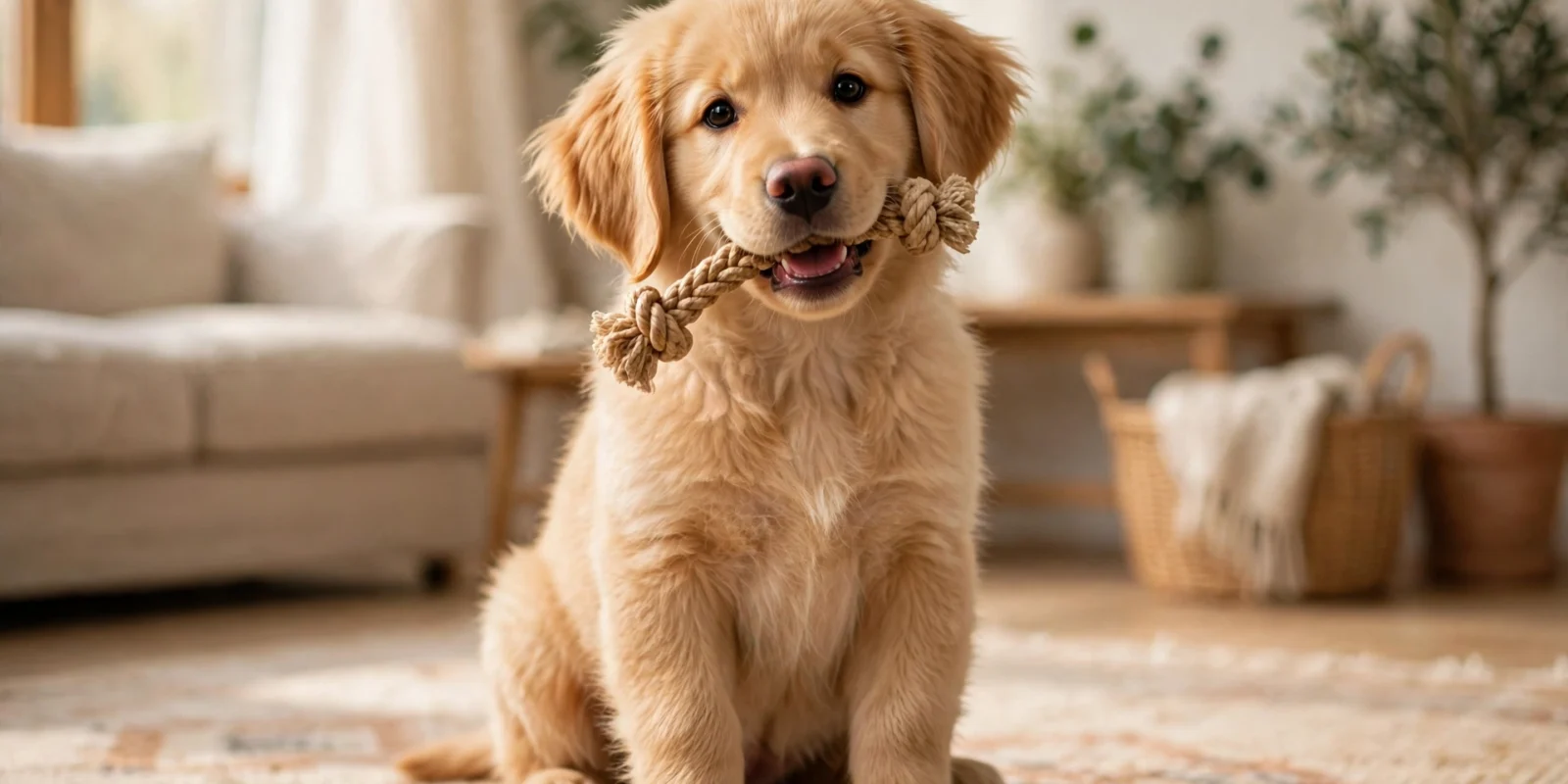
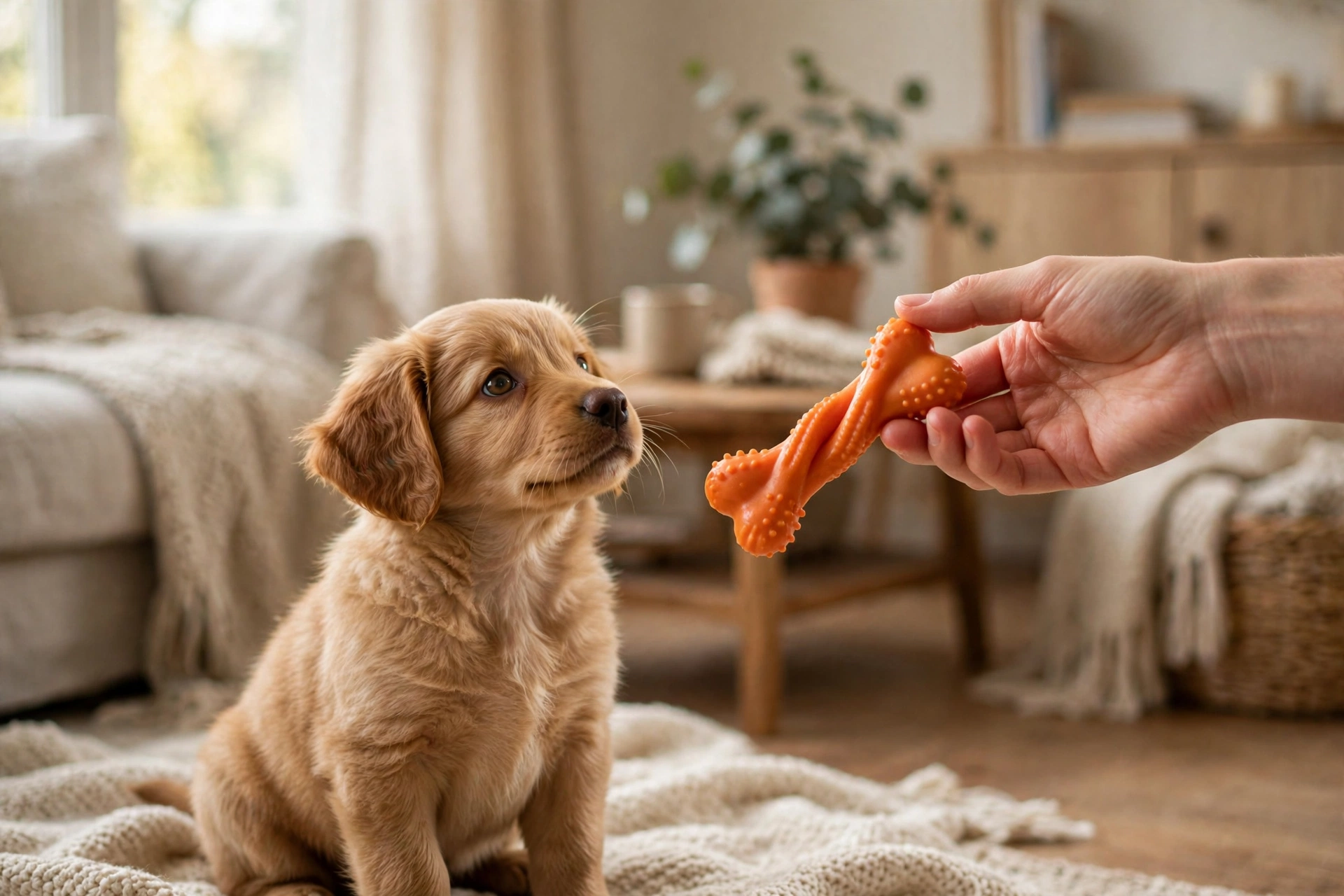
When your puppy releases, immediately offer something legal: a rubber chew, a rope tug, or a soft toy — and praise them warmly the moment they take it. The AKC recommends keeping a chew toy at hand at all times, so you can substitute the toy for your hand. PetMD suggests a good supply of puppy-safe toys — soft rubber, a puppy-sized ball, a rope toy, a stuffed toy with a squeaker.
Timing matters more than the toy: offer it a beat before teeth land, not afterwards. Watch for the pre-bite tell — your puppy fixates on your hand or sleeve, body tense, eyes locked on. That is your cue. Toy in, hand out.
For teething puppies, a chilled chew can help; PetMD notes teething toys use softer plastic so they will not hurt baby or incoming adult teeth. Always supervise play, and remove anything chewed into small pieces.
Step 4: Protect the sleep
Build naps into the day on purpose, before biting starts: settle your puppy in a crate or pen with a chew after play and let them rest undisturbed. PetMD stresses scheduled undisturbed sleep — an overtired puppy will chew on random items, or on you. The AKC agrees: sometimes a biting puppy is really an overtired puppy that needs a quiet space to nap.
Young puppies sleep far more than most new owners expect, and almost never choose to rest on their own. If biting gets worse as the day goes on, try roughly an hour awake followed by a proper nap, and see what changes — many owners find this single adjustment does more than any training technique. If the crate itself still needs work, our guide to crate training a puppy step by step covers how to make it a calm, happy place rather than a punishment.
Step 5: Reward the calm moments you usually ignore
We are good at reacting to biting and bad at noticing the opposite. When your puppy lies quietly, chews a toy, or sits calmly before play, say so — a quiet “good dog”, a piece of kibble, a gentle pat. The AKC puts it well: we sometimes forget to reinforce calm.
In practice: ask for a sit before every play session and reward it. VCA recommends teaching your puppy to sit or lie quietly before play, so calm behaviour — not biting — earns the game. It takes ten seconds and changes the whole dynamic.
Step 6: Get everyone in the house on the same page
This plan only works if it is consistent. If one person yelps and walks away while another wrestles and laughs, your puppy gets two sets of rules and learns neither. VCA is blunt: all family members must consistently follow the rules for the puppy to understand what is desirable. Agree on the routine — freeze, pause, redirect — and stick to it for a few weeks before judging it.
Step 7: Use play that keeps teeth away from skin
Not all play is equal. Fetch, tug with a long toy, and sniffing games keep teeth on objects; wrestling and rough hand play teach your puppy that hands are toys. The AKC warns against roughhousing that only encourages your pup to lose control and bite.
Tug games are fine — genuinely useful — if they stay under your control. VCA explains tug can be an excellent outlet for play biting, provided it is directed at appropriate toys and stops abruptly the moment teeth touch skin or clothing. Teach your puppy to give up the toy on command, and end each session with a chew or a calm activity.
How Do You Stop a Puppy Biting Your Hands and Feet?
Hands and feet get bitten most, for a simple reason: they move. To a puppy, a wiggling hand or a walking ankle looks exactly like a playmate.
Hands during play and petting
Always play using toys, so there is something appropriate to engage with — that is PetMD’s first rule for hands. If your puppy bites while being petted, redirect to a chew and stop petting for a moment. Some puppies get overexcited by hands moving over their body; try slower strokes.
And never entice a puppy to chase your hands or toes. PetMD warns it seems harmless while they are small, but soon your puppy will be bigger with sharper teeth, and the harmless nip becomes a bite that is no longer fun.
Ankles and trouser legs while walking
This is the classic hallway ambush: you walk across the room and your puppy launches at your ankles. The AKC suggests holding a high-value treat next to your leg as you walk. PetMD offers a similar trick: drag a tug toy on the floor so your puppy targets that instead of your feet.
If your puppy keeps biting your feet, stop walking. Stand still until they settle, and only move again when calm; if they persist, leave behind a gate for a short break. If it happens mostly in the evening, check the sleep section below first — ankle-biting at 7pm is often just an exhausted puppy.
Clothes, sleeves and dressing gowns
Clothes are fun to grab because they move and tug. Dogs Trust advises against pulling clothing away, which turns it into a game. Stay still, wait for a pause, and redirect onto a toy. Thicker clothing helps you feel protected — and if your puppy has latched onto a dressing gown or coat, removing it stops the game.
Why Does My Puppy Bite More at Night?
Ask around in any puppy group and you will hear about it: the evening witching hour. The puppy who was manageable all morning turns into a tiny shark somewhere between 6 and 8pm — and it is not that your puppy has suddenly become badly behaved.
By evening your puppy has had a full day of new sights, sounds, people and learning. They are tired and overstimulated — but like an overtired toddler, they cannot put themselves to bed. Instead they zoom, grab clothes, and bite harder than all day. Dogs Trust lists over-excitement and tiredness among the most common reasons for mouthing.
The fix is not more exercise or training. It is less. When evening biting starts: a quick toilet break, then a calm settle in the crate or pen with a chew. Dim the lights, lower your voice, stop active games. Many puppies fall asleep within minutes — which tells you everything about what the problem was.
Plan for it: if the witching hour starts around 7pm, schedule a nap for 6pm. An enforced rest before the storm beats any correction during it. If your puppy’s daily routine needs structure — toilet breaks, play, training and rest — our puppy potty training guide covers how to build a predictable day.
When Do Puppies Stop Biting?
There is no single birthday when it ends. Dogs Trust says plainly there is no magic age — though mouthing usually eases after around seven months. PetMD agrees: biting peaks around 12 to 13 weeks, adult teeth are typically all in by seven months, and with clear, consistent responses the behaviour should then subside.
What matters more than the date is the direction: biting should be steadily reducing. If it is getting worse at six months, that is the moment to get professional help. The AKC’s chief veterinarian, Dr Jerry Klein, advises that if you have not moderated the behaviour by six months, it is a good idea to consult an experienced dog trainer or animal behaviour specialist.
| Age | What is happening | What to focus on |
|---|---|---|
| 8–10 weeks | Just home from the litter; mouthing everything, constantly | Start the freeze-and-redirect routine; keep toys in every room |
| 10–16 weeks | Needle-sharp baby teeth; teething begins around 12 weeks | Peak biting phase; teach bite inhibition in stages; protect sleep |
| 4–6 months | Adult teeth coming in; jaw pressure increasing | Fewer bites overall, but harder ones; tighten the rule to no teeth on skin |
| 6–7 months | Teething mostly finished; adult teeth in place | Mouthing should be clearly easing; seek help if it is not |
| 7–12 months | Adolescence; impulse control still developing | Keep the same plan; occasional mouthing during exciting play is normal |
A few honest caveats: larger breeds may keep mouthing into their first year, and puppies that left the litter early or live with excited young children often take longer. Teething ending does not automatically end the behaviour — if biting was accidentally rewarded, it can continue long after the teeth changed.
What Recent Guidance Says
Advice on puppy biting has shifted over the years, in one direction: gentler. The current guidance from the major veterinary and welfare organisations is strikingly consistent.
First, the yelp is now optional, not essential. The AKC’s current guide, updated in November 2025, warns that for some puppies the yelp gets them more worked up and likely to bite — quietly turning around and walking away works better. The method matters less than the message: biting ends the fun.
Second, punishment is out — clearly and explicitly. VCA’s behaviourists state that physical methods are not recommended, explaining that pain can cause aggression and make a puppy anxious, fearful, defensive, or more excited. PetMD agrees: verbal and physical corrections do not teach a puppy how to behave; they only teach suppression or escalation.
Third, the focus has moved from correction to management. The newest guidance from Dogs Trust starts with meeting the dog’s needs — sleep, exercise, mental stimulation — and preventing the behaviour before it starts. Plan ahead for the moments your puppy usually bites, and keep toys within reach.
Common Mistakes That Make Puppy Biting Worse
Most owners who struggle with puppy biting are not doing nothing — they are doing the wrong things, with the best intentions.
1. Yanking your hand away. A fast-moving hand triggers the chase reflex and turns biting into a game. Go still instead, every time.
2. Shouting, smacking, or holding the muzzle shut. Physical methods are not recommended by VCA’s veterinary behaviourists: pain can cause aggression, fear, or more excitement, and some puppies interpret punishment as rough play, which makes biting worse. A raised voice can also act as a reward — it is still attention.
3. Playing rough hand games. Wrestling, waving fingers in your puppy’s face, or letting them chase your toes teaches them hands and feet are toys. Fun for a week, a problem for a year. Keep hands out of the game entirely.
4. Being inconsistent. If biting ends the game on Monday but gets a laugh on Tuesday, your puppy learns that biting sometimes works — and “sometimes” is the most powerful reward there is. Everyone in the house must follow the same rule, every time.
5. Skipping naps and then wondering why evenings are chaos. An overtired puppy cannot learn. If the witching hour is nightly, the problem is almost certainly the schedule, not the puppy. Build rest into the day before biting starts.
6. Waiting too long to get help. If biting is getting harder rather than softer, or has not improved by six months, call a professional now — not six months later. PetMD advises contacting a certified behaviour consultant, a certified applied animal behaviourist, or a veterinary behaviourist if an adult-toothed dog keeps biting hard enough to cause pain, broken skin, or bleeding.
7. Letting children run the training. Children move fast, squeal, and flail — all of which look like an invitation to a puppy. VCA warns a child’s response is often seen as an invitation to chase and play more. Keep children and puppies supervised, and let adults handle the bite-inhibition work.
Final Recommendations
- Start with bite inhibition, not with “no biting”. Teach a soft mouth first, then fade out mouthing altogether. It is the skill that keeps everyone safe for life.
- Freeze, pause, redirect — every time. Teeth on skin means the game stops immediately. Offer a toy, and praise the toy choice. That loop, repeated hundreds of times, is the whole method.
- Keep a toy within arm’s reach in every room. You cannot redirect if there is nothing to redirect to. A basket of chews by the sofa and one by the back door will save your hands daily.
- Protect sleep like it is training — because it is. Enforced naps, a quiet crate, and a predictable routine do more for biting than any correction. If evenings are wild, the day needs more rest.
- Use tug and fetch, not wrestling. Give your puppy outlets that keep teeth on toys. End any game the instant teeth touch skin or clothing.
- Enrol in a puppy class. Littermates teach bite inhibition better than any human can, and a well-run class gives your puppy safe chances to practise. Check the class is for puppies only.
- Get the whole household on one page. One rule, one response, every person, every time.
- Know the line between normal and not normal. Play mouthing is loose and wiggly. A stiff body, bared teeth, hard bites that break skin, growling, or biting out of fear are reasons to call your vet or a behaviour professional promptly.
- Be patient with the timeline. Most puppies improve within a few weeks of consistent practice and bite much less by five to seven months. Progress is rarely a straight line — judge by the trend over weeks, not by one bad evening.
Frequently Asked Questions
Most puppies bite much less by five to seven months, once adult teeth are in and they have learned bite inhibition. Biting usually peaks around 12 to 13 weeks, during teething; larger breeds may keep mouthing into their first year. What matters is the trend: biting should be steadily reducing. If it is worse at six months, ask an experienced trainer or behaviour specialist for help.
Because hands move, and to a puppy a moving hand looks like a playmate. Puppies explore the world with their mouths, and play-biting is how they learn bite inhibition from littermates. Always play using toys, go still the moment teeth touch skin, and redirect to a chew. Never wave fingers or toes in your puppy's face — it teaches them hands are for biting.
Ankles and trouser legs are moving targets, and chasing them is a game. Drag a tug toy on the floor so your puppy targets that instead, or hold a treat next to your leg as you walk. If they keep biting, stop and stand still until they settle. If it happens mostly in the evening, your puppy is probably overtired and needs a nap, not more activity.
Evening biting usually means your puppy is overtired or overstimulated — the classic witching hour, often around 6 to 8pm. After a full day of new experiences, puppies run out of self-control and bite harder. The fix is rest, not more play: a toilet break, then a calm settle in the crate or pen with a chew. A nap scheduled before the witching hour works even better.
Yes. Mouthing, nipping and play-biting are normal social play and exploration, not a sign your puppy is aggressive — VCA's veterinary behaviourists describe it as generally a form of social play. Biting with a stiff body, bared teeth, growling, or hard bites that break skin is not normal: talk to your vet or a behaviour professional.
A short, high-pitched 'ouch' can work, mimicking the yelp a littermate would give. But it does not suit every puppy — the AKC warns that for some, the yelp gets them more worked up and likely to bite. If yours gets more excited, drop the sound and simply go still, turn away, and end the game. The pause teaches the lesson, not the noise.
Get help promptly if biting is getting harder rather than softer, if it has not improved by six months, or if bites break skin or bleed. Also seek advice if biting comes with a stiff body, bared teeth, growling, snapping, or fear — or if it started suddenly, which can signal pain. A certified behaviour consultant, a certified applied animal behaviourist, or a veterinary behaviourist can assess it.
This content is for educational purposes only and does not replace professional veterinary advice. Always consult your veterinarian before making health decisions for your pet.
Conclusion
Puppy biting feels personal. It is not. It is a normal developmental phase — a puppy learning, with the only tool it has, how hard is too hard and what is okay to chew. The owners who get through it fastest are rarely the ones with the cleverest technique. They are the ones who stay boring when teeth land on skin, keep a toy within reach, protect the afternoon nap, and do the same calm thing every time until the lesson sticks.
Your puppy will not learn this in a day. Give it a few weeks of consistency and bites should get softer and less frequent. By five to seven months, most puppies have largely moved past it — and the work you do now pays off for years, in a safer, gentler companion for life.
If you are in the thick of it tonight, start simple: freeze, pause the game, offer a toy, then put your puppy down for a nap. Do it again tomorrow. That is the whole plan, and it works.
For more on the early weeks with a new puppy, read our complete pet care basics guide and our guide to stopping a dog barking — the same calm, consistent approach applies to almost every puppy behaviour.
References
- American Kennel Club — How to Stop Puppy Biting and Train Bite Inhibition — Updated November 2025 — https://www.akc.org/expert-advice/training/stop-puppy-biting/
- PetMD — How To Stop a Puppy From Biting — Written by Wailani Sung, MS, PhD, DVM, DACVB; updated March 2026 — https://www.petmd.com/dog/training/puppy-biting
- Dogs Trust — Mouthing, nipping and puppy biting: causes and how to stop it safely — https://www.dogstrust.org.uk/dog-advice/training/unwanted-behaviours/mouthing-nipping-and-biting
- VCA Animal Hospitals — Play Biting in Puppies — https://vcahospitals.com/know-your-pet/play-biting-in-puppies