You know the sound. A neighbour’s drill starts up mid-sentence on a client call. The kids argue in the next room just as you sit down to write the report. Traffic hums through a window that never quite seals. You turn the volume up, close the door, put your headphones on — and still, the noise finds you.
If you work from home, you already know that reducing noise in your home office is not about luxury. It is about being able to think. Research keeps showing the same thing: background noise measurably weakens concentration and raises stress hormones. The good news is that a quieter office rarely needs a builder or a big budget — most fixes cost less than a takeaway dinner.
This guide covers the whole job: the cheap fixes that make the biggest difference, what to do about doors, windows, walls and floors, and the technology that actually helps. Everything here is drawn from published research and established acoustic guidance, with every major claim linked to its source.
Written by Md Masud Rana based on published expert sources. This article has not been professionally reviewed. See our sources below.
Quick Answer
To reduce noise in your home office, start by sealing gaps: fit a door sweep and weatherstripping around the door, then seal window frames. Next, add mass and softness — a thick rug, heavy curtains and a full bookshelf against the shared wall. Add acoustic panels behind your desk to cut echo, and use noise-cancelling headphones or a white noise machine for what remains. Most people get a noticeably quieter room for under $100.

Contents
- Why Is Noise So Bad for Your Focus?
- Soundproofing vs Sound Absorption: What Is the Difference?
- How to Seal Your Door — the Cheapest Big Win
- How Can You Quiet Your Windows?
- What About Walls, Floors and Ceilings?
- How Do Acoustic Panels and Soft Furnishings Help?
- What Tech Actually Helps? Headphones, White Noise and Call Settings
- What Recent Research Shows
- Common Mistakes That Waste Money
- Final Recommendations
- Frequently Asked Questions
Why Is Noise So Bad for Your Focus?
Noise feels like a minor irritation, something you should be able to tune out. Your body disagrees: when sound you cannot control keeps reaching you, your brain treats it as something to monitor, and that monitoring costs attention you would rather spend on your work.
The effect is strongest with other people’s speech. Our brains are wired to process language, so an overheard conversation competes directly with the words in your own head. Researchers point out that we can only really follow about one and a half conversations at once — so a colleague’s call or a television through the wall quietly uses up most of that capacity before you have typed a word. Resonics summarises the research on how this plays out across a working day, and the picture is consistent: noise is not a backdrop, it is a load.
That load shows up in the numbers. Workers exposed to a single nearby conversation can be up to 66% less productive, and studies published in the British Journal of Psychology found that background noise disrupts reading and writing, not just complex analytical work. A well-known Cornell study from 2000 placed clerical workers in either a quiet office or one with low-level office noise for three hours. The noisy-office workers did not report feeling more stressed, but their epinephrine levels were higher and they made 40% fewer attempts at an unsolvable puzzle, a standard test of motivation.
Your body keeps the score even when your mind adapts
Getting used to noise does not mean it stops affecting you. A Bond University study published in the Journal of Management & Organization in 2021 found that short exposure to typical office noise raised measured stress by 34% and negative mood by 25%, though immediate task performance did not drop. People kept working at the same level while their stress and mood got worse — which is why the cost is easy to miss until the end of the day. Research from the University of California, Irvine found it takes an average of over 20 minutes to fully regain focus after an interruption. You do not need silence; you need control.
Soundproofing vs Sound Absorption: What Is the Difference?
Almost every guide to a quiet home office starts with the same confusion, and it is the confusion that wastes the most money. Soundproofing and sound absorption sound like the same job. They are not, and buying the wrong one first is the most common reason people spend $200 and hear no difference.
Soundproofing blocks sound from travelling between rooms. It needs mass (heavy walls, double glazing), decoupling (separating wall structures with air gaps) and sealing every gap. It is expensive, structural and largely impractical for renters. Sound absorption reduces echo and reverberation inside a room, improving voice clarity on calls and reducing the amount of sound that escapes. It needs soft materials — fabric, foam, rugs — and it is cheap, non-destructive and highly effective for working from home.
For most remote workers, sound absorption is what you actually need, not true soundproofing. Soundproofing stops the neighbour’s television reaching you; absorption stops your own room sounding like a bathroom on a video call. If your main problem is echo and muddy call audio, panels and soft furnishings will transform the room. If it is voices through the wall, you need sealing and mass first — panels alone will disappoint you.
Diagnose before you spend anything
Sound reaches your desk in three ways. Airborne noise — voices, traffic, television — travels through air and passes through surfaces that are not dense enough to stop it. Impact noise — footsteps overhead, bass from a subwoofer — travels as vibration through the structure. Flanking noise travels around a wall rather than through it: through the floor, a shared ceiling, a doorframe or an outlet.
Before buying anything, spend ten minutes listening at your desk and note every sound and where it comes from. Then clap once with doors and windows closed — a sharp, prolonged ring means an echo problem — and press your hand against the wall, door and window frame while the noise is happening; the surface that vibrates most is the one to treat first. Echo and call quality mean absorption; voices from next door mean sealing and mass; traffic means the window. The sequence: seal gaps first, add mass second, treat windows third, absorb what remains last.
How to Seal Your Door — the Cheapest Big Win
Your door is the weakest link in the room, and not by a little. It is the only surface designed to have gaps in it: at the bottom, the sides, the top. Sound does not care that the gap is there for ventilation. It just walks through.
The numbers explain why this matters so much. Gaps and cracks in a room can account for up to 90% of sound leakage, according to acoustic engineering standards, and a door with a gap representing just 1% of its surface area loses roughly half its soundproofing value. That gap under your hollow-core door is a hole, not a minor inefficiency. Every dollar spent on foam panels before sealing it is a dollar spent on decoration, not acoustics.
Most interior doors in homes built after 1960 are hollow-core, with a Sound Transmission Class (STC) rating of roughly 20–25. At STC 25, loud speech is clearly audible and fairly intelligible; at STC 35, it is audible but not intelligible — you hear someone talking but cannot make out words. Solid-core doors achieve STC 35–45, but replacing one costs $150–$400 plus installation, and renters usually cannot do it at all. Sealing the door you have can realistically add 5–8 STC points.
What to buy, in order of impact per dollar
- Door sweep ($10–$25): seals the gap at the bottom of the door — the largest single gap in most rooms. Automatic sweeps rise when the door opens and drop when it closes. This is your first purchase, always.
- Weatherstripping foam tape ($8–$15): applied to the door frame perimeter, it seals the three remaining sides. Foam tape works for most gaps; self-adhesive rubber is more durable on uneven frames.
- Door-frame acoustic seal kit ($25–$50): a step up from basic foam tape — compression gaskets that hold up better with daily use.
- Heavy curtain over the door ($30–$80): adds mass to a hollow-core door and is completely reversible — hang it from a tension rod inside the doorframe.
If you are renting, a rolled towel or draft stopper along the bottom gap costs nothing and helps immediately, and adhesive weatherstripping peels off cleanly when you move out. Also check outlets on shared walls: foam outlet gaskets cost about $5 for a pack of ten.
How Can You Quiet Your Windows?
Windows are the second-largest gap problem after doors, and for anyone whose office faces a road, usually the first. Even a closed single-pane window has an STC of roughly 26–28, and the gap between the sash and the frame — and between the frame and the wall — is where the real leakage happens. If traffic is your main noise, start here.
The cheapest window fix is also the most overlooked: rope caulk. It is a temporary, removable product you press into window frame gaps and peel out at the end of a lease, and it costs about $5. Acoustic caulk does the same job permanently for owned homes — it stays flexible after curing, while rigid caulk eventually cracks and opens new gaps. A $7 tube around a window frame can do more than a $60 curtain hung in front of it, because the curtain cannot seal an air gap.
Heavy curtains, done properly
Heavy curtains help, but only if hung well. Look for dense fabric with a woven backing — the backing is what does the acoustic work. Hang the rod several inches outside the window frame, with the curtains reaching the floor and extending well past the edges on both sides. That seals far better than a curtain hung exactly at the window edge, and the extra fabric adds absorption inside the room. Heavy blackout curtains do double duty: they block light for video call backgrounds and absorb sound from outside. For renters, this is one of the easiest wins — no permission, no drilling with a tension rod, and they move with you.
Window inserts and when to consider them
Acoustic window inserts — secondary glazing panels that sit inside the existing window reveal — are the most effective window treatment short of replacing the window, at $200–$400 per window. A cheaper halfway option is a DIY foam insert: cut rigid foam board to fit the frame, pop it in during your loudest hours and pull it out when you want the light back. One honest limit: no window treatment stops low bass. If bass is your problem, spend the money on headphones instead.
What About Walls, Floors and Ceilings?
Once the door and windows are sealed, the walls are next — but here the rule is mass, not foam. Sound is blocked by weight and density, not softness, which is why a bookshelf full of books does more for a shared wall than foam tiles ever will.
The most practical mass you already own is furniture: a large bookshelf filled with books against the shared wall adds meaningful mass and costs nothing if you already own the books. Filing cabinets, wardrobes and storage units do the same job — anything heavy and full, pushed against the wall the noise comes through.
Mass-loaded vinyl and the surfaces people ignore
If furniture is not enough, mass-loaded vinyl (MLV) is one of the more effective materials available without construction: a heavy, dense sheet that blocks airborne sound at $1–$3 per square foot, hung behind a curtain or fabric covering so the room still looks like a room. Reach for it when the shared wall itself is thin and voices come through clearly even with the door sealed.
The same principle applies to ceiling and floor. Impact noise from above travels through the ceiling, not the wall, and adding mass to a ceiling as a renter is difficult without landlord permission — but acoustic tiles on a tension system or temporary cloud panels need no permanent installation and run $100–$300. For the floor, a thick rug with a dense acoustic pad addresses impact noise below you and softens echo; a pad designed for sound absorption runs $25–$60.
Two hidden paths catch people out. The first is HVAC vents and ductwork: a forced-air system creates a direct air channel between rooms. The professional fix is acoustic duct liner, but renters can partially cover the vent with a fabric cover or vent deflector — at the cost of some airflow. The second is low-frequency vibration through the structure itself, which surface treatments cannot touch; for bass and footsteps, combine a rug with headphones.
Before buying anything for the walls, try moving the desk: position it away from the noisy wall and put a bookshelf or storage unit between your desk and the noise source. Distance is free and it works immediately. If you are setting the room up from scratch, our complete home office setup guide covers the layout, and standing desk setup pairs well with the acoustic changes here.
How Do Acoustic Panels and Soft Furnishings Help?
This is where acoustic panels finally belong: step four, not step one. Once you have sealed the gaps and added mass, absorption deals with what remains — the echo and reverb that make voices on calls sound unclear, and the residual mid- and high-frequency sound that passes through surfaces.
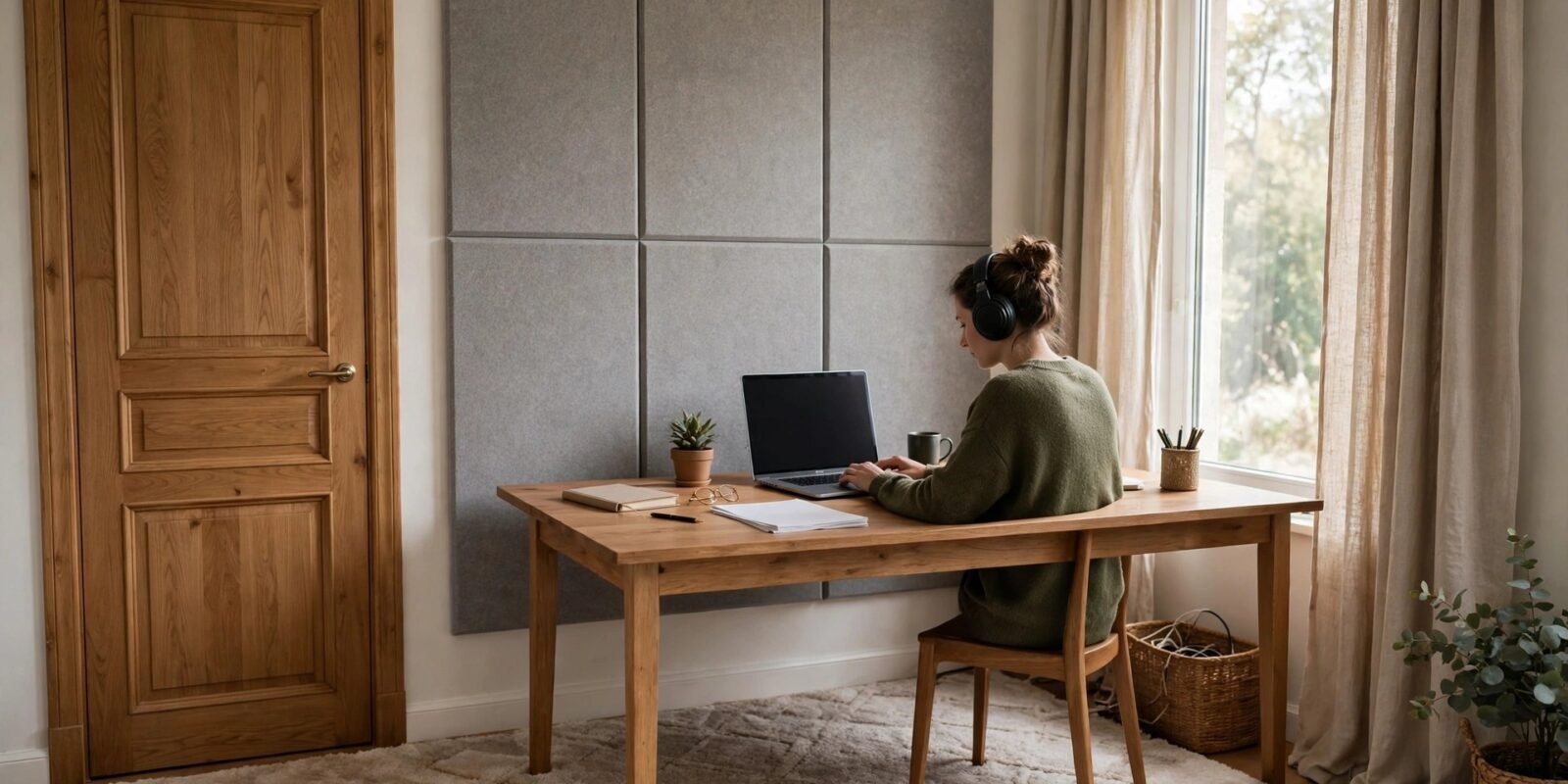
Self-adhesive foam acoustic panels on the wall behind and around your desk absorb reflected sound and reduce the room’s reverb. On video calls, this makes your voice sound cleaner — similar to the difference between talking in a bathroom and talking in a bedroom. A set of 12 panels ($25–$40) on two walls behind your desk makes a noticeable difference; they do not need to cover every surface. Target the reflection points: directly behind your desk and the wall to the side. The right foam is 2-inch wedge or pyramid foam, not the thin decorative tiles often sold in small packs — thinner foam absorbs high frequencies only, while 2-inch foam addresses the mid frequencies where speech problems live.
DIY panels and soft furnishings
A DIY panel can beat shop-bought foam at a similar price: wrap mineral wool or dense fibreglass in a fabric-covered frame for two to three times the acoustic damping of cheap foam tiles, at roughly $15–$25 per panel. Moving blankets are the honest budget alternative — a four-pack runs $30–$50, and hung behind your desk absorbs mid- and high-frequency noise far better than many decorative panels.
Do not underestimate the furniture you already have. Hard floors reflect sound; soft surfaces absorb it. A rug under your desk, an upholstered chair, a bookshelf of books and heavy curtains all contribute, and if your room sounds echoey, soft furnishings are the cheapest fix there is. One caution: foam panels absorb echo, they do not block sound through a wall. If the neighbour’s conversation still carries after sealing the door, panels will not fix it — mass will.
What Tech Actually Helps? Headphones, White Noise and Call Settings
Some noise cannot be fixed with a door sweep — construction outside, a neighbour’s renovation, children on school holidays. Sometimes the room can only do so much, and technology has to carry the rest. The best of it is cheap or already on your computer.
Noise-cancelling headphones: the single best tool
When family or construction noise is breaking your concentration, noise-cancelling headphones are the single best tool you can buy. Active noise cancellation (ANC) reduces low-frequency ambient noise — traffic hum, engine drone, air conditioning — by roughly 20–35 dB, according to practical home-office testing. That is the range building treatments struggle with most.
For video calls, the priority is different. The most effective upgrade for call audio is a headset with a noise-cancelling microphone — it sits close to your mouth and actively filters noise from the mic signal, far more effective than room treatment for call quality alone. If you sit for long hours, your chair matters too: our guide to ergonomic office chairs for back pain covers seating that stays comfortable all day.
One health note: in-ear headphones sit within the ear canal, closer to the cochlea than over-ear headphones, and studies suggest they can amplify sound levels by around 9 decibels. Over time, that can damage the sensitive hair cells that transmit sound to the brain. Over-ear headphones are the kinder choice for all-day use.
White noise, sound masking and call settings
If complete silence is not possible, a white noise machine can be the next best thing. It produces a steady broadband sound — like a fan or soft static — that masks irregular noise such as conversation and footsteps. It works better for focus than for video calls, because the masking sound can be picked up by your microphone. Brown noise, pink noise, rainfall or a fan all work the same way. Try a free app before buying a machine, and keep the volume just below the noise you are covering.
Finally, check the software you already use. Most video-call apps now include built-in noise suppression in their audio settings, and turning it up can remove keyboard clatter, a barking dog or a washing machine from what your colleagues hear. It is usually one menu deep in audio preferences — worth five minutes before your next call. Combined with panels behind your desk and a headset microphone, it transforms how you sound on calls.
And if your eyes are as tired as your ears, our home office lighting guide and our guide to reducing eye strain are the natural next step.
What Does It Cost? A Budget Guide
| Budget | Best moves | Expected impact |
|---|---|---|
| Under $50 | Door sweep + weatherstripping + 12 acoustic panels | Better call audio, reduced echo, less sound through the door |
| $50–$150 | Above + heavy curtains + desk rug with acoustic pad | Meaningful noise reduction for focus and calls |
| $150–$300 | Above + quality ANC headphones | Near-professional call quality, good focus isolation |
| $300+ | Above + white noise machine + bookshelf buffer + DIY panels | Comprehensive solution for most home offices |
The one sentence to remember: for better video call audio, acoustic panels plus a quality headset outperforms everything else at its price. For blocking noise coming in, noise-cancelling headphones are irreplaceable. And door sweeps are the highest-return structural change at any price.
What Recent Research Shows
A 2025 study published in the journal Buildings tested nine acoustic environments — three sound types at three intensities — measuring both performance and brain activity with EEG. Increasing levels of office noise and music generally impaired accuracy and efficiency, and the damage was channelled through emotion: tension and anxiety fully mediated the performance drop. In plain terms, noise does not just distract you — it puts you in a worse emotional state, and that state degrades the work. The study is openly available to read in full.
The same research found something counterintuitive: moderate dialog shortened reaction times at some intensities, even while accuracy suffered. For writing, reading and anything needing accuracy, quiet still wins. The World Health Organization’s synthesis of large-scale studies concludes that chronic indoor environmental noise is associated with auditory fatigue, elevated stress biomarkers and diminished cognitive performance, and a multitask study cited in the 2025 paper found that raising ventilation or traffic noise from 50 to 65 dBA reduced spatial-memory accuracy by 4.4% and slowed reaction times. Noise works through stress and mental workload, not just distraction — so fixes that reduce your stress do more than make the room quieter.
Common Mistakes That Waste Money
1. Buying foam panels before sealing the door
Foam absorbs echo inside the room; it does almost nothing to stop sound travelling through surfaces. A room with an unsealed door and a wall of foam tiles still carries every word from the hallway. Seal first, absorb second.
2. Treating the wrong wall
People treat the wall across from the noise source instead of the shared wall closest to it, or treat a wall while ignoring the floor. Diagnose first, then treat the surface the sound actually uses.
3. Expecting foam to block the neighbours
Acoustic foam absorbs echo and softens sound inside your room. It does very little to stop sound travelling through a wall. If voices come through clearly, you need mass and sealing — a bookshelf, mass-loaded vinyl, a sealed door — not more foam.
4. Hanging curtains that do not seal anything
A heavy curtain hung exactly at the window edge, short of the floor and narrow of the frame, leaves air gaps on every side — and air gaps are where the sound comes through. Hang the rod wide, let the curtain reach the floor, and overlap the frame.
5. Ignoring the small leaks
Outlets on shared walls, gaps around baseboards, the vent connecting your office to the next room — sound will use them all. A $5 pack of outlet gaskets and a $7 tube of acoustic caulk close leaks that a $300 panel order never touches.
6. Buying technology before fixing the room
Noise-cancelling headphones are a supplement, not a substitute. A $300 pair in an echoey, leaky room will still leave you listening to your own voice bouncing off bare walls on every call. Fix the room first, then buy the headphones.
Final Recommendations
- Diagnose before you spend. Listen at your desk and use the clap test and the hand test.
- Seal the door first. A door sweep and weatherstripping cost $20–$40 combined and deliver the biggest single improvement.
- Seal the windows next. Rope caulk or acoustic caulk around the frames, then heavy curtains hung wide and long.
- Add mass where the noise comes through: a full bookshelf against the shared wall, a thick rug with an acoustic pad, mass-loaded vinyl if the wall is thin.
- Treat the echo last: acoustic panels behind the desk, DIY mineral-wool panels, or moving blankets.
- Buy over-ear noise-cancelling headphones for the low-frequency noise building treatments cannot touch.
- Use masking sound wisely: a white noise machine, a fan or brown noise at low volume, just below the level of the sound you are masking.
- Turn on your call app’s noise suppression and use a headset with a noise-cancelling microphone.
Frequently Asked Questions
Seal the gaps first. A door sweep ($10–$25) and adhesive weatherstripping ($8–$15) deliver the biggest improvement per dollar, because gaps can account for up to 90% of sound leakage. Add a thick rug and heavy curtains next, then acoustic panels. Most people get a noticeably quieter room for under $50.
Yes, but only for the right problem. Acoustic panels absorb echo and reverberation inside your room, which makes your voice sound cleaner on video calls and reduces the muddy, hollow sound of a bare room. They do very little to block sound through walls — for that you need sealing and mass, like a door sweep and a full bookshelf.
Stick to removable fixes: a door sweep, adhesive weatherstripping, a heavy curtain on a tension rod, a thick rug with an acoustic pad, freestanding bookshelves against the shared wall, and acoustic panels mounted with removable strips. Rope caulk seals window gaps and peels out cleanly. Avoid permanent caulk and screws into shared walls.
You can reduce noise a great deal without construction, but not achieve total silence. Sealing gaps, adding mass with furniture and rugs, treating windows, and using noise-cancelling headphones will handle most everyday noise. True soundproofing needs mass, decoupling and sealed construction — a building job.
Layer your defences. Seal the door and windows so less sound enters, add soft furnishings and acoustic panels to calm the echo, then use over-ear noise-cancelling headphones or a white noise machine for what remains. ANC headphones are particularly effective against low-frequency noise like traffic hum, which room treatments struggle with most.
Start with a headset that has a noise-cancelling microphone — it sits close to your mouth and filters noise from the mic signal, improving how you sound more than any room treatment. Then put acoustic panels behind your desk, close the door with a sweep fitted, and turn on your call app's built-in noise suppression.
For many people, yes. A white noise machine produces a steady, predictable sound that masks irregular noise like conversation and footsteps. It works better for focus than for video calls, because the masking sound can be picked up by your microphone. Keep the volume just below the noise you are covering.
This content is for educational purposes only and does not replace professional acoustic or building advice. Always consult a qualified professional before making structural changes to your home.
Conclusion
A noisy home office is not something you have to accept, and it is not something you need a renovation to fix. Background noise costs you more than irritation: it raises stress hormones, weakens concentration, and quietly drains motivation. But the fix is, for most people, a weekend project and a modest budget — not a building job.
The order is what makes it work: diagnose first, seal the door, seal the windows, add mass where the sound comes through, and only then treat the echo. Layer technology on top — headphones for the low rumble, white noise for irregular sounds, a good headset microphone for the people on the other end. Start with the door sweep: it costs less than a takeaway, takes ten minutes to fit, and it is the single change most people notice first.
References
- Resonics — 12 Ways Workplace Noise Affects Productivity — Resonics, 2025 — https://resonics.co.uk/our-blog/12-ways-workplace-noise-affects-productivity/
- When Sound Helps or Hurts: Behavioral and EEG Evidence on the Dual Effects of Indoor Acoustic Environments on Office Work Performance — Buildings (MDPI), 2025 — https://www.mdpi.com/2075-5309/16/1/69
- WFH Lounge — How to Soundproof Your Home Office: Cheap Solutions — 2026 — https://www.wfhlounge.com/blog/how-to-soundproof-home-office
- DesignLike — Quiet Your Home Office Without Spending Much — 2026 — https://designlike.com/cheap-home-office-sound-fixes/
- Simon Stapleton — How to Soundproof Your Home Office for Maximum Focus — https://www.simonstapleton.com/how-to-soundproof-your-home-office-for-maximum-focus/
- With Bureau — How Sound Affects Productivity at Work — 2026 — https://withbureau.com/us/blog/office-culture/noise-vs-focus-how-soundscapes-affect-your-brain-at-work/