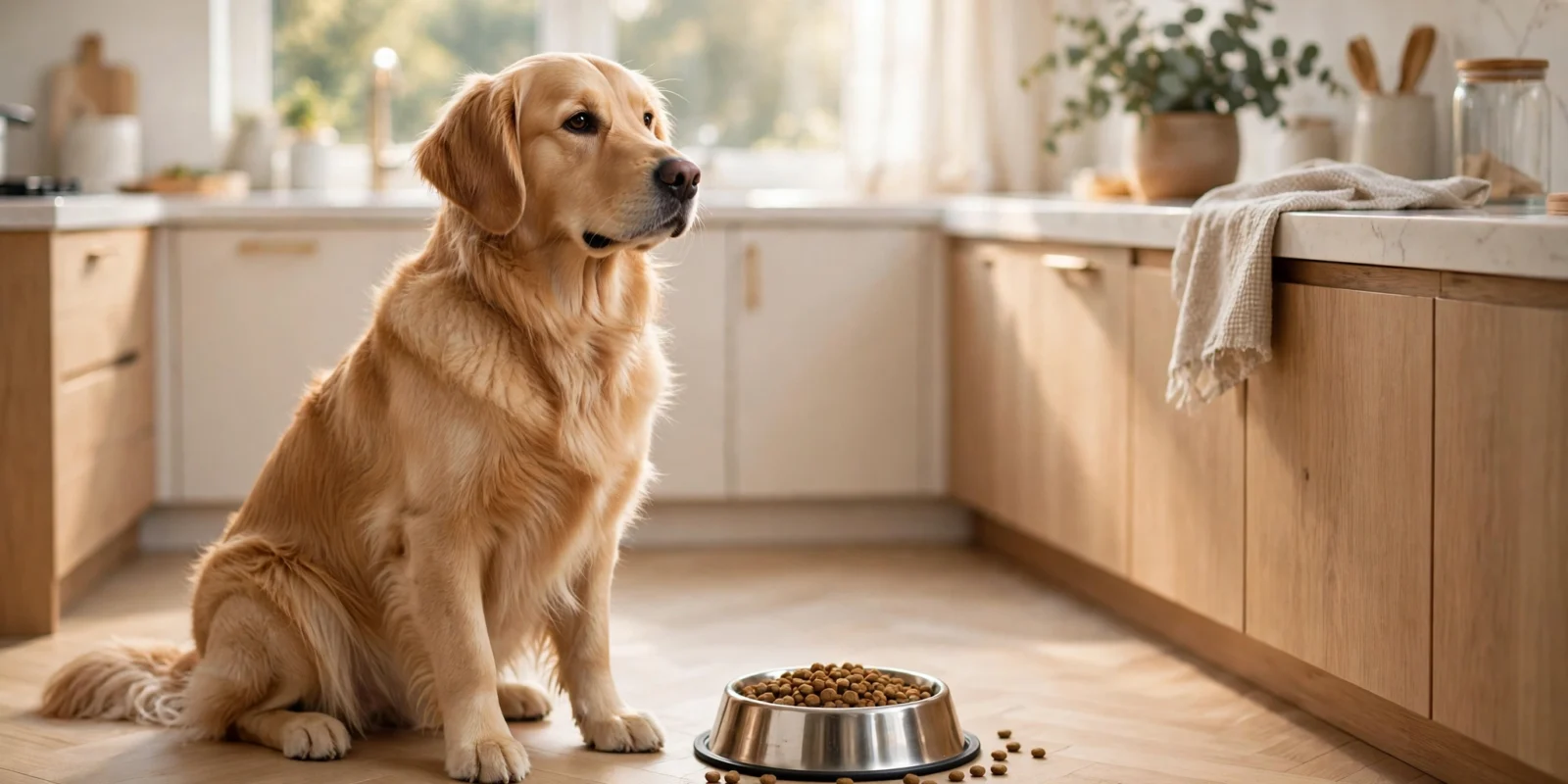
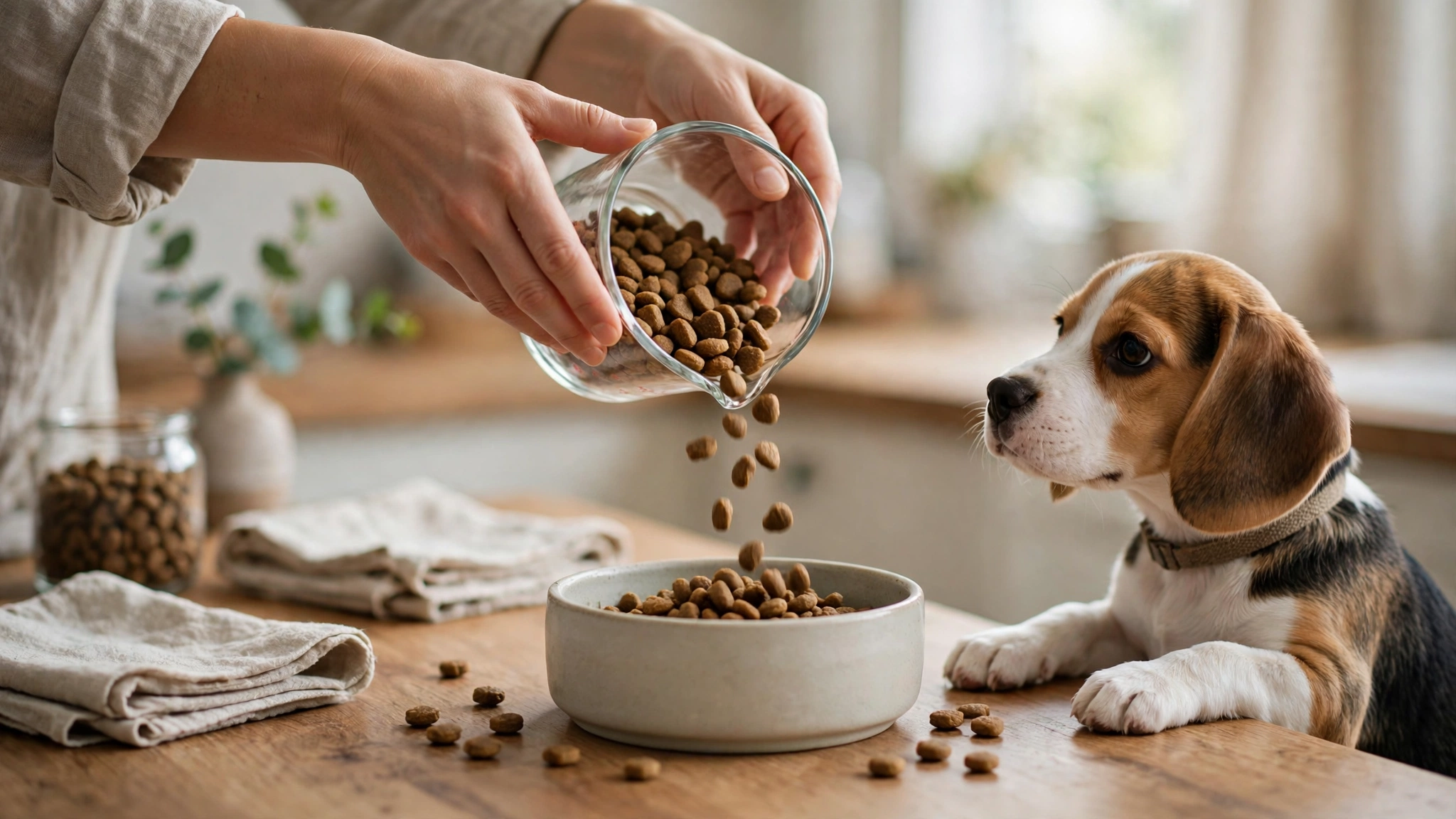
Most healthy adult dogs do well on two measured meals a day, roughly eight to twelve hours apart — and that is the short answer to how often you should feed a dog. Puppies need three or four smaller meals, and some toy breeds, seniors, and dogs with certain health conditions do better on smaller, more frequent ones. That is the short version — but how often you feed your dog also affects digestion, weight, behaviour, and even the risk of a life-threatening emergency in large breeds.
Written by Md Masud Rana based on published expert sources. This article has not been professionally reviewed. See our sources below.
Feeding a dog sounds like the simplest part of owning one. You fill the bowl, the dog eats, done. Yet it is one of the questions veterinarians hear most often, and the answer is never as simple as the bag of kibble makes it look: the feeding guide is written for an average dog at an average activity level. It cannot know whether your dog is a three-month-old puppy, a seven-year-old with a fading appetite, a Chihuahua with a fast metabolism, or a Great Dane whose stomach could twist after one enormous meal.
Get the schedule wrong and the signs creep in slowly: a dog that begs all afternoon, weight that drifts up a little each year, or bile vomit on the carpet at 5 a.m. This guide covers the schedule for each life stage, how much food belongs in the bowl, and when the usual rules do not apply.
Quick Answer
Most healthy adult dogs: two meals a day, morning and evening, about 8–12 hours apart. Puppies under six months: three to four small meals a day; from six to twelve months: two to three. Seniors: two meals, or three smaller ones if appetite is fading. Toy breeds often need three small meals to avoid low blood sugar, while large, deep-chested breeds should eat two or more smaller meals.
Contents
- The Schedule by Age
- How Much Food Should Go in the Bowl?
- Are You Feeding the Right Amount?
- Once a Day vs Twice a Day
- Free Feeding vs Scheduled Meals
- When Size Changes the Rules
- When Health Changes the Schedule
- What Recent Research Shows
- Common Mistakes
- Final Recommendations
- Frequently Asked Questions
How Often Should You Feed a Dog? The Schedule by Age
Age matters more than anything else: a puppy’s stomach is small and its growth is fast, an adult’s needs are steadier, and a senior’s appetite and digestion may both be slowing down. The table below gives the schedule most veterinary guidance agrees on.
| Life stage | Meals per day | Why |
|---|---|---|
| Puppy, 6–12 weeks | 4 | Tiny stomach, very fast growth, needs steady fuel |
| Puppy, 3–6 months | 3 | Growth still rapid, stomach capacity increasing |
| Puppy, 6–12 months | 2–3 | Growth slows; most breeds can move toward two meals |
| Healthy adult | 2 | Steady hunger, easy appetite monitoring, predictable routine |
| Toy breed adult | 2–3 | Small energy reserves; some are prone to low blood sugar |
| Large, deep-chested adult | 2 or more | Smaller meals are linked to lower bloat risk |
| Senior dog | 2–3 smaller meals | Appetite, dental and medical changes; easier digestion |
The figures above match the guidance published by Vetstreet, which notes that puppies need three or four meals a day until about four to six months of age, then two or three, while most healthy adults settle into two.
Feeding a puppy: little and often
Puppies should be completely weaned, meaning moved from milk to solid food, between six and eight weeks of age, according to The Farmer’s Dog, quoting veterinarian Dr Alex Larsen. From weaning to around six months, veterinarians usually recommend three to four meals a day: a puppy’s stomach cannot hold a full day’s food at once, yet its body is building bone, muscle and brain at a pace it will never repeat.
At around six months, most breeds can start moving toward once- or twice-daily feeding; large and giant breeds grow for longer, often twelve to eighteen months, so they stay on the slower transition. Keep the total daily amount the same and phase out the dropped mealtime over two or three weeks — a sudden switch can upset a puppy’s stomach. Puppies that eat on a schedule also tend to toilet on a schedule, which helps with house training. Our guide on how to crate train a puppy pairs well with a regular feeding routine, since both rely on the same kind of consistency.
Feeding an adult dog: two meals is the default
For a healthy adult, two measured meals — one in the morning, one in the evening — is the schedule most veterinarians recommend as the starting point. Dr Larsen puts it plainly: “Generally, for a healthy adult dog, feeding twice daily — roughly in the morning and evening — is recommended,” while adding that “all dogs are individuals.” That quote comes from The Farmer’s Dog.
Two meals work for practical reasons: hunger stays steadier, appetite is easy to monitor — a dog that suddenly leaves food is telling you something — and a regular schedule usually means a regular toilet routine. Three meals a day is also fine, as long as the total daily amount stays the same. The rule is to divide the day’s food, not to add a third full meal on top of two.
Feeding a senior dog: watch the appetite, not the calendar
Senior dogs usually need at least two meals a day, and many finish their food more reliably on three smaller ones. Older dogs may have dental pain, a reduced appetite, slower digestion, or kidney disease that makes large meals harder to finish. Vetstreet notes that a senior’s schedule depends less on the calendar than on the individual dog.
The American Animal Hospital Association defines the senior life stage as the last 25% of a dog’s expected lifespan — a Great Dane can be a senior at seven, a small terrier not until eleven or twelve. There is no reason to change the schedule simply because of age. Change it because appetite, weight or health has changed, and talk with your veterinarian when it does.
How Much Food Should Go in the Bowl?
How often a dog eats is only half the question. The other half is how much, and this is where most feeding problems start. The Association for Pet Obesity Prevention estimated in its 2022 survey that 59% of dogs evaluated by veterinary professionals in the United States were overweight or had obesity — a figure the US Food and Drug Administration also cites. Oversized portions are the everyday cause, and they usually creep up unnoticed.
The feeding guide on the bag is the best starting point, but only a starting point: it is written for an average dog at an average activity level. Your dog’s real needs depend on its weight, age, activity, breed and whether it has been spayed or neutered. Use the chart below — standard dry kibble at roughly 350 to 400 calories per cup — then adjust to your dog’s body condition.
| Dog’s ideal weight | Daily dry food (approx.) | Approximate daily calories |
|---|---|---|
| 5 lbs (2.3 kg) | ½ cup | 185–210 kcal |
| 10 lbs (4.5 kg) | ¾ cup | 275–340 kcal |
| 20 lbs (9 kg) | 1¼ cups | 450–530 kcal |
| 35 lbs (16 kg) | 2 cups | 650–780 kcal |
| 50 lbs (23 kg) | 2⅔–3 cups | 900–1,050 kcal |
| 75 lbs (34 kg) | 3¼–3¾ cups | 1,200–1,400 kcal |
| 100 lbs (45 kg) | 4–4⅔ cups | 1,500–1,750 kcal |
These ranges come from the feeding guide published by Vety, which assumes a standard kibble at about 375 calories per cup. Calorie-dense foods need smaller portions; lower-calorie formulas need larger ones. Always check the calorie content on your own dog’s food packaging, because two foods that look identical can differ by a hundred calories a cup.
Calories matter more than cups
A cup is a unit of volume, not nutrition, and kibble varies: one brand’s cup might hold 320 calories while another’s holds 450. That is why veterinarians work in calories first and cups second — work out the daily calorie number, then divide by the calories per cup printed on the bag, and recalculate if you switch foods. As a rough rule, most dogs need about 2% to 4% of their ideal body weight in food each day, according to Vety.
Base portions on ideal weight, not current weight
If your dog is overweight, calculate portions from its target weight, not the weight it is now — feeding for the current weight maintains the current weight. A dog that is too thin needs portions based on the weight it should reach, increased gradually with veterinary guidance. Spayed and neutered dogs typically need fewer calories than intact dogs, pregnant dogs need more (especially in the final trimester), nursing mothers may need two to three times their normal portion, and highly active dogs may need 20% to 40% more than a sedentary dog of the same size. All of these adjustments are described in the Vety feeding guide.
How to Tell If You Are Feeding the Right Amount
No chart can see your dog. The most reliable check is the dog itself, using the body condition score: a scale from 1 to 9, where 4 to 5 is ideal. You can do a basic version at home in under a minute, and it is worth doing every couple of weeks.
The rib and waist check
Run your hands along your dog’s ribs with gentle pressure. You should be able to feel them easily without pressing hard, but they should not be visible through the coat. Look down from above: there should be a visible waist behind the ribs. Look from the side: the belly should tuck up behind the ribcage. If you have to press firmly to find the ribs, or there is no waistline, your dog is likely carrying extra weight. If the ribs, spine and hip bones are clearly visible with no fat covering, your dog is likely underweight.
Vety sets out the scale clearly: 1–3 means underweight, 4–5 is ideal, 6–7 is overweight, and 8–9 is obese. An overweight dog usually needs its food reduced by about 10% to 15%, while an obese dog needs a vet-guided plan with a reduction of 15% to 25%. Do not cut portions drastically on your own: dogs should lose weight gradually, at about 1% to 2% of body weight per week.
Measure, don’t eyeball
Eyeballing portions is one of the quietest ways to overfeed: Vety reports that guessing often results in giving 20% to 50% more food than intended. A kitchen scale is the most accurate method, especially for small dogs where a few extra kibbles make a real difference. If you use a cup, make sure it is a standard 8-ounce measuring cup filled to a flat, level top — a heaped cup can add 10% to 20% extra. A random scoop from the bag is best avoided. For a broader look at everyday care, see our pet care basics guide.
Count the treats
Treats are food, and dogs do not know the difference. The widely used rule is that treats should make up no more than 10% of a dog’s daily calories, and meal portions should be reduced to make room for them. For a 50-pound dog eating about 1,000 calories a day, that means no more than 100 calories of treats — a couple of large biscuits and a dental chew can use up the whole allowance before dinner. Training sessions are the worst offender: a hundred small rewards across a week can equal several full meals. Our guide on how to stop a puppy biting uses reward-based training, and it works best when the rewards are counted as part of the day’s food.
Once a Day vs Twice a Day: What the Research Says
Ask a group of dog owners whether one meal a day is enough and you will get confident answers on both sides. The honest answer is that the question is not settled.
In 2022, researchers working with the Dog Aging Project analysed survey data from more than 24,000 dogs and found that dogs fed once a day had lower odds of several age-related conditions, including gastrointestinal, dental and orthopaedic problems, than dogs fed more often. But the study was observational: it shows an association, not proof that one meal a day caused better health. The data came from owner surveys rather than controlled feeding trials. The lead author, Dr Emily Bray of the University of Arizona, put it carefully: when it comes to cause and effect, “we don’t know which direction the arrow is going in.” Both Vetstreet and The Farmer’s Dog report the finding with these caveats.
Who should not eat once a day
Whatever the research eventually shows, some dogs are clearly better served by two or more meals: puppies and toy breeds can run low on energy between meals, diabetic dogs need meals timed with insulin, dogs prone to vomiting bile on an empty stomach often improve with a smaller evening meal, and large, deep-chested breeds at risk of bloat should never eat their whole day’s food in one sitting. For a healthy, lean adult thriving on one meal, there is no strong reason to change — but most veterinarians still recommend two meals as the default. If you are considering a switch, talk with your veterinarian first and make the change gradually.
Free Feeding vs Scheduled Meals
Free feeding means leaving food out all day so the dog can graze whenever it likes. A few dogs genuinely self-regulate and maintain a healthy weight that way. For most dogs, though, it causes more problems than it solves.
The main problem is control. With a full bowl always available, it is hard to know how much your dog actually eats, which makes weight gain easy and appetite loss hard to spot — a dog that suddenly eats less is often showing the first sign of illness. In a multi-dog home, one dog may eat more than its share while another eats too little, and medications that must be given with food are harder to time. Fresh food left at room temperature also spoils: Vetstreet notes it should be discarded after more than two hours. “Overfeeding is far easier to do with free-feeding,” Dr Larsen told The Farmer’s Dog.
Switching is simple: offer the measured portion split into two meals, leave the bowl down for 15 to 20 minutes, then pick it up. Most dogs learn within a few days. The exceptions are underweight dogs and nursing mothers, who may genuinely need free access to food.
Dogs that pace, whine or destroy things when left alone may be dealing with anxiety rather than hunger — our guide to dog separation anxiety explains the difference.
When Size Changes the Rules: Toy Breeds and Large Breeds
Size shapes feeding frequency in two very different ways: at the small end, the danger is running out of fuel; at the large end, overloading the stomach. That is why size changes the number of meals, not just the amount.
Toy and small breeds: small reserves, frequent meals
Toy breeds such as Chihuahuas, Yorkshire Terriers and Pomeranians have very small energy reserves and fast metabolisms. A toy puppy that skips a meal, vomits or gets chilled can develop hypoglycaemia, or low blood sugar, within hours — weakness, trembling and wobbliness need prompt veterinary care. Frequent small meals are the main prevention, which is why toy puppies usually eat three or four meals a day and many toy adults do best on two or three.
Large and giant breeds: smaller meals, lower bloat risk
Large dogs need at least two meals a day, and the reason is serious. Large and giant breeds, especially deep-chested dogs such as Great Danes, Weimaraners, Standard Poodles and German Shepherds, are at higher risk of gastric dilatation-volvulus (GDV), commonly called bloat. The Vetstreet guide cites the Merck Veterinary Manual, which describes GDV as a life-threatening emergency in which the stomach fills with gas and can twist, and lists eating one large meal a day among the factors linked to higher risk.
The signs of bloat include a swollen or tight belly, repeated unproductive retching, restlessness, drooling and weakness. It is an emergency: call your veterinarian or the nearest emergency clinic right away. Lower the risk by feeding two or more smaller meals, slowing fast eaters with a puzzle feeder or slow-feed bowl, avoiding vigorous exercise for about an hour before and after meals, keeping mealtimes calm, and asking your veterinarian about preventive gastropexy for high-risk breeds. For a Great Dane, splitting the day’s food is not a preference. It is a safety measure.
When Health Changes the Schedule
A healthy dog’s schedule is a starting point. A dog with a medical condition may need a different one, and in these cases the veterinarian’s plan comes first.
Diabetes, kidney disease and sensitive stomachs
Dogs with diabetes often need their meals timed exactly with insulin doses, usually twice a day at consistent hours: a skipped or delayed meal can cause a dangerous drop in blood sugar. Never change a diabetic dog’s feeding schedule without talking to the veterinarian managing its diabetes.
Dogs with kidney disease or other chronic conditions often eat less at a sitting, and splitting the same daily amount into three or four smaller meals can help them finish enough food and keep weight on. If that does not help, go back to the vet and rule out a medical cause.
Some dogs vomit yellow bile in the early morning, usually because their stomach has been empty for too long overnight. A small late-evening meal, or splitting the day’s food into three meals instead of two, often solves it. The same approach helps dogs with reflux or impaired digestion. If vomiting is frequent, contains blood, or comes with lethargy or diarrhoea, that is a veterinary visit, not a feeding adjustment.
Some medicines need to be taken with a meal, and some on an empty stomach — ask the veterinarian whether mealtimes need to move when a new medicine starts. A pregnant dog’s needs rise sharply late in pregnancy, and a nursing mother may need two to three times her normal portion, usually through more frequent meals or free access to food under veterinary guidance.
What Recent Research Shows
Two findings from recent years are worth knowing. The first is the Dog Aging Project study from 2022, discussed above, which analysed data from more than 24,000 dogs and linked once-a-day feeding with lower odds of several age-related conditions. It is observational, and the authors called for more study before anyone changes a routine based on it.
The second is the weight trend. The Association for Pet Obesity Prevention’s 2022 survey found that 59% of dogs evaluated by veterinary professionals in the United States were overweight or had obesity, up from 56% in 2018. It also gives owners hope: The Farmer’s Dog notes that research shows lean dogs can live up to 2.5 years longer than their overweight counterparts.
Common Mistakes Owners Make
1. Adding a meal without shrinking the others
Moving from two meals to three should mean dividing the same daily amount into three smaller portions. Many owners simply add a third full meal — a 50% increase in food — and the weight gain that follows is easy to blame on age or the breed instead of the bowl.
2. Trusting the scoop instead of the scale
Guessing portions usually adds 20% to 50% more food than intended, according to Vety. A heaped cup here, a scoop from the bag there — each is small, and together they add up to a meaningful surplus over a year.
3. Free feeding a dog that cannot self-regulate
A few dogs can graze and stay lean. Most cannot, and free feeding also hides appetite changes and complicates multi-dog homes. Unless your veterinarian has a specific reason to recommend it, scheduled meals are the safer choice.
4. Feeding a large breed one big meal a day
One enormous meal raises bloat risk in deep-chested breeds, and bloat can be fatal within hours. Two or more smaller meals and a slow-feed bowl are simple precautions with serious consequences.
5. Changing the schedule overnight
A sudden switch — from four meals to two, or from free feeding to set times — can cause an upset stomach, skipped meals and a confused dog. Phase changes in over two to three weeks, keep the total amount the same, and let the dog’s response set the pace.
Final Recommendations
- Start with two meals a day for a healthy adult dog, morning and evening.
- Feed puppies three to four small meals a day until about six months, then move gradually to two.
- Work out the daily amount in calories first, then convert to cups using the figure printed on the bag.
- Base portions on your dog’s ideal weight, not its current weight, and adjust by body condition.
- Check body condition every couple of weeks with the rib and waist check; 4–5 on the 1–9 scale is ideal.
- Measure food with a scale or a level cup, and keep treats under 10% of daily calories.
- Feed large, deep-chested breeds two or more smaller meals, use a slow-feed bowl if they gulp, and avoid vigorous exercise around mealtimes.
- Use scheduled meals, not free feeding, unless your vet has a specific reason to recommend grazing.
- Change schedules gradually, over two to three weeks, keeping the daily amount the same.
- Talk to your veterinarian before changing the schedule of a dog with diabetes, kidney disease, or any condition that affects appetite.
This content is for educational purposes only and does not replace professional veterinary advice. Always consult your veterinarian before making health decisions for your pet.
Frequently Asked Questions
Most healthy adult dogs do well on two measured meals a day, roughly eight to twelve hours apart. Three smaller meals are also fine as long as the total stays the same. Puppies, toy breeds and dogs with certain health conditions usually need more frequent meals, so two a day is a starting point.
Puppies under six months usually need three to four small meals a day, because their stomachs are small and their energy needs are high. From about six to twelve months most can move to two or three; large breeds often stay on three until twelve to eighteen months. Keep the total the same and phase the change over two to three weeks.
Some healthy, lean adult dogs thrive on one meal a day, and a 2022 Dog Aging Project study of more than 24,000 dogs linked once-daily feeding with lower odds of several age-related conditions. But it was observational, not proof of cause and effect, and most vets still recommend two meals as the default.
Free feeding is not recommended for most dogs. It makes it hard to know how much your dog eats, encourages weight gain, hides appetite loss that can be an early sign of illness, and causes problems in multi-dog homes. Scheduled meals — offered for 15 to 20 minutes, then picked up — are safer.
Use the body condition check: you should be able to feel your dog's ribs easily with gentle pressure without seeing them, see a waist from above, and see the belly tuck up — a score of 4 to 5 on the 1 to 9 scale vets use. If you have to press hard to find the ribs, reduce food by about 10 to 15 percent.
Overfeeding is one of the most common feeding problems: the Association for Pet Obesity Prevention estimated that 59 percent of dogs in the United States were overweight or obese in 2022. Excess weight raises the risk of osteoarthritis, diabetes, heart disease and a shorter life. The fix is simple: measure portions, count treats, and adjust to body condition.
Most puppies can start moving to two meals a day from about six months of age, though large breeds often need longer. Change gradually over two to three weeks, keeping the total the same. If your puppy leaves food, has loose stools or seems very hungry, slow the transition down a little.
Conclusion
Feeding a dog well is not complicated, but it is not quite as simple as filling a bowl either. The schedule that works for most dogs is a modest one: two measured meals a day for a healthy adult, three or four small ones for a puppy, and two or three smaller ones for a senior whose appetite is fading. The amount matters at least as much as the frequency, and the most reliable measure of either is the dog in front of you — its ribs, its waist, and whether it finishes its food or leaves half of it behind.
Dogs are not interchangeable. A Chihuahua needs frequent small meals to keep its blood sugar steady; a Great Dane needs its food split to protect it from a twisted stomach. A puppy needs fuel little and often; a diabetic dog needs its meals timed to its insulin; a senior needs patience and smaller portions. The schedule that fits your dog is the one that fits its age, size, health and life — and it will change as your dog changes.
Start with the defaults in this guide, measure honestly, check your dog’s body condition every couple of weeks, and adjust a little at a time. If something changes suddenly — appetite drops, weight shifts, vomiting starts — that is a conversation with your veterinarian, not a feeding experiment. Done well, feeding is one of the quietest, most reliable ways to add healthy years to a dog’s life. It takes five minutes a day and a measuring cup. That is a small price for the years it can buy.
References
- Vetstreet — How Many Times a Day Should a Dog Eat? — Vetstreet — 2026 — https://www.vetstreet.com/our-pet-experts/how-many-times-a-day-should-a-dog-eat
- The Farmer’s Dog — How Often Should You Feed Your Dog? — The Farmer’s Dog — 2026 — https://www.thefarmersdog.com/digest/how-often-should-you-feed-your-dog/
- Vety — How Much to Feed Your Dog — Vety — 2026 — https://vety.com/articles/how-much-to-feed-your-dog
- Association for Pet Obesity Prevention — 2022 U.S. State of Pet Obesity Report — 2022 — https://www.petobesityprevention.org/2022-state-of-pet-obesity-report-summary
- U.S. Food and Drug Administration — Helping Pets Live Healthier, Thinner Lives — https://www.fda.gov/animal-veterinary/animal-health-literacy/helping-pets-live-healthier-thinner-lives-aaha-nutritional-assessment-guidelines