
Christmas is the one time of year when most of us happily throw our usual habits out of the window. We buy more, eat more, wrap more and throw away more — and then, somewhere between the last mince pie and the first bin bag of torn wrapping paper, a small voice asks whether it all had to cost the planet quite so much. A sustainable Christmas is not about cancelling the fun — it is about keeping everything you love about the season and quietly cutting the waste nobody enjoys anyway.
Written by Md Masud Rana based on published expert sources. This article has not been professionally reviewed. See our sources below.
The good news is that the biggest wins are also the easiest ones: a tree you keep or dispose of properly, gifts people genuinely want, wrapping paper that can actually be recycled, and a Christmas dinner planned so the leftovers get eaten instead of binned. This guide walks through each of them, with the evidence behind the advice.
One honest note first: there is no such thing as a zero-impact Christmas. What follows is researched guidance from environmental organisations and waste experts. Where the evidence is mixed — the real-versus-artificial tree debate, for instance — this guide says so.
Quick Answer Box
A sustainable Christmas means celebrating the same way, with less waste: choose a locally grown real tree (or keep an artificial one for at least 7–10 years), give gifts people actually want, wrap in recyclable paper, plan dinner portions, switch to LED lights on a timer, and recycle or compost everything afterwards. The Carbon Trust’s core advice: share the celebration where you can, and avoid buying things used once and thrown away.
Table of Contents
- Why Christmas Has Such a Big Footprint
- Real vs Artificial Christmas Tree
- Eco-Friendly Christmas Gifts
- Sustainable Gift Wrapping
- A Lower-Waste Christmas Dinner
- Christmas Lights and Energy
- Decorations You Can Reuse Year After Year
- After Christmas: Recycling and Clearing Up
- What Recent Research Shows
- Common Mistakes
- Final Recommendations
- Frequently Asked Questions
- References
Why Christmas Has Such a Big Footprint
Christmas concentrates a year’s worth of consumption into about three weeks. In the UK alone, roughly 230,000 tonnes of food are thrown away over the festive period, including an estimated 263,000 turkeys, 740,000 portions of Christmas pudding and more than 7.5 million mince pies every year, according to figures cited by BSI Group. In landfill, that food breaks down and releases methane, a greenhouse gas far more potent than carbon dioxide. BSI also notes that around a quarter of the food we cook ends up wasted simply because we prepare, cook or serve too much.
Then there is the packaging. UK households throw away around 114,000 tonnes of plastic packaging over the festive season, and the UK uses around 227,000 miles of wrapping paper each year. Much of it cannot be recycled at all, because foil, glitter and plastic coatings contaminate the paper recycling stream.
None of this happens because people do not care. Christmas runs on autopilot: the same trolley, the same traditions, the same last-minute panic buying. Most of the waste comes from small, fixable decisions — buying food “just in case”, choosing the shiniest wrapping paper, replacing decorations that were fine. A greener Christmas needs no different personality, just a short plan made before the shopping starts.
The biggest sources of festive waste
Food waste leads the list, and it is the most expensive kind. WRAP surveyed more than 3,000 families and found the average household threw away 16% of the food bought for the main festive days — close to a third for families with children. Carrots, sprouts and roast potatoes top the most-wasted list: foods we buy in bulk out of habit rather than appetite.
Packaging comes second: every gift arrives in a box, inside a bag, inside another bag, and much of it is unrecyclable or never reaches a recycling bin. Christmas crackers deserve a mention: the Carbon Trust points out that the vast majority of the small gifts inside crackers never last beyond the end of the meal, yet they are produced and thrown away by the million.
Real vs Artificial Christmas Tree: Which Is More Sustainable?
The tree is where most people’s sustainable Christmas questions start, and it is the question with the least simple answer. The honest summary, backed by lifecycle research: a locally grown real tree that is recycled or composted afterwards narrowly beats an artificial tree — unless you already own one, in which case keeping it for as many years as possible is the greenest choice of all.
The case for a real tree
Real Christmas trees take more than ten years to grow to around 1.8 metres, absorbing carbon dioxide and providing wildlife habitat along the way. For each tree harvested, one to three seedlings are planted the following spring, according to the US National Christmas Tree Association, as reported by IFLScience. A real tree is also biodegradable: it can be chipped into mulch or composted, rather than sitting in landfill for decades.
Disposal matters enormously, though. The Carbon Trust explains that chipping a real tree can cut its carbon footprint by up to 80%, while landfill disposal releases methane, which is 25 times more potent than carbon dioxide. The greenest real tree is one whose ending you planned before buying it — check your council’s tree collection scheme in advance, as most run one in early January.
When buying a real tree, look for one grown locally and, if possible, certified by the Forest Stewardship Council. Slow-grown trees without heavy fertiliser are preferable, and a local tree avoids long transport emissions. A potted tree with roots is the most sustainable real-tree option: it can be replanted or kept and reused, spreading its footprint across several years.
The case for an artificial tree — and its catch
Artificial trees are mostly made from PVC, one of the most environmentally damaging plastics, and are very difficult to recycle. Manufacturing a standard two-metre artificial tree generates around 40 kilograms of greenhouse gas emissions — more than double that of a real tree sent to landfill, and more than ten times that of a chipped or composted one, according to IFLScience. Up to 80 percent of them are made in China, adding long shipping distances to the footprint.
The Carbon Trust’s guidance is that an artificial tree only becomes the lower-carbon choice if used for 7 to 20 years, depending on weight and materials. Many are discarded after six to eight years because the lights fail or tastes change. If you already own one, the maths flips: the manufacturing emissions are already spent, so keep using it as long as it lasts, repair it when you can, and pass it on rather than binning it.
Eco-Friendly Christmas Gifts People Actually Want
An estimated £42 million worth of Christmas gifts are unwanted each year in the UK, and much of that ends up in landfill. The single most sustainable gift is therefore not a greener product — it is a gift the person actually wants. Ask, listen, and give things with a life after Boxing Day.
Start with a list, not a shopping trip
The pattern is familiar: a vague sense of obligation, a busy high street, and a trolley full of guesses. West Sussex County Council’s Christmas recycling guidance puts it plainly — speak to loved ones about what they want, make a list before you shop, and you will avoid panic buying something the recipient does not need, just for the sake of giving a gift. A short conversation in November saves money, waste and the awkwardness of an unwanted present in December.
For larger families, Secret Santa is the simplest fix there is: one thoughtful gift per person instead of a dozen small ones means less wrapping, less packaging and less money — and usually a better present. It works just as well among friends and colleagues.
Experience gifts beat stuff
Tickets to a show, a meal out together, a class, a membership, a day trip — experience gifts create memories instead of clutter and arrive with almost no packaging. They suit almost everyone, and if someone is hard to buy for, an experience is usually the answer: personal in a way a generic gadget never is.
Second-hand, homemade and zero-waste
A pre-loved gift is not a lesser gift. A good book, a vintage record, a quality item from a charity shop — often more personal than anything new, and they keep an existing object in use. For children, good-quality second-hand toys are an easy win: kids outgrow toys fast, and charity shops are full of barely-used ones.
Homemade gifts carry the same logic further: baking, preserves, handmade candles, a knitted scarf, a framed photo — the effort is the point. For the kitchen-minded, a zero-waste starter kit makes a genuinely useful present: a reusable bottle, beeswax wraps, produce bags and a bamboo cutlery set in a tote bag.
When you do buy new, choose durability over novelty: a well-made item in a natural material that lasts for years beats a cheap plastic gadget that breaks by February. Check the packaging too — a box three times the size of the gift is part of its real cost.
What to avoid
Novelty gifts are the worst offenders: the joke mug, the singing fish, the gadget nobody asked for. Most are used once, if at all, and cannot be recycled because they mix plastic, metal and electronics. Christmas crackers fall into the same category — the Carbon Trust suggests crackers with just jokes and hats, with the paper and card recycled afterwards.
Sustainable Gift Wrapping That Still Looks Beautiful
Most people assume wrapping paper is recyclable — and much of it is not. Paper coated in foil, glitter or plastic film cannot go in the recycling bin, and it contaminates the paper around it. Telling the difference takes about five seconds.
The scrunch test
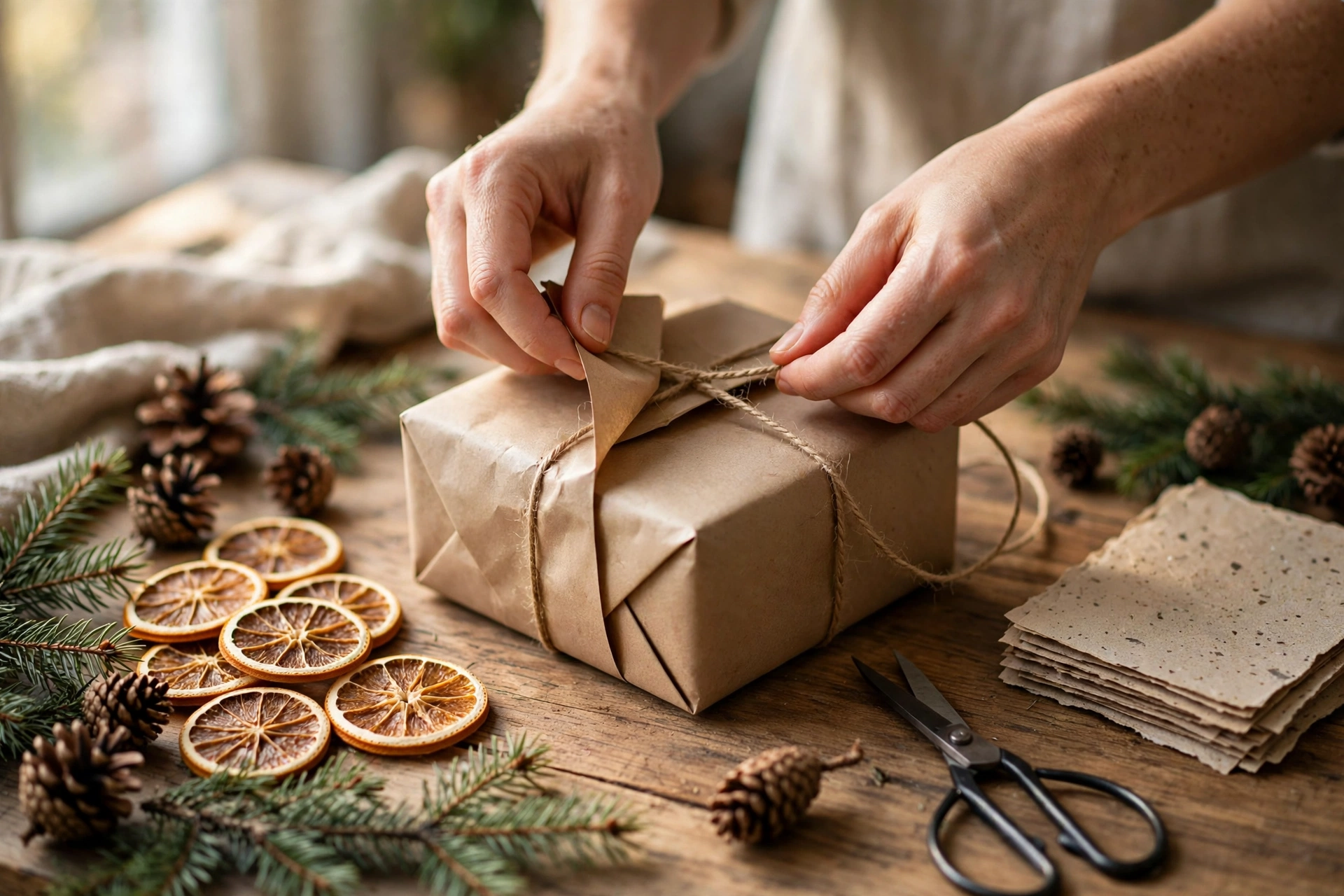
West Sussex County Council recommends a simple check waste experts use everywhere: scrunch the paper in your hand. If it holds its shape, you can recycle it; if it springs back, it contains plastic and belongs in general waste. When buying, choose plain uncoated paper — brown kraft is the safest bet, widely recyclable and often compostable. Avoid foil, glitter and metallic finishes, and use paper ribbon or natural twine instead of plastic bows.
The same logic applies to tape: standard sticky tape is plastic and should be peeled off before recycling, while paper tape can go straight in with the paper.
Furoshiki and reusable wrapping
Furoshiki is the Japanese art of wrapping gifts in cloth. A square of fabric — a scarf, a tea towel, a purpose-bought cloth — folds around a gift beautifully, and the wrapping becomes part of the present. Reusable gift bags work the same way: buy a few sturdy fabric bags once, and they wrap presents for years.
Other low-waste options cost nothing: old newspapers and magazines make characterful wrapping, last year’s Christmas cards cut into gift tags save buying new ones, and a sprig of evergreen or a dried orange slice tied on with twine looks better than a plastic bow ever did. To learn more about what can and cannot go in the recycling, our guide to how to recycle at home covers the rules in detail.
A note on cards
Christmas cards follow the same rules: glittery, foiled and plastic-coated cards cannot be recycled, but plain card can. If you send a lot, consider e-cards for distant friends or plantable seed-paper cards. Keep the cards you receive and cut them into gift tags for next year.
A Lower-Waste Christmas Dinner
Christmas dinner is the emotional centre of the day, and the biggest source of festive food waste. The average UK household throws away 16% of the food bought for the main festive days, according to WRAP’s survey of more than 3,000 families — close to a third for families with children. The fix is not a smaller dinner. It is a better-planned one.
Plan portions before you shop
The single biggest cause of Christmas food waste is overbuying, driven by what West Sussex County Council memorably calls FORO — the fear of running out. Nobody remembers the Christmas when there were exactly enough roast potatoes; everyone remembers the year the fridge was still full of them on New Year’s Eve.
Before the big shop, count heads, check the cupboards, and write a list based on what people actually eat. If only one person likes sprouts, buy a few loose ones rather than a whole bag. Use a portion planner — WRAP’s Love Food Hate Waste campaign provides a Perfect Portions calculator. Over-catering by 10% is insurance; by 50% it is waste.
Choose a lower-impact main course
The main course sets the footprint of the whole meal. The Carbon Trust notes that turkey has a lower carbon footprint than beef, and vegetarian options are lower still. Swapping one or two elements — a vegetable centrepiece alongside the turkey, or a nut roast for the vegetarians — cuts the meal’s footprint noticeably. Cheese has a very high carbon footprint too, so keep the cheese board modest.
Buying local and seasonal helps too: a turkey from a local farm, vegetables from a market, drinks from a nearby producer. To go further, our guide to reducing food waste at home covers portion planning and storage in more depth.
Leftovers are the plan, not the accident
The difference between food waste and a second meal is a plan. Let people serve themselves: food left in a serving dish can be eaten the next day, while food left on a plate usually gets binned — advice the Carbon Trust gives explicitly. Before Christmas Day, decide what Boxing Day lunch will be: turkey curry, bubble and squeak, soup from the trimmings, sandwiches from the leftover ham.
Storage matters too: cool leftovers quickly, label them with the date, and use them within two to three days, or freeze them in portions for January. Vegetable peelings and trimmings can go in the compost — our guide to starting composting at home explains how — and most councils now collect food waste separately, so even the genuinely inedible bits need not go to landfill.
Christmas Lights and Energy: Small Switches, Real Savings
Christmas lights are one of the easiest sustainability wins in the whole house, because the technology has already done the hard work. If your lights are still the old incandescent kind, replacing them with LEDs is the single most effective change you can make to festive energy use — and you only have to do it once.
LEDs use up to 90% less energy
According to the US Department of Energy, LEDs use up to 90% less energy and can last 25 times longer than incandescent bulbs, as reported by National Grid. In practice: a 100-bulb incandescent mini string uses around 40 watts, while the LED equivalent uses about 5 watts, and a large C9 incandescent bulb uses 7 watts against about 1 watt for LED. Over a whole season, that adds up to real money — and real carbon saved.
LEDs also run cool, removing the fire risk of hot old bulbs, and last up to 50,000 hours against around 3,000 for incandescent. A set bought this year could still be working in the 2040s. If your old lights still work, use them until they fail, then replace them with LEDs — but if you are buying new, there is no reason to buy anything else.
Timers, heating and the oven effect
A timer or smart plug on your lights is a small purchase that pays for itself in the first season: it switches the lights off at bedtime and on again in the evening, so nothing burns all night because someone forgot. National Grid also recommends an advanced power strip, which cuts power to switched-off devices instead of letting them draw standby power.
Heating is the bigger December cost, and Christmas itself helps: having the oven on for hours while cooking keeps the house warmer than usual, so you can turn the central heating down on Christmas Day. Closing the curtains as the dark afternoon draws in retains more heat. For more on cutting household energy use year-round, see our guide to saving energy at home.
Decorations You Can Reuse Year After Year
The most sustainable decoration is the one you already own. Most households have a box in a cupboard or loft that comes out every December — and that box is the whole secret. Reusing what you have, repairing what breaks, and adding only natural or second-hand pieces is the lowest-impact approach there is.
Natural decorations cost almost nothing
A walk in a park or garden can supply most of what a festive home needs: evergreen sprigs, pine cones, holly, ivy and dried citrus slices. Strung on twine, they make garlands and wreaths that smell wonderful and can be composted in January. Dried orange slices are easy to make — slice and bake on low heat until dry — and children love helping.
Buying second-hand is the other easy route: charity shops and reuse centres are full of baubles, tinsel and tree stands in December, often in perfect condition. A second-hand decoration has no manufacturing footprint at all, and buying it supports a good cause.
Store them well and they last decades
Many people buy new decorations each year because last year’s got broken in storage. Wrap baubles in tissue or old newspaper, coil fairy lights around a piece of card so they do not tangle, and keep everything in one labelled box in a dry place. When a decoration does break, check whether it can be repaired first — a dab of glue is cheaper and greener than a new purchase.
After Christmas: Recycling, Reusing and Clearing Up Right
The sustainable Christmas does not end on Boxing Day. The week after Christmas is when most of the season’s waste is actually created — the wrapping paper, packaging, cards and tree all leave the house.
Sort as you go
On Christmas Day, keep a box or bag ready for the wrapping paper as presents are opened. That one habit — recommended by West Sussex County Council — keeps recyclable paper separate from ribbons, bows and non-recyclable wrap. Remove tape and ribbons before recycling, and do the scrunch test on anything you are unsure about.
Cards follow the same rule: plain card can be recycled, glittery and foiled card cannot. Batteries from toys and gadgets need a battery recycling point, not the general bin, and old electronics can go to a household recycling centre. Our guide to recycling at home lists the rules for the trickier items.
The tree, the food and the leftovers
For a real tree, the best options in order are: replant it if potted, have it chipped into mulch, or compost it. Most councils run a tree collection or drop-off scheme in the first two weeks of January — check the dates before the holidays. Never send a real tree to landfill if you can avoid it: as the Carbon Trust notes, chipping can reduce its footprint by up to 80%.
Food waste that cannot be eaten — peelings, bones, plate scrapings — should go in the food waste caddy where your council provides one, or in the compost heap. Vegetable peelings and eggshells compost well; meat and dairy do not belong in a home compost bin. If you still have edible leftovers, share them with neighbours or family.
What Recent Research Shows
The evidence base for a sustainable Christmas has sharpened in the last few years, and two findings stand out. The first is the scale of festive food waste, now measured rather than guessed. WRAP’s most recent survey, reported in November 2026, found the average UK household threw away 16% of the food bought for the main festive days — nearly a third for families with children. The figures are people’s own estimates, which WRAP acknowledges, but the pattern matches earlier studies: overbuying, not overcooking, is the main driver.
The second finding concerns the Christmas tree. The Carbon Trust puts the break-even point for an artificial tree at 7 to 20 years of reuse, and independent analysis puts the manufacturing footprint of a standard two-metre artificial tree at around 40 kilograms of CO2 equivalent — more than ten times the footprint of a chipped or composted real tree. The tree you already own is the greenest tree, and if you are buying new, a local real tree with a planned ending wins.
Common Mistakes to Avoid
1. Buying the shiniest wrapping paper. Foil, glitter and metallic-coated paper cannot be recycled. Choose plain kraft or uncoated paper, and do the scrunch test.
2. Panic-buying food “just in case”. FORO — the fear of running out — is the main reason a sixth of Christmas food ends up binned. Count heads, make a list, and remember shops reopen on Boxing Day.
3. Plating up for everyone. Food left on a plate usually gets thrown away; food left in the serving dish becomes tomorrow’s lunch.
4. Leaving the lights on all night. Old incandescent lights left burning overnight waste energy and money. Switch to LEDs on a timer — the saving is up to 90%.
5. Buying novelty gifts nobody wants. The joke present is funny for ten seconds and landfill for centuries. If you cannot think of something the person would genuinely like, an experience gift or a voucher beats a guess.
6. Putting everything in the general bin on Boxing Day. Batteries, electronics, foil wrapping and food waste all have separate routes. Sorting takes five minutes.
Final Recommendations
- Make a list before you shop — for gifts and for food. It is the single highest-impact habit in this whole guide.
- Choose a tree with a planned ending — a local real tree you will chip or compost, a potted tree you can keep, or an artificial tree you already own.
- Give gifts people asked for — and consider experience gifts, second-hand finds and homemade presents first.
- Wrap in paper that can be recycled — plain kraft paper, paper tape, twine, or reusable cloth and bags. Do the scrunch test.
- Plan Christmas dinner portions — and plan Boxing Day lunch from the leftovers at the same time.
- Switch to LED lights on a timer — up to 90% less energy, and they last decades.
- Reuse your decorations — and add natural or second-hand pieces instead of buying new plastic each year.
- Keep the habits that work — meal planning, buying less, reusing what you have. They pay off all year, not just at Christmas.
This content is for educational purposes only and does not replace professional environmental or waste-management advice. Always check your local council’s recycling guidance before disposing of items, as rules differ by area.
Frequently Asked Questions
Plain, uncoated wrapping paper is recyclable — but foil, glitter and plastic-coated paper is not. Do the scrunch test: scrunch the paper in your hand. If it holds its shape, it can be recycled; if it springs back, it contains plastic and belongs in general waste. Brown kraft paper is the safest choice.
A locally grown real tree that is chipped or composted afterwards narrowly beats an artificial tree, according to lifecycle research and Carbon Trust guidance. An artificial tree only becomes the lower-carbon option if you use it for 7 to 20 years, as manufacturing one generates around 40 kg of CO2 equivalent. If you already own one, keeping it as long as possible is the greenest choice.
Start with a list for gifts and food, so you buy only what people want and will eat. Give experience gifts or second-hand finds, wrap in recyclable paper, plan dinner portions and use the leftovers, switch to LED lights on a timer, and sort recycling on the day. Most Christmas waste comes from a handful of fixable decisions.
The best eco-friendly gifts are ones the person actually wants: experience gifts like theatre tickets or a meal out, homemade food or crafts, good-quality second-hand items, and zero-waste kits such as a reusable bottle, beeswax wraps and produce bags. Avoid novelty gifts — usually used once and impossible to recycle.
In the UK, around 230,000 tonnes of food are thrown away over the festive period, including an estimated 263,000 turkeys, 740,000 portions of Christmas pudding and more than 7.5 million mince pies each year. WRAP found the average household wastes 16% of the food bought for the main festive days.
Yes. According to the US Department of Energy, LEDs use up to 90% less energy and last up to 25 times longer than incandescent bulbs. A 100-bulb incandescent string uses about 40 watts, while the LED equivalent uses about 5 watts. LEDs also run cool, removing the fire risk of hot old bulbs.
A sustainable Christmas is usually a cheaper Christmas. Buy fewer, better gifts — or give experiences and homemade presents. Use wrapping paper you already have, or brown kraft paper with twine. Plan food portions so nothing is wasted, reuse last year's decorations, and switch to LED lights once. Second-hand gifts and Secret Santa cut costs and waste together.
References
- The Carbon Trust — The Carbon Trust’s tips for a more sustainable Christmas — 2023 — https://www.carbontrust.com/news-and-insights/news/the-carbon-trusts-tips-for-a-more-sustainable-christmas-0?es_c=b5069e527d2793429ec54999559c1019&es_cl=99ee33a3ca6689b0f65c0e4748d718d4&es_id=phc%C2%A388
- IFLScience — Real Or Fake Christmas Trees: Which Is Better For The Environment? — https://www.iflscience.com/real-or-fake-christmas-trees-which-is-better-for-the-environment-82016
- National Grid — Making energy efficient holiday choices: The gift that keeps on giving — 2026 — https://www.nationalgrid.com/news/making-energy-efficient-holiday-choices-gift-keeps-giving
- West Sussex County Council — Recycling at Christmas — https://www.westsussex.gov.uk/land-waste-and-housing/waste-and-recycling/recycling-and-waste-prevention/recycling-news/recycling-at-christmas/
- BSI Group — Cutting Food Waste this Christmas — 2024 — https://www.bsigroup.com/en-IE/insights-and-media/insights/blogs/cutting-festive-season-food-waste-making-sustainable-changes-from-farm-to-fork/
Conclusion
A sustainable Christmas is not a smaller Christmas. It is the same celebration — the same tree, the same dinner, the same people — with the waste quietly taken out of it.
Start where it matters most to you. If you only change one thing this year, make a list before you shop — for gifts and for food. That single habit prevents more waste than any other.
Christmas is also a good moment to start habits that last beyond December: meal planning, buying less and buying better, reusing what you already own. Do it once, notice how little you miss the waste, and it becomes the way you do things. That is the real prize: not a greener Christmas, but a household that stays a little greener all year.