
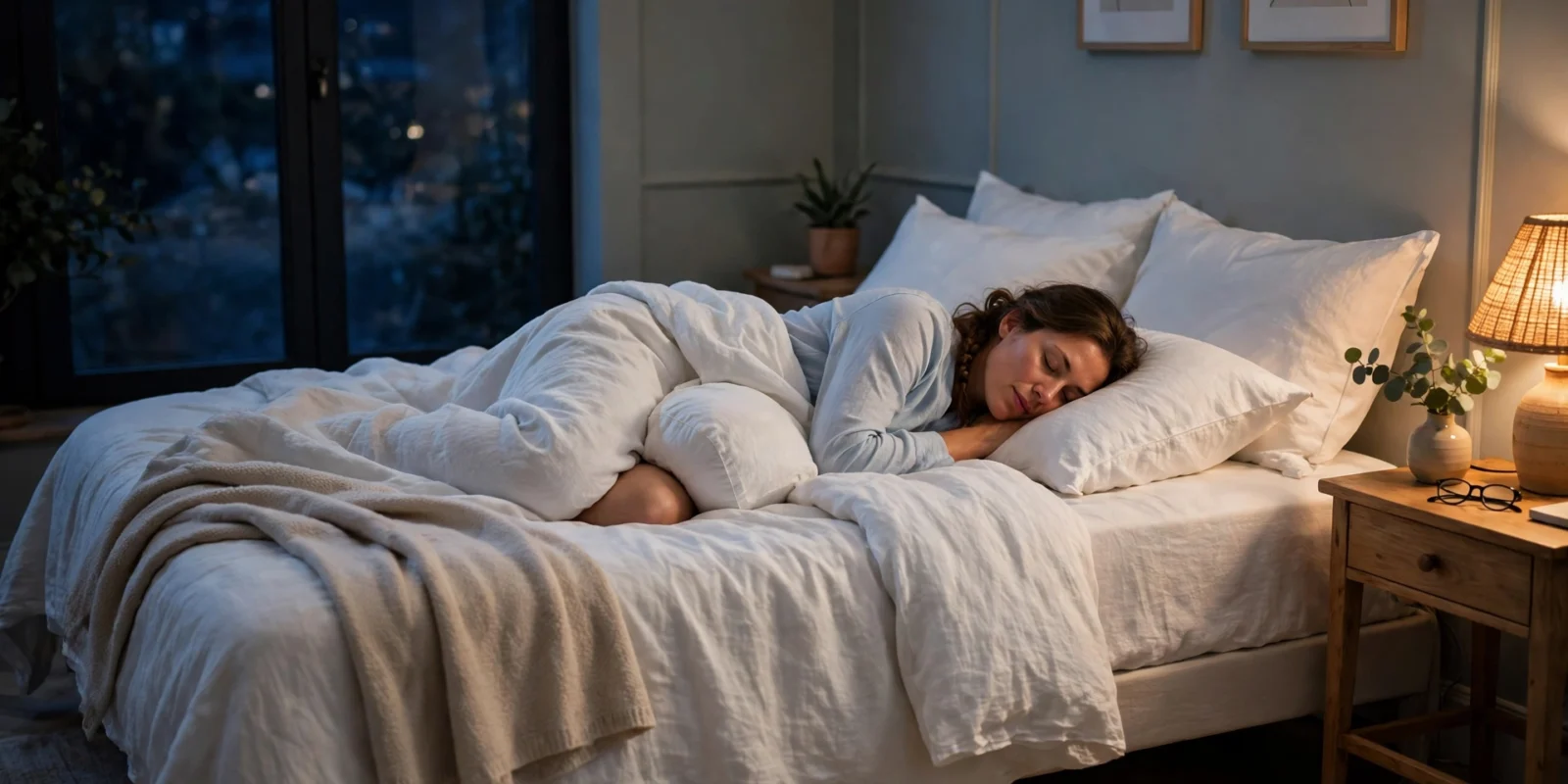
Most of us fall into the same sleeping position every night without ever choosing it — then we wake up stiff, snoring, or with heartburn, and we blame the mattress. But the way you lie in bed shapes your night: how freely you breathe, how much pressure lands on your spine, and whether stomach acid stays where it belongs. There is no single best sleeping position for everyone. This guide helps you find the one that fits your body.
Written by Md Masud Rana based on published expert sources. This article has not been professionally reviewed. See our sources below.
Key Takeaways
- The best sleeping position for most adults is on the side, ideally the left — it keeps the airway open, eases snoring, and helps with acid reflux.
- Back sleeping is best for spinal alignment — but it can worsen snoring and sleep apnoea.
- Stomach sleeping ranks last: it twists the neck and flattens the lower back.
- Left-side sleeping is the usual recommendation for acid reflux and pregnancy.
- Pillow placement matters as much as position — a pillow between the knees for side sleepers, one under the knees for back sleepers.
- If you wake up rested and pain-free, you probably do not need to change anything — unless a doctor has advised otherwise.
Quick Answer: What Is the Best Sleeping Position?
For most adults, the best sleeping position is on your side, ideally your left. Side sleeping keeps the upper airway open, which reduces snoring and eases sleep apnoea, and lying on the left side uses gravity to keep stomach acid down, which helps acid reflux. Back sleeping is best for spinal alignment, provided you do not snore heavily. Stomach sleeping is generally the least recommended position because it twists the neck and arches the lower back.

Contents
- What Is the Best Sleeping Position?
- Side Sleeping: The Best Default for Most People
- Back Sleeping: Kind to Your Spine, Rough on Snoring
- Stomach Sleeping: Why Experts Rank It Last
- The Best Sleeping Position for Back Pain and Neck Pain
- The Best Sleeping Position for Snoring and Sleep Apnoea
- The Best Sleeping Position for Acid Reflux — and for Pregnancy
- How to Change Your Sleeping Position
- What Recent Research Shows
- Common Mistakes That Make Your Sleeping Position Worse
- Final Recommendations
- Frequently Asked Questions
What Is the Best Sleeping Position?
Ask three sleep specialists and you will get the same careful answer: it depends. A position that relieves one person’s back pain can worsen another person’s sleep apnoea. So the useful question is not “which position is best?” but “which position is best for me, with my body?”
Still, the evidence points in a clear direction. Side sleeping is the most common position among adults, and the one most guidelines quietly favour: it rarely makes anything worse, and it often improves breathing and digestion. Back sleeping comes second, and wins outright for spinal alignment. Stomach sleeping trails behind on almost every measure.
| Position | Best for | Think twice if you have | Key pillow tip |
|---|---|---|---|
| Side (left or right) | Snoring, sleep apnoea, acid reflux, back pain, pregnancy | Shoulder pain on one side — try the other side | Pillow between the knees; thick enough head pillow |
| Back | Spinal alignment, even weight distribution, some neck and back pain | Snoring, sleep apnoea, acid reflux, late pregnancy | Pillow under the knees; low pillow under the head |
| Stomach | Keeping the airway open in some snorers | Neck or back pain, reflux, pregnancy | Very thin head pillow or none; slim pillow under the hips |
| Propped up | Congestion, colds, nighttime reflux | Lower back pain if the incline is too steep | Wedge pillow or adjustable bed rather than a stack of pillows |
Comfort counts, too. If you sleep well and wake up refreshed, with no pain and no snoring complaints, there is probably no reason to change — a point Cleveland Clinic sleep specialist Dr Nancy Foldvary-Schaefer makes herself. Change your position when something is wrong, not because a video told you your posture is incorrect.
Side Sleeping: The Best Default for Most People
Side sleeping is where most adults end up, and it is also where most expert guidance lands. The Sleep Foundation describes it as the most common sleep position and often the best choice for relieving back pain and reducing sleep apnoea symptoms. Lying on your side keeps your spine fairly straight, lets your airway stay open, and takes pressure off your internal organs.
The catch: side sleeping only works well when the pillows are right. Without support between the knees, the top leg pulls the hip forward and twists the lower spine. Without a thick enough head pillow, the neck droops toward the mattress all night.
Left side vs right side: does it matter?
Most of the time, either side is fine. Cleveland Clinic’s sleep specialists say it is more a matter of comfort than anything else. But there are three situations where the side you choose genuinely matters.
For acid reflux, the left side wins. Your stomach sits mostly on the left side of your body, so lying on the left keeps the stomach below the oesophagus and gravity helps keep acid down. A systematic review and meta-analysis found that sleeping on the left side was linked to fewer reflux symptoms than sleeping on the right side or on the back, as reported by Health.com.
For pregnancy, the left side is the usual recommendation, especially in the second and third trimesters: lying on the left takes pressure off the large vein that carries blood back to the heart. Most healthcare providers say either side is acceptable, but the left is the default advice.
For a stuffy nose, pick the side that breathes better. If your left nostril is working better than your right, sleep on your left side with the right side up, and vice versa. Cleveland Clinic’s Dr Foldvary-Schaefer suggests exactly this — sleeping on your side can help open up the nasal passages when one side is blocked.
The fetal position: cosy, but keep it loose
Many side sleepers curl up with their knees drawn toward their chest. It feels safe and warm, and for lower back pain it can actually help, because the slight bend opens up the spaces between the vertebrae. The Sleep Foundation names side sleeping with knees slightly bent, and a pillow between them, as the best sleeping position for lower back pain.
The problem starts when the curl gets too tight: it rounds the shoulders, tucks the chin to the chest, and can restrict breathing. Cleveland Clinic advises side sleepers not to tuck the chin to the chest. Think “loosely curled” — knees bent, not pulled up to your chin, arms relaxed in front of you.
Back Sleeping: Kind to Your Spine, Rough on Snoring
Sleeping on your back — the supine position — is often described as the gold standard for spinal alignment, and the description is fair. Lying face-up with a modest pillow lets your head, neck and spine rest in a roughly straight line, and your body weight spreads evenly across the mattress. Nothing is twisted. Nothing is compressed.
Cleveland Clinic notes that back sleeping is often the most comfortable position for people with neck and back pain, whether the pain is chronic or from a recent injury. The clinic’s advice is practical: use a pillow as a bolster under your knees, and a supportive pillow under your neck. The pillow under the knees matters more than people expect — it keeps the lower back from arching too much, which is what happens when the legs lie flat, especially if the hamstrings are tight. Keep both arms in the same position, not one above your head and one on your belly.
Now the downside, and it is a significant one. Back sleeping is the worst position for breathing at night: lying flat lets your tongue and the soft tissues at the back of your throat fall backward and narrow the airway, which is why it worsens snoring and sleep apnoea. In a sleep lab, Cleveland Clinic specialists see people with significant sleep apnoea on their backs whose breathing improves markedly when they roll onto their side. It can also worsen acid reflux, because lying flat puts the stomach and oesophagus at the same level.
Stomach Sleeping: Why Experts Rank It Last
Sleeping on your stomach — the prone position — is the one position where expert opinion is unusually united, and not in its favour. The Sleep Foundation notes that side and back sleeping are generally more beneficial than stomach sleeping, because they make it easier to support the spine. People spend less than 10% of their time asleep on their stomachs, according to the Sleep Foundation, and there is a reason it is so unpopular.
The problem is mechanical. Lying face-down flattens the natural curve of your lower back and forces you to turn your head sharply to one side to breathe. Your neck spends the whole night twisted, your lower back arches, and your weight presses down through your ribs. Cleveland Clinic lists the likely results plainly: back pain, neck pain, and shoulder pain.
Stomach sleeping does have one genuine advantage: because your airway stays open face-down, it can reduce snoring for some people. But it is a trade — quieter breathing in exchange for a strained neck and back — and for most people the trade is not worth it. There is also a safety note: Cleveland Clinic warns that people prone to seizures should be cautious about stomach sleeping, because a pillow can obstruct the airway during a seizure. During pregnancy, stomach sleeping becomes impractical as the belly grows; experts recommend switching to side sleeping between weeks 16 and 28.
If you are a committed stomach sleeper, two adjustments reduce the strain. Use a very thin pillow under your head, or none at all, to reduce the neck angle. Place a slim pillow under your hips and lower stomach to keep the lower back from arching so deeply. Then try, gently, to shift toward your side.
The Best Sleeping Position for Back Pain and Neck Pain
Back pain changes the question. You are no longer asking which position is healthiest in general. You are asking which position lets you wake up without that first stiff, careful movement of the morning. Here the evidence is consistent enough to give a clear answer.
For lower back pain, the best sleeping position is on your side with your knees slightly bent and a pillow between them. That is the Sleep Foundation’s recommendation, echoed by Cleveland Clinic and by physical therapists. The slight bend and the pillow keep the hips aligned and take the twist out of the lower spine. Back sleeping is the next best option, with a pillow under the knees to relax the back muscles and keep the natural curve of the lower back. Stomach sleeping without support is the position most sources advise against for back pain.
For neck pain, back sleeping is often the best choice. The Sleep Foundation notes that back sleeping reduces overactivity in the muscles around the neck, because the head rests in a neutral position with nothing twisted or compressed. Side sleeping can also work well for neck pain, as long as the pillow is supportive enough to keep the head level with the spine. What hurts the neck most is stomach sleeping, where the head is turned to one side for hours. Side sleeping also puts pressure on the shoulder underneath you — if that shoulder hurts, sleep on the other side, or switch to your back.
A word of honesty: the evidence here is mostly expert guidance and small studies, not large trials comparing positions head to head. No position guarantees a pain-free morning. Take it as a starting point — side or back, with the right pillow support — and judge it over a couple of weeks. If your back pain is new, severe, or comes with numbness or weakness, see your doctor. And if you often wake up tired every morning despite sleeping long enough, your position may be only part of the story.
The Best Sleeping Position for Snoring and Sleep Apnoea
If you snore, or your partner says you stop breathing during the night, your sleeping position matters more than it does for most people. On your back, gravity pulls your tongue and the soft tissues of your throat backward, narrowing the airway — that vibration is snoring. In obstructive sleep apnoea, the airway collapses repeatedly, breathing pauses, and sleep is broken again and again.
Side sleeping is the best position for snoring and sleep apnoea. It keeps the throat wider because the tongue falls to the side rather than backward. The Sleep Foundation’s guidance is the same: sleeping on your side or stomach is typically best for sleep apnoea, while sleeping on your back is the worst for obstructive sleep apnoea. Some studies estimate that roughly half of people with obstructive sleep apnoea have the positional kind — their breathing is much worse on their back than on their side. Cleveland Clinic specialists see this clearly in the sleep lab: people with significant sleep apnoea on their backs often improve markedly when they roll onto their side.
Position can help mild snoring and positional apnoea, but it is not a treatment for diagnosed sleep apnoea. If you snore loudly, gasp or choke during the night, wake up with morning headaches, or feel exhausted despite a full night in bed, see your doctor. For more on snoring itself — its causes, and what actually helps beyond position — our guide to how to stop snoring covers ten approaches that work.
The Best Sleeping Position for Acid Reflux — and for Pregnancy
These two situations share something useful: the left side is the answer in both, and the reason is simple anatomy.
Acid reflux and heartburn
Acid reflux is often worse at night, because lying down removes gravity from the equation. Sleeping on your left side is the best position for acid reflux. The stomach sits mostly on the left side of the body, so lying left keeps the stomach below the oesophagus and uses gravity to keep acid down. A systematic review and meta-analysis found left-side sleeping was linked to fewer reflux symptoms and faster acid clearance than right-side or back sleeping. The Sleep Foundation adds that sleeping on the left side with the head of the bed raised offers the biggest benefit. It also helps to avoid lying down soon after meals and to keep evening meals lighter.
Pregnancy
Experts recommend that people who are pregnant sleep on their side, ideally the left, especially in the second and third trimesters. Lying on the back with a large bump can put pressure on the big veins that carry blood back to the heart. Sleeping on the left side relieves that pressure and supports healthy circulation. The NHS advises people to go to sleep on their side from 28 weeks onward. Most healthcare providers say either side is acceptable — the left is preferred, and brief periods on the right are fine to relieve pressure on the left hip. A pregnancy pillow, or a firm pillow tucked between the knees and another supporting the belly, makes side sleeping far more comfortable.
Babies, note, are different: they should always sleep on their backs, which protects their airway and reduces the risk of sudden infant death syndrome.
How to Change Your Sleeping Position
Changing how you sleep is harder than it sounds. You can fall asleep on your side and wake up on your stomach, with no memory of rolling over. Treat this as a slow retraining, not a single night’s decision.
Step 1: Pick the right target, and only one. If you snore, your target is your side. If your lower back aches, your target is your side with a pillow between your knees, or your back with a pillow under them. Do not try to fix everything at once.
Step 2: Build a pillow wall. Place a firm pillow behind your back to stop yourself rolling onto it, and another in front of your body to stop yourself rolling onto your stomach. A long body pillow works well. Set the pillows up before you are tired, while you are still alert — side sleepers need a thicker head pillow, back sleepers a lower one. It feels strange for the first few nights. That is normal.
Step 3: Give it two weeks, not two nights. The first few nights often feel worse, not better. Most people need one to two weeks before the new position feels natural. Judge it after a fortnight, by how you feel in the morning.
And if the new position simply will not stick after a few honest weeks, let it go. The best sleeping position is the one that lets you sleep. Comfort, and actually staying asleep, matter more than textbook posture.
What Recent Research Shows
A few recent findings sharpen advice that used to be vague.
Left-side sleeping and reflux. A systematic review and meta-analysis — a study pooling the results of many smaller studies — found that sleeping on the left side was associated with fewer reflux symptoms and less time with acid in the oesophagus than sleeping on the right side or on the back. The left-side recommendation for reflux now rests on pooled evidence, not just anatomical reasoning.
Positional sleep apnoea is common. Research summarised by the Sleep Foundation suggests that roughly half of people with obstructive sleep apnoea have the positional form — their breathing is much worse on their back than on their side. Position alone can make a real difference for a large group of people, and sleep clinics pay close attention to which position a patient spends the night in.
No large trial has crowned one winner. There is no large randomised trial comparing side, back and stomach sleeping head to head. What exists is a consistent pattern across expert guidance, smaller studies, and sleep-lab observation. Anyone who claims one position is proven best for all adults is overselling the evidence.
Common Mistakes That Make Your Sleeping Position Worse
1. Using the wrong pillow height for your position
Side sleepers use a flat pillow and their neck droops all night. Back sleepers use a thick pillow and their chin is pushed toward their chest. Fix the pillow before blaming the position.
2. Sleeping on your stomach because it is the only way you can fall asleep
Many stomach sleepers started as children and never questioned it. But if you wake up with neck or back pain, the position is a likely suspect. The fix is the pillow wall described above, and two weeks of patience.
3. Curling into a tight ball on your side
A hard curl rounds the shoulders, tucks the chin, and can restrict breathing. Keep the curl loose: knees bent, but not pulled up to your chin, and arms relaxed in front of you.
4. Stacking ordinary pillows to sleep propped up
A tower of pillows collapses during the night and bends your neck forward, trading reflux relief for neck pain. Use a wedge pillow or an adjustable bed instead.
5. Ignoring loud snoring and breathing pauses
Loud snoring with gasping, choking, morning headaches or daytime exhaustion can point to sleep apnoea. Changing position can help, but it is not a diagnosis and not a treatment. See your doctor.
6. Changing position every few nights and concluding nothing works
Your body needs time to adjust. Switching from side to back to stomach across a single week tells you nothing. Pick one position, set it up properly, and give it a full two weeks.
Final Recommendations
- Start with your side, ideally the left. It is the best default for most adults — good for breathing, good for reflux, good for the spine with the right pillow support.
- Match the position to your main problem. Back pain: side with a pillow between the knees, or back with a pillow under them. Snoring or apnoea: side, and stay off your back. Reflux: left side, head slightly raised. Pregnancy: left side from the second trimester onward.
- Fix your pillows before changing your position. The right pillow height, a pillow between the knees for side sleepers, and one under the knees for back sleepers. These three adjustments cost little and change a lot.
- Move away from stomach sleeping if you can. It is the position most likely to strain your neck and lower back. Use the pillow-wall method and give yourself two weeks.
- Build a wind-down routine around the position. A regular sleep schedule and a calm hour before bed matter just as much. If your schedule has drifted, our guide on how to fix your sleep schedule walks through resetting it.
- Know how much sleep you actually need. Most adults need seven to nine hours — see how much sleep you actually need. If you struggle to drift off, the techniques in how to fall asleep faster pair well with a better position.
- See a doctor when symptoms point beyond position. Loud snoring with breathing pauses, morning headaches, severe or new back pain, numbness, or sleep trouble lasting months are all reasons to get proper advice. The NHS advises seeing a GP if changing your sleeping habits has not helped, or if poor sleep is affecting your daily life.
Frequently Asked Questions
For most adults, sleeping on the side — ideally the left — is considered the healthiest overall position. It keeps the airway open, which reduces snoring and eases sleep apnoea, and lying on the left side uses gravity to keep stomach acid down, which helps acid reflux. Back sleeping is best for spinal alignment, but it can worsen snoring.
Sleeping on your stomach is generally the least recommended position. It flattens the natural curve of your lower back and forces your head to turn sharply to one side so you can breathe, which strains the neck. It does keep the airway open, so some snorers prefer it, but side sleeping gives the same benefit without the strain. If you cannot give it up, use a very thin head pillow and a slim pillow under your hips.
Either side is usually fine. The left side is better in two specific situations: acid reflux, because the stomach sits mostly on the left and gravity helps keep acid down, and pregnancy, because the left side takes pressure off the large vein that returns blood to the heart. For a stuffy nose, sleep on the side where the clearer nostril is on top.
The best sleeping position for lower back pain is on your side with your knees slightly bent and a pillow between them, which keeps the hips aligned and takes the twist out of the lower spine. Back sleeping is the next best option, with a small pillow under your knees. If your back pain is new, severe, or comes with numbness or weakness, see your doctor rather than relying on position alone.
Sleeping on your left side is the best position for acid reflux. Because the stomach sits mostly on the left, lying on the left keeps the stomach below the oesophagus so gravity helps keep acid down. A systematic review and meta-analysis found left-side sleeping linked to fewer reflux symptoms than right-side or back sleeping. Sleeping on the left with the head of the bed raised offers the biggest benefit.
Experts recommend sleeping on your side during pregnancy, ideally the left, especially in the second and third trimesters. Lying on the left takes pressure off the large vein returning blood to the heart, which supports healthy circulation. The NHS advises going to sleep on your side from 28 weeks onward. Either side is acceptable, and brief periods on the right are fine to relieve pressure on the left hip.
Yes. Side sleeping is one of the most effective simple steps for snoring. On your back, your tongue and throat tissues fall backward and narrow the airway, causing the vibration we hear as snoring. Lying on your side keeps the throat wider. Sleep specialists see this clearly in sleep labs: people with significant snoring or sleep apnoea on their backs often improve markedly when they roll onto their side.
Most people need one to two weeks before a new sleeping position starts to feel natural. The first few nights often feel worse, not better, because your muscles are used to the old arrangement. A pillow wall — a firm pillow behind your back and one in front — helps stop you rolling back into the old position. Judge it after a full fortnight, by how you feel in the morning.
This content is for educational purposes only and does not replace professional medical advice. Always consult a qualified healthcare professional before making health decisions about your sleep.
Conclusion
Your sleeping position is one of those things you never think about until something goes wrong — and then it is the only thing you can think about, at 3 a.m., with a stiff neck or a burning throat. The good news is that it is also one of the easiest things to change: no prescription, no purchase, no appointment. Just a different way of lying down, and a pillow or two in the right places.
If you remember nothing else: side sleeping, ideally on the left, is the best starting point for most adults. Back sleeping is best for alignment, as long as you do not snore heavily. Stomach sleeping is the one to move away from. And the pillows matter as much as the position.
Try the change that matches your main problem, and give it two honest weeks. Pay attention to your mornings — they tell the truth about a position. And if the problem does not shift, if the snoring comes with gasping or the back pain with numbness, that is a conversation for your doctor, worth having sooner rather than later.
References
- Cleveland Clinic — The Best Sleeping Positions for a Restful Night — 2026 — https://health.clevelandclinic.org/best-sleeping-position
- Sleep Foundation — What Is the Best Sleeping Position? — https://www.sleepfoundation.org/sleeping-positions
- Sleep Foundation — How to Sleep With Lower Back Pain — 2025 — https://www.sleepfoundation.org/physical-health/how-to-sleep-with-lower-back-pain
- Health.com — 5 Healthiest Sleep Positions for Proper Spine Alignment — https://www.health.com/healthiest-way-to-sleep-11696842
- NHS — Insomnia — https://www.nhs.uk/conditions/Insomnia/
- Cleveland Clinic — 10 Tips To Help You Fall Asleep Fast — https://health.clevelandclinic.org/how-to-fall-asleep-fast