
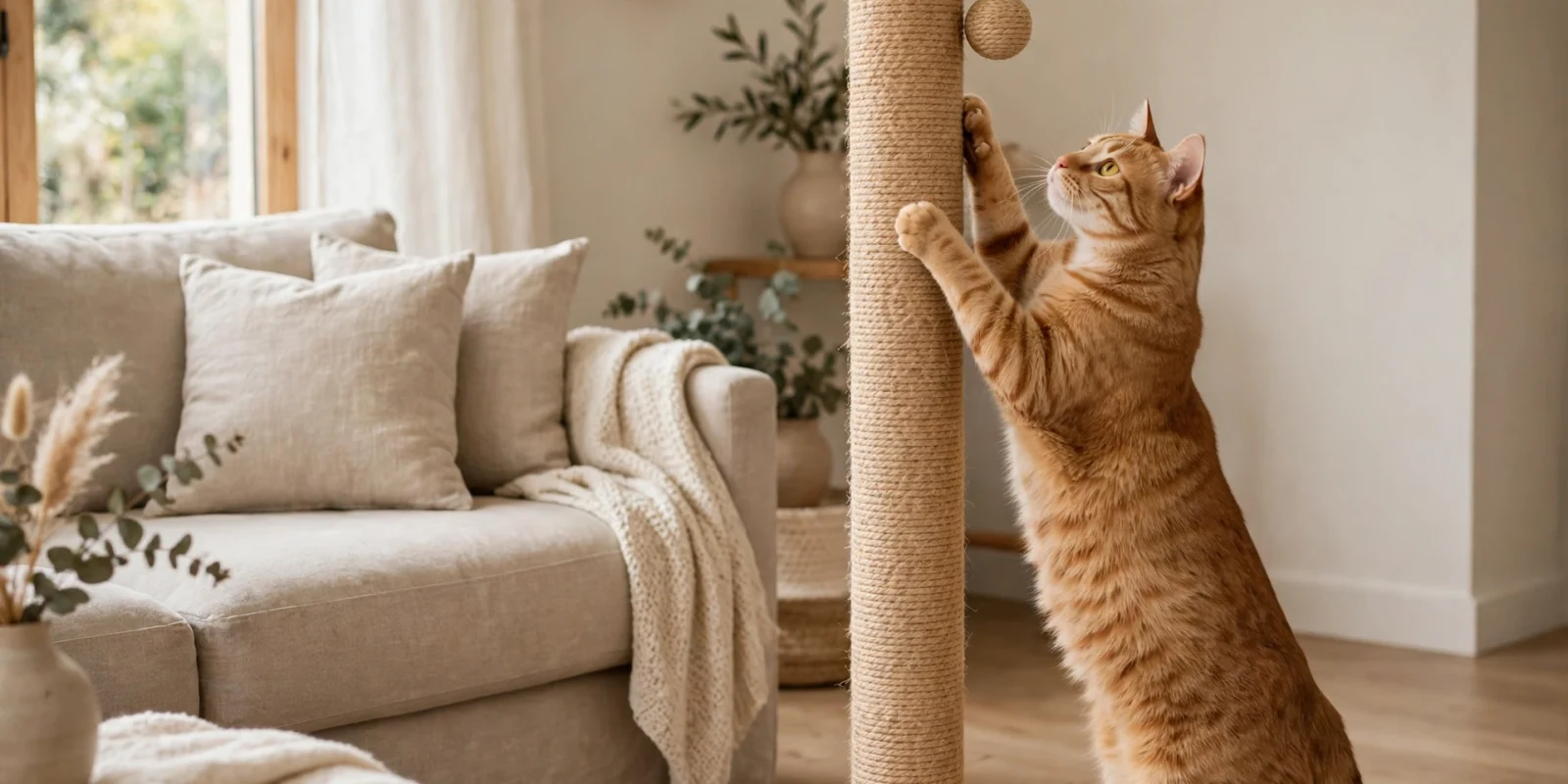
Your sofa was fine this morning. By lunchtime, one arm looks like it lost a fight with a cheese grater — and the culprit is asleep on the very cushion she shredded. If you want to know how to stop a cat scratching furniture, here is the honest answer up front: you cannot stop a cat from scratching. You can only move the scratching somewhere better.
That sounds like bad news, but it is actually the whole solution. Scratching keeps claws in shape, stretches the back and shoulders, and leaves a scent message other cats can read. Give it a better home — a post she actually likes, in the right spot — and most cats switch within a couple of weeks.
Written by Md Masud Rana based on published expert sources. This article has not been professionally reviewed. See our sources below.
Quick answer: To stop a cat scratching furniture, place a tall, sturdy scratching post right beside the spot your cat already scratches, reward every use with treats or praise, and cover the furniture temporarily with a blanket, plastic sheet or double-sided tape while the new habit forms. Trim claws, clean old scratch marks, and never punish or declaw your cat.
Key takeaways:
- Scratching is normal and necessary — the goal is redirection, not elimination.
- The post must beat the sofa: tall, sturdy, and placed where your cat already scratches.
- Protect the furniture at the same time, or the old habit wins while the new one forms.
- Leather needs special care: never stick adhesive tape or guards directly onto it.
- Punishment backfires, and declawing is illegal in the UK and opposed by veterinary bodies elsewhere.
Contents
- Why Do Cats Scratch Furniture?
- The Three-Part Plan That Actually Works
- How to Choose the Right Scratching Post
- How to Train Your Cat to Use the Post
- Protecting Your Furniture While the Habit Changes
- Leather Sofas Need a Different Approach
- Nail Trims and Soft Nail Caps
- When Scratching Means Stress or Boredom
- What Recent Research and Guidance Shows
- Your Two-Week Redirection Plan
- Common Mistakes That Keep the Scratching Going
- Final Recommendations
- Frequently Asked Questions
Why Do Cats Scratch Furniture?
Before fixing the problem, it helps to know what your cat is actually doing when she digs her claws into the arm of your sofa. She is not being spiteful. She is doing three useful jobs at once, and the sofa just happens to be the best tool in the room for all three.
First, claw maintenance. A cat’s claws grow in layers, and scratching drags off the worn outer sheath to reveal a sharp new surface underneath. Cornell’s Feline Health Center describes scratching as largely a marking behaviour that also removes the outer sheath of the claws, and notes that it is innate, like grooming. Kittens start scratching from around five weeks of age, according to International Cat Care.
Second, stretching. Watch a cat scratch and the whole body gets involved: front legs extended, back arched, shoulders working. It is a full-body stretch after a sleep — one reason cats so often scratch right after waking, and why a post near a favourite sleeping spot gets used far more than one hidden in a spare room.
Third, communication. Cats have scent glands between the pads of their paws, and scratching deposits a chemical message along with the visible marks. International Cat Care explains that the combination of the mark, the discarded claw husks and the smell sends a strong visual and scent message to other cats. Indoors, the sofa arm — tall, prominent, in the middle of the family’s living space — is the indoor equivalent of the tree trunk.
Why the sofa always wins
A good scratching surface needs to be tall enough to stretch against, stable enough not to move, and textured enough for claws to hook into and pull against. Your sofa is all three. It also sits where the family spends time, which matters, because scratching is partly a social signal. PetMD notes that in house cats, the arms of couches and the legs of unvarnished wooden furniture are common targets for territorial scratching, partly because the fabric rips easily and the wood splinters — both give a satisfying result.
This is why the classic mistake — buying a small, wobbly carpet-covered post and putting it in a hallway — fails. The post loses to the sofa on every measure that matters to the cat. The fix is not to argue with the cat. It is to build something that beats the sofa. A cat that scratches furniture is a normal cat; the behaviour only becomes a problem when she has no acceptable outlet for it. International Cat Care puts it bluntly — scratching is normal and necessary, so you will not be able to stop it, nor should you. For the wider picture of everyday cat care, our complete guide to pet care basics covers the daily routines that keep a cat healthy and settled.
The Three-Part Plan That Actually Works
Every successful approach does three things at the same time. Skip one, and the other two usually fail — a gap in most short advice lists online.
One: offer a better scratching surface — a post your cat genuinely prefers over the sofa. Two: make the furniture less appealing for a while — temporary covers, double-sided tape or a clear guard, so the old habit stops paying off while the new one forms. Three: reward the new behaviour — treats, praise or play every time your cat uses the post, especially in the first two weeks.
Do all three together and most cats redirect within two to three weeks. Do only the post, and the cat keeps using the sofa out of habit. Do only the deterrent, and the cat finds a new piece of furniture.
How to Choose the Right Scratching Post
This is where most people go wrong: they buy the post they like, not the one their cat likes. Spend a few days watching before you buy, and the choice gets much easier.
Watch first: material, direction, and height
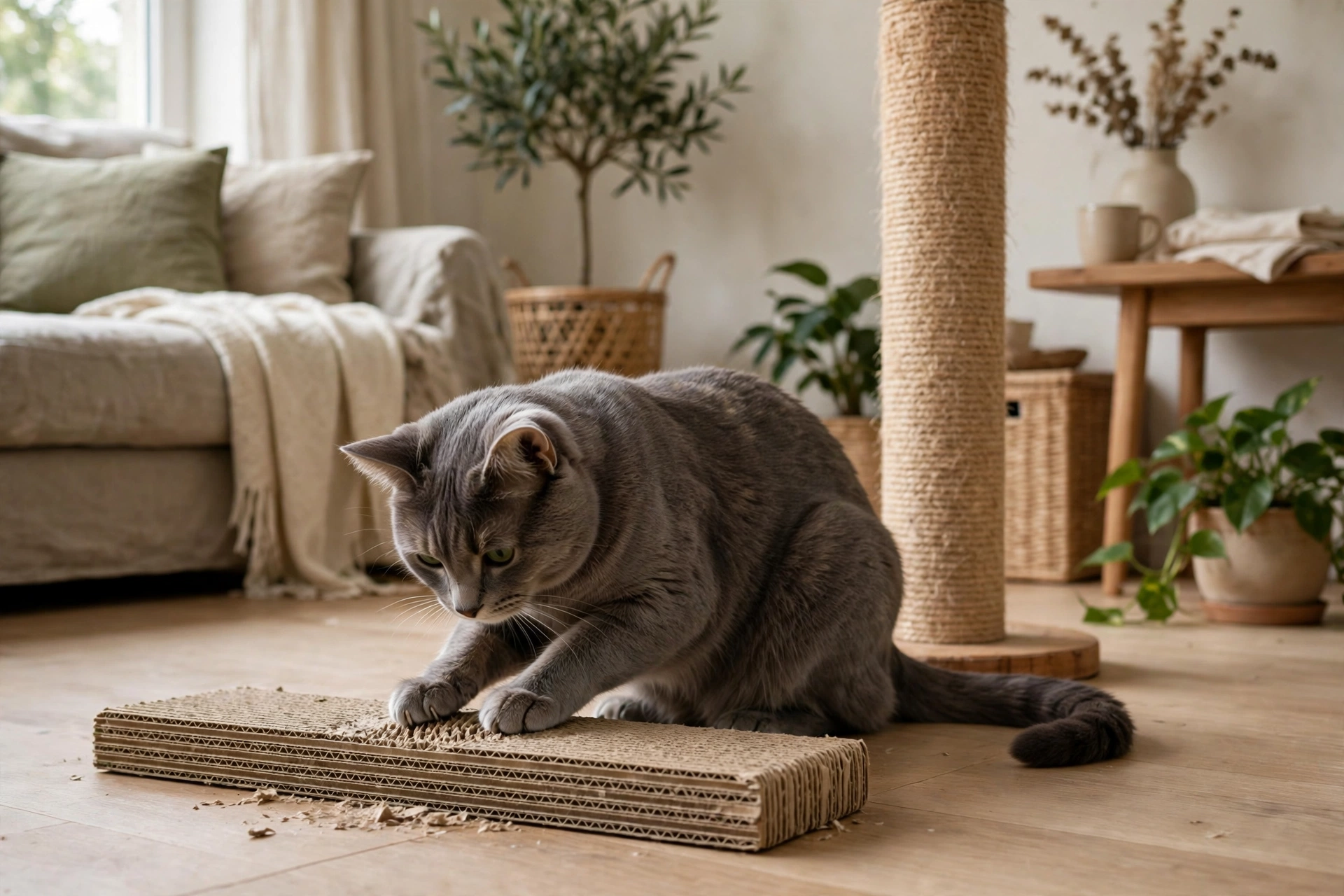
Cornell recommends watching what your cat already scratches, and noting the material, direction, and height. Does she scratch vertically, paws stretched above her head, or horizontally, lying down and raking at the carpet? Match the post to those preferences — a sisal or rope-covered post for a cat that likes nubby sofa fabric, a carpet-covered post for a carpet scratcher, a flat cardboard board for a horizontal scratcher.
A vertical post should be at least as tall as your cat standing on her hind legs with her front legs fully outstretched — for an average adult cat, around 60–80 cm (roughly 2 to 2.5 feet) of usable surface, and more for a large cat. A short post forces the cat to crouch, which defeats the stretching purpose.
Stability is non-negotiable
A post that wobbles or tips over will be used exactly once — a startled cat may avoid posts for weeks. Look for a heavy, wide base, or a post that fixes to a wall. If it rocks in the shop, do not buy it.
Materials cats actually prefer
There is no single best material, only the one your cat prefers:
- Sisal rope — the most popular all-rounder for vertical scratchers: rough, satisfying to hook claws into, and durable.
- Corrugated cardboard — the favourite for horizontal scratchers. Cheap, replaceable, and many cats love the tearing sensation.
- Natural wood or bark — closest to a tree trunk; good for cats that target wooden furniture legs.
- Carpet — suits carpet scratchers. International Cat Care notes there is no evidence that a cat’s scratching habits will move to other carpeted areas once the post is used regularly.
- Seagrass or woven fibres — a good middle ground for cats that like a rough, natural texture.
Plush, soft fabric is the one material most cats find unsatisfying — claws slide over it instead of catching. If the post you bought is covered in soft plush and your cat ignores it, the material is the likeliest reason. For sustainable options, see our eco-friendly pet care guide.
How many posts, and where?
One post is rarely enough. Cornell advises a post near each location your cat likes to scratch, and International Cat Care recommends one scratching post per cat plus one extra in multi-cat households. Put the main post directly beside the piece of furniture your cat targets — touching it if you can — not across the room and definitely not in a spare bedroom. Cats also often scratch right after waking, so a post near a favourite sleeping spot is a smart second location.
How to Train Your Cat to Use the Post
Buying the post is the easy half. Getting the cat to choose it over the sofa takes a little stagecraft — and patience. The good news is that cats are quick learners when the reward is clear and immediate.
Start by making the post interesting. Rub a little catnip into the sisal, or sprinkle dried catnip around the base. Scratch the post yourself with your fingernails — PetMD suggests modelling the behaviour, because the sound and movement catch a cat’s attention. Dangle a wand toy around the base so her claws touch the surface, and scatter a few treats nearby.
Then reward, reward, reward. Every single time you see your cat use the post in the first two weeks, respond straight away with a treat, a few words of praise, or a short play session. Timing matters: the reward has to land within seconds of the scratching, or the cat will not connect the two. It feels silly. It is also what makes the habit stick.
What not to do
Never pick your cat up and drag her paws down the post. International Cat Care warns against this explicitly: it can be uncomfortable and frightening, risks injury to you, and damages trust. The same goes for spraying her with water, shouting, or clapping loudly when she scratches the sofa. Cornell explains why punishment fails: cats do not link the punishment to the scratching. They learn that your presence brings something unpleasant, so they simply scratch when you are not there. Worse, punishment can make a fearful cat more anxious — and anxious cats scratch more. If you catch her on the sofa, calmly move her to the post and reward her there.
Protecting Your Furniture While the Habit Changes
Even the best post will not win overnight. While your cat is learning, make the old target temporarily unrewarding, without damaging the furniture or frightening the cat.
Covers and barriers
The simplest option is a thick throw or blanket draped over the scratched area. It changes the texture under the claws and hides the visual marks that invite re-scratching. For fabric sofas, double-sided sticky tape works well: cats dislike the sticky feeling, and it is not painful. Clear vinyl guards cut to fit the arms and corners are nearly invisible and easy to wipe clean. Cornell also suggests covering furniture with a plastic sheet.
Whichever you choose, treat it as temporary. The covers come off once the cat is reliably using the post — usually after two to three weeks.
Clean away the scent
This is the step almost everyone misses. Scratching deposits scent from the glands in the paw pads, and cats are drawn back to places that already carry their scent. Cornell recommends an odour neutraliser to break the cycle: wash the scratched area with an unscented enzymatic cleaner, which breaks down the scent compounds rather than covering them up.
Pheromone sprays and diffusers
Synthetic feline pheromone products mimic the scent cats leave when they rub their faces against things they consider safe. Spraying one on the previously scratched area, or plugging in a diffuser nearby, can reduce the urge to mark that spot. International Cat Care notes that research has shown cats are less likely to scratch or spray urine in areas where this pheromone is deposited. They work best as a support for the post-and-reward plan, not a replacement for it.
What about deterrent sprays?
Walk down any pet aisle and you will find sprays that promise to stop scratching. Results vary, and safety matters more than the marketing. Many use citrus scents, which most cats dislike — but citrus essential oils can be toxic to cats, so never use a homemade citrus oil spray, and only use a product clearly labelled safe for cats and for the furniture material. Animal Friends advises seeking expert advice from a vet or qualified feline behaviourist before using an anti-scratch spray. If you are unsure, skip the spray entirely — the post, the cover and the cleaning will do the heavy lifting on their own.
Leather Sofas Need a Different Approach
Leather is the hardest case, because the usual advice can make things worse. A leather sofa is a prime target: tall, stable, in the middle of the room, and its surface gives claws a satisfying resistance. The damage is also the most visible and the most expensive to repair — leather tears and punctures rather than fraying, and the marks are permanent.
The first rule for leather is: never stick anything adhesive directly onto it. Double-sided tape, sticky guards and adhesive vinyl sheets can lift the finish or leave residue when removed, and most tape manufacturers specifically warn against use on leather.
What works instead:
- A tall post pressed right against the arm. The acceptable surface touches the unacceptable one — the cat does not have to travel or choose.
- A heavy throw or slipcover. Drape a thick cotton or microfibre throw over the arms and back while retraining is under way, secured with non-slip pads.
- Clear guards that attach without adhesive. Some corner guards are held by the sofa’s legs or tucked under cushions rather than by glue.
- More frequent nail trims. Shorter claws do less damage per scratch, which matters when every mark is permanent.
- Nail caps. Soft vinyl caps glued over the claws are especially worth considering for leather furniture owners — see the next section.
Nail Trims and Soft Nail Caps
Nail care will not stop scratching — nothing will, and nothing should — but it reduces the damage while the redirection plan takes effect.
Trimming your cat’s claws
Regular trims blunt the sharp tips, so each scratch does less harm. Every one to two weeks is a reasonable rhythm for most indoor cats. Use proper cat nail clippers, trim only the clear tip, and stay well clear of the pink quick inside the nail — cutting it is painful and causes bleeding. If your cat will not sit still for trims, or you are nervous about the quick, ask your vet or a groomer to show you the technique once. Senior cats may need more frequent trims, as their claws can overgrow and catch on furnishings. International Cat Care notes that very overgrown claws can also signal conditions such as osteoarthritis, so a sudden change is worth mentioning to your vet.
Soft nail caps
Soft vinyl caps, glued over each claw, let a cat go through the motions of scratching without doing damage. They last around four to six weeks before falling off naturally as the claw grows, and they need replacing as they shed. Cornell notes that nail caps should only be applied to cats that allow you to handle and manipulate their paws. They suit leather furniture owners and rented homes, or a short period while retraining. They are not a substitute for a scratching post — the cat still needs somewhere to scratch — and some cats simply will not tolerate them.
When Scratching Means Stress or Boredom
Most furniture scratching is ordinary behaviour aimed at the wrong target. Sometimes, though, the pattern tells a different story.
Sudden increases. If a cat that never scratched the sofa suddenly starts, something has changed — a house move, building work, a new baby, a new pet, or a neighbour’s cat at the window. Stress-driven scratching tends to be more frantic and widespread, around doorways and windows, rather than focused on one favourite armchair. International Cat Care notes that widespread scratching often signals a general sense of insecurity.
Boredom. Indoor cats with little to do will scratch more, simply because scratching is something to do. If your cat scratches most when the house is quiet and nobody is playing with her, boredom is a likely contributor. The fix is enrichment: daily interactive play (a wand toy for ten minutes beats an hour of a toy left on the floor), puzzle feeders, a window perch, a cat tree to climb.
Multi-cat tension. In a home with more than one cat, scratching can be part of a quiet territorial negotiation you may barely notice. Give every cat their own resources — food bowls, water, litter trays, beds, and scratching posts — spread around the house, so no cat has to compete. If tension is obvious, a pheromone diffuser and a chat with your vet are sensible next steps.
When to see the vet. Scratching that comes with other changes — hiding, eating less, over-grooming, limping, or scratching at their own skin — is a medical question first. Pain, skin irritation and anxiety can all drive unusual scratching, and none of them is fixed by a better post. Our guide to pet wellness plans explains what a routine vet check covers. And if the scratching is paired with toileting outside the litter box, read our guide to why cats pee outside the litter box — the two behaviours often share a cause.
What Recent Research and Guidance Shows
The guidance on this topic has quietly shifted in the last few years. The biggest shift is the consensus that scratching should be accommodated rather than suppressed. International Cat Care updated its scratching guidance in October 2026: scratching is normal and necessary, and the owner’s job is to provide attractive alternatives, not to stop the behaviour.
The second shift is about punishment. Older advice sometimes suggested squirting a cat with water. The current veterinary consensus, reflected in Cornell’s guidance and PetMD’s updated advice, is that punishment does not teach a cat where to scratch — it teaches the cat to fear the person doing the punishing.
The third development is the attention to the emotional side of scratching. PetMD now includes anxiety management in its guidance, noting that scratching releases calming chemicals in the brain and helps cats cope with anxiety and overexcitement.
Your Two-Week Redirection Plan
Here is the whole plan on one page. Print it, stick it on the fridge, and tick things off.
- Days 1–2: Watch and buy. Note what your cat scratches, which direction, and at what height. Buy a post that matches — tall, sturdy, right material — plus tape or a cover for the sofa, enzymatic cleaner, and treats.
- Day 3: Set up. Place the post directly beside the scratched furniture. Clean the scratched areas with the enzymatic cleaner. Cover the furniture. Put a little catnip on the post.
- Days 3–5: Introduce. Play with a wand toy around the base of the post. Scratch it with your nails. Reward any interest — even a sniff or a single paw touch — with a treat.
- Days 5–10: Reinforce. Reward every use of the post immediately. If you catch your cat on the sofa, calmly move her to the post and reward her there.
- Days 10–14: Judge. Most cats are using the post most of the time by now. If the sofa is untouched for several days, start removing the covers one section at a time.
- After two weeks: Keep the post where it is and keep rewarding occasionally. If scratching returns, check whether the post has become wobbly, too short, or worn out — and go back to step one for that spot.
Common Mistakes That Keep the Scratching Going
1. Buying a post that is too short or too wobbly. The most common mistake, and the most expensive, because it convinces people that “posts don’t work” when the post was never fit for purpose.
2. Putting the post in the wrong room. Cats scratch where they spend time. A post in a spare room is a decoration. Put it beside the sofa, near the bed, or wherever the scratching actually happens.
3. Punishing the cat. Shouting, squirting water, or clapping does not teach a cat to use a post. It teaches her to scratch when you are out, and it can increase anxiety — which increases scratching.
4. Forgetting to clean the scent away. If the old scratch marks still carry your cat’s scent, she will keep coming back to them. Clean first, then protect.
5. Giving up after three days. Habits take time. Two to three weeks is a realistic window for most cats, and older cats or multi-cat households may take longer.
6. Using citrus oils or essential oils as a deterrent. Many homemade recipes call for lemon or orange oil, but citrus essential oils can be toxic to cats. Use only commercial deterrents labelled safe for cats, or skip sprays entirely.
7. Considering declawing. Declawing is not a nail trim. It is the surgical amputation of the last bone of each toe, and it is illegal in the UK under the Animal Welfare Act 2006, which treats it as a form of mistreatment. Cornell advises it should be considered only as an absolute last resort when all other strategies have failed and only if the cat’s scratching would otherwise mean removal from the home. It does not stop the urge to scratch — it only removes the tool, and can cause lasting pain and behaviour problems.
Final Recommendations
- Accept that scratching is normal, and plan around it rather than against it.
- Watch your cat for two days before buying anything — material, direction and height decide which post will work.
- Place it touching the furniture your cat scratches.
- Clean old scratch marks with an unscented enzymatic cleaner to remove the scent.
- Cover the furniture temporarily with a throw, tape (never on leather) or a clear guard.
- Reward every use of the post immediately for at least two weeks.
- Trim claws every one to two weeks, and consider soft nail caps for leather furniture.
- Add daily play and enrichment, especially for indoor-only cats.
- If scratching is sudden, widespread, or paired with other behaviour changes, book a vet visit before buying more equipment.
Frequently Asked Questions
Cats scratch to keep their claws in shape, to stretch the muscles of their back and shoulders, and to leave a scent mark from glands in their paw pads. It is innate — kittens start from around five weeks old — not spite. The sofa is a popular target because it is tall, stable, and textured.
Give the scratching a better home rather than trying to end it. Put a tall, sturdy post right beside the spot your cat scratches, reward every use with a treat or praise, and cover the couch temporarily with a blanket or double-sided tape. Clean old scratch marks with an unscented enzymatic cleaner.
The best post matches your cat's preferences. Vertical scratchers usually prefer tall sisal posts, horizontal scratchers prefer flat cardboard boards. The post must allow a full stretch — around 60 to 80 centimetres for an average adult cat — and be heavy or wall-fixed so it never wobbles. One post per cat, plus one spare, is the usual recommendation.
No, but it reduces the damage while you redirect the behaviour. Trimming every one to two weeks blunts the sharp tips, so each scratch does less harm. It must be combined with a good post and rewards. Never cut the pink quick inside the nail, and ask your vet to demonstrate if you are unsure.
Results vary, and safety matters more than the marketing. Never use homemade citrus oil sprays — citrus essential oils can be toxic to cats. Only use products clearly labelled safe for cats and your furniture material, and treat sprays as a support for the post-and-reward plan, not a replacement.
The usual reasons are that the post is too short, too wobbly, the wrong material, or in the wrong place. Move it right beside the furniture your cat scratches, try a different material, rub in a little catnip, and play with a wand toy around the base. Never force her paws onto the post — that frightens cats and puts them off entirely.
Declawing is the surgical amputation of the last bone of each toe, not a nail trim. It is illegal in the UK under the Animal Welfare Act 2006, and veterinary bodies oppose it as a remedy for scratching because it can cause lasting pain, biting and litter-box problems. Redirection to a scratching post, furniture protection and nail care are the humane alternatives.
A sudden increase usually means something changed: a house move, building work, a new pet or baby, a neighbour's cat at the window, or boredom in an indoor-only cat. Stress-driven scratching is often widespread — around doorways and windows — rather than focused on one chair. If it comes with hiding, eating less or over-grooming, book a vet visit.
This content is for educational purposes only and does not replace professional veterinary advice. Always consult your veterinarian before making health decisions for your pet.
Conclusion
Your cat is not trying to ruin your sofa. She is doing something her body and her instincts tell her to do, and she is doing it on the best available surface — which, until now, has been your furniture. You are not fighting a bad habit. You are offering a better option.
The plan is simple: watch what your cat likes to scratch, buy a post that beats the sofa on height, stability and texture, put it right where the scratching happens, protect the furniture, clean away the old scent, and reward every use. Two to three weeks of that, and most cats switch — because the post is genuinely the better deal.
Start today: put the post beside the sofa, scatter a few treats at its base, and let your cat discover it on her own terms.
References
- Cornell University College of Veterinary Medicine — Feline Behavior Problems: Destructive Behavior — https://www.vet.cornell.edu/departments-centers-and-institutes/cornell-feline-health-center/health-information/feline-health-topics/feline-behavior-problems-destructive-behavior
- International Cat Care — Scratching on furniture and carpets (updated 7 October 2026) — https://icatcare.org/articles/scratching-on-furniture-and-carpets
- PetMD — How to Stop Cats From Scratching the Furniture — https://www.petmd.com/cat/behavior/how-to-stop-cats-from-scratching-furniture
- Animal Friends — Why your cat is scratching furniture (and how to stop it) — https://www.animalfriends.co.uk/cat/cat-advice/cat-training-and-behaviour/why-your-cat-is-scratching-furniture-and-how-to-stop-it/