
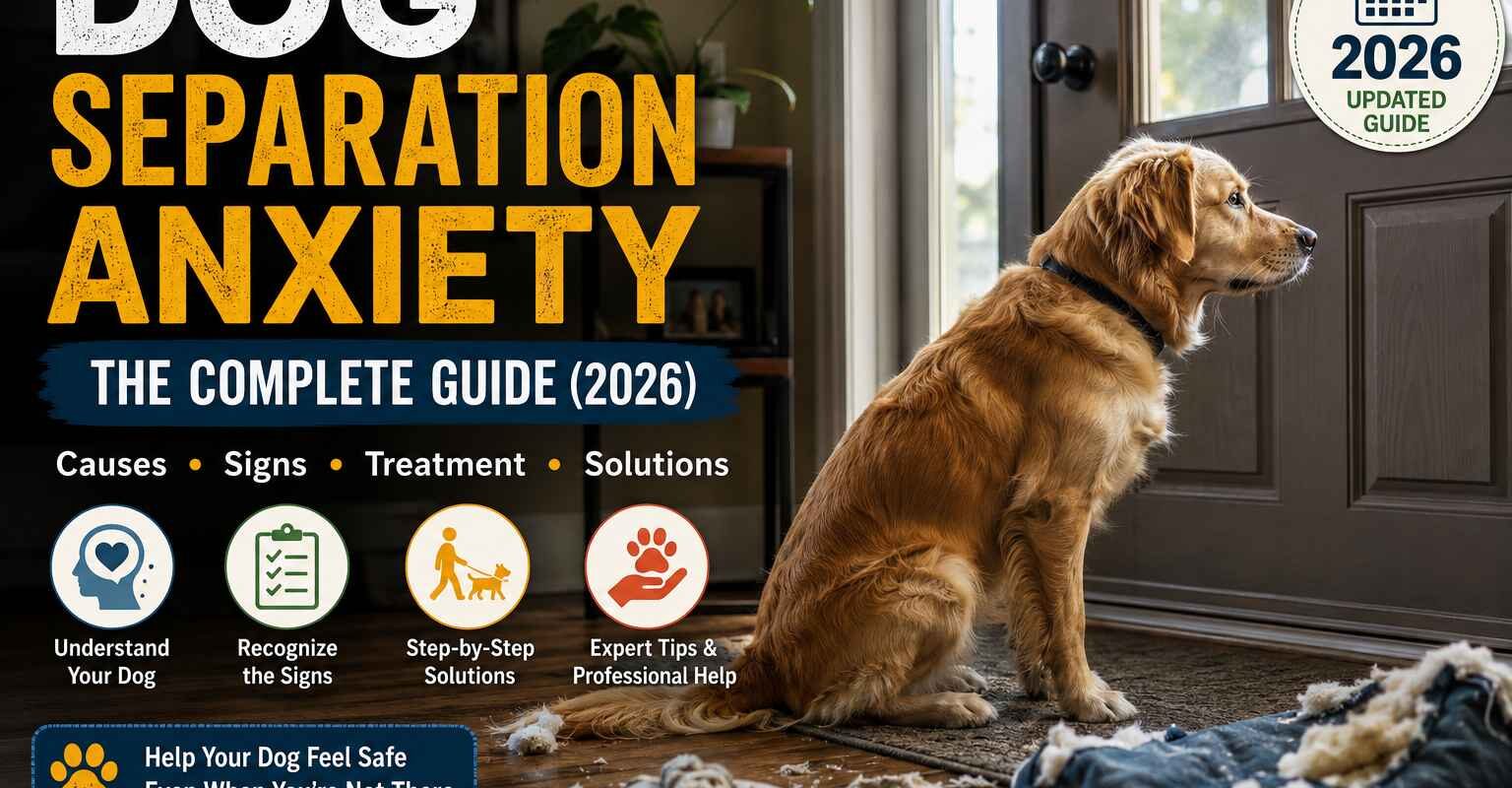
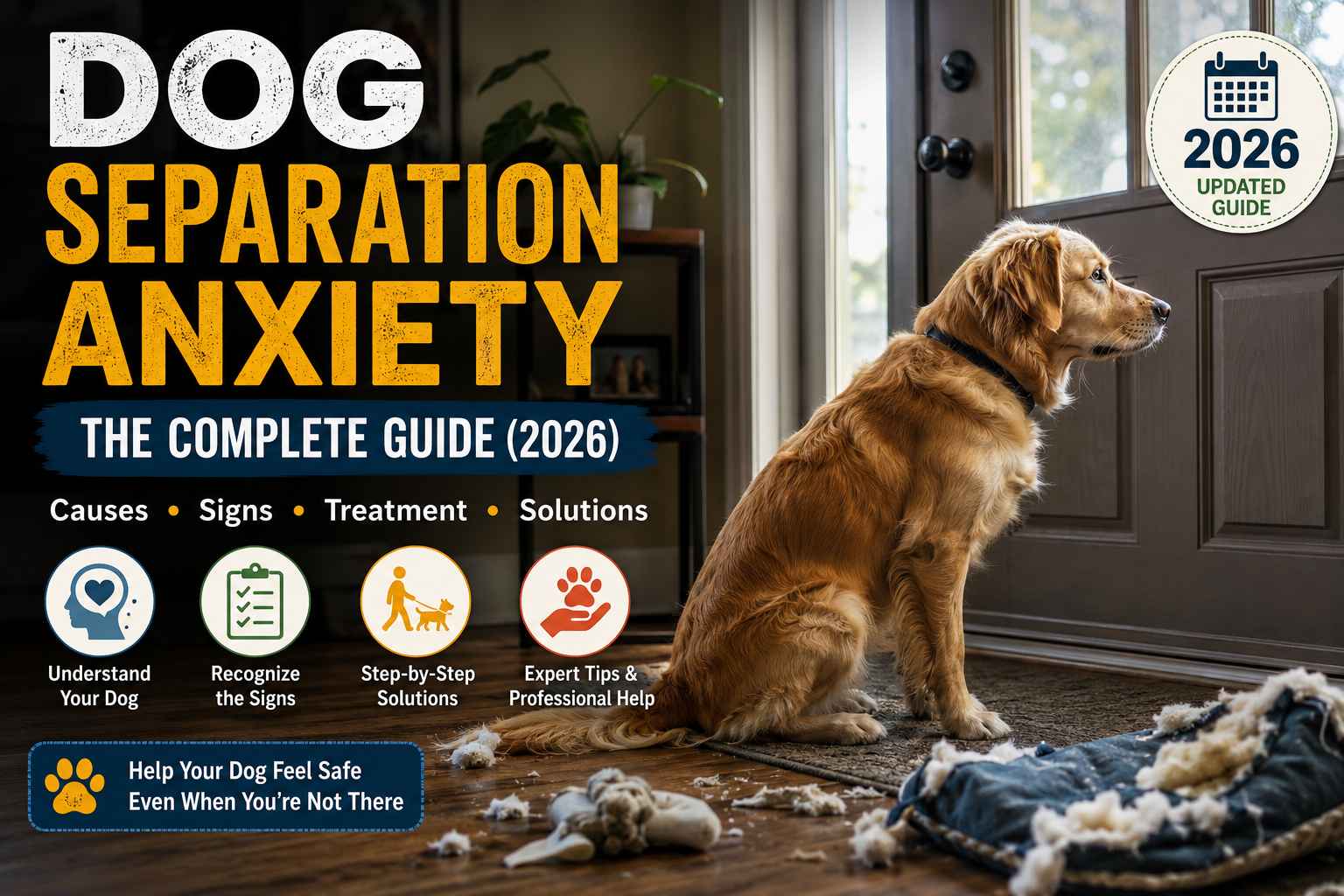
Dog Separation Anxiety: The Complete Guide (2026)
Your dog tears apart the sofa cushion the moment you leave. Or howls until a neighbour knocks on your door. Or trembles visibly as soon as you pick up your car keys. You come home to chaos — and guilt — and you are not sure whether this is a training problem, a health issue, or something far deeper.
Dog separation anxiety is real, it is distressing for your dog, and it is one of the most misunderstood conditions in pet ownership. The good news: it is also one of the most treatable, when you understand what is actually happening and how to respond.
This guide covers everything you need to know in 2026 — from recognising the early signs to choosing between desensitisation training and medication, from helping a newly adopted rescue dog to knowing which certified professional to call in your country. Whether you are in the United States, the United Kingdom, Canada, Australia, or New Zealand, you will find clear, honest, sourced guidance here.
The one thing we will not do: overstate simple solutions or promise a quick fix. Separation anxiety takes time and consistency. But dogs improve every day when owners understand the real problem.
⚡ Quick Answer: What Is Dog Separation Anxiety?
Dog separation anxiety is a behavioural condition in which a dog experiences significant distress — not just mild sadness — when left alone or separated from their primary attachment figure. It is not disobedience. It is closer to a panic response. Signs include persistent barking, destructive behaviour near exits, indoor accidents in a house-trained dog, and frantic escape attempts. It typically peaks within the first 30–40 minutes after you leave. Treatment combines behaviour modification (gradual desensitisation) with environmental management, and sometimes veterinary-prescribed medication for moderate to severe cases.
What Is Dog Separation Anxiety — and What It Is Not
The word “anxiety” gets used loosely, and that matters when you are trying to decide what your dog actually needs. Not all unsettled behaviour when you leave the house is separation anxiety. Knowing the difference saves you from months of misdirected effort.
True Separation Anxiety vs. Normal Behaviour
According to the ASPCA, true separation anxiety is triggered specifically by separation from the people a dog is attached to. The dog is not simply bored or mischievous — they are in genuine distress. A bored dog might gradually chew on a toy or investigate the bin at some point during the day. A dog with separation anxiety is typically frantic within the first 30–40 minutes you are gone, focused on exit points, and unable to settle at all.
One practical test: set up a phone or camera to record the first 45 minutes after you leave. A dog simply bored or under-stimulated will usually be relatively calm, moving around and exploring. A dog with separation anxiety will pace, whine, bark, scratch at the door, or show physiological signs of stress like heavy panting and drooling — behaviours that are hard to attribute to anything other than distress at being alone.
Separation Anxiety vs. Incomplete Training
Before reaching for a clinical label, rule out the basics. Has your dog truly learned good indoor manners, or have they never been taught what is expected when alone? Are they fully house-trained? An untrained puppy who chews and has accidents when unsupervised is not the same as a dog who is panicking. The American Kennel Club advises checking whether the dog shows multiple symptoms consistently every time you leave, or whether the behaviour is occasional and exploratory in nature.
Other Conditions That Look Similar
Several medical conditions can produce behaviour that mimics separation anxiety. PetMD notes that pain from arthritis can cause restlessness, and urinary tract infections or other health problems can cause accidents in an otherwise house-trained dog. This is why a veterinary check is always the first step — not to embarrass your dog with a diagnosis, but to rule out anything treatable that might be driving the behaviour.
📹 The Camera Test
Recording your dog during the first 45–60 minutes after you leave is one of the most actionable steps you can take right now. Set up a phone, a pet camera, or even just a laptop with the lid up and camera facing the room. Watch the footage when you return. You will see very quickly whether you are dealing with panic or simple restlessness — and it gives your vet or behaviourist the most important evidence they can use.
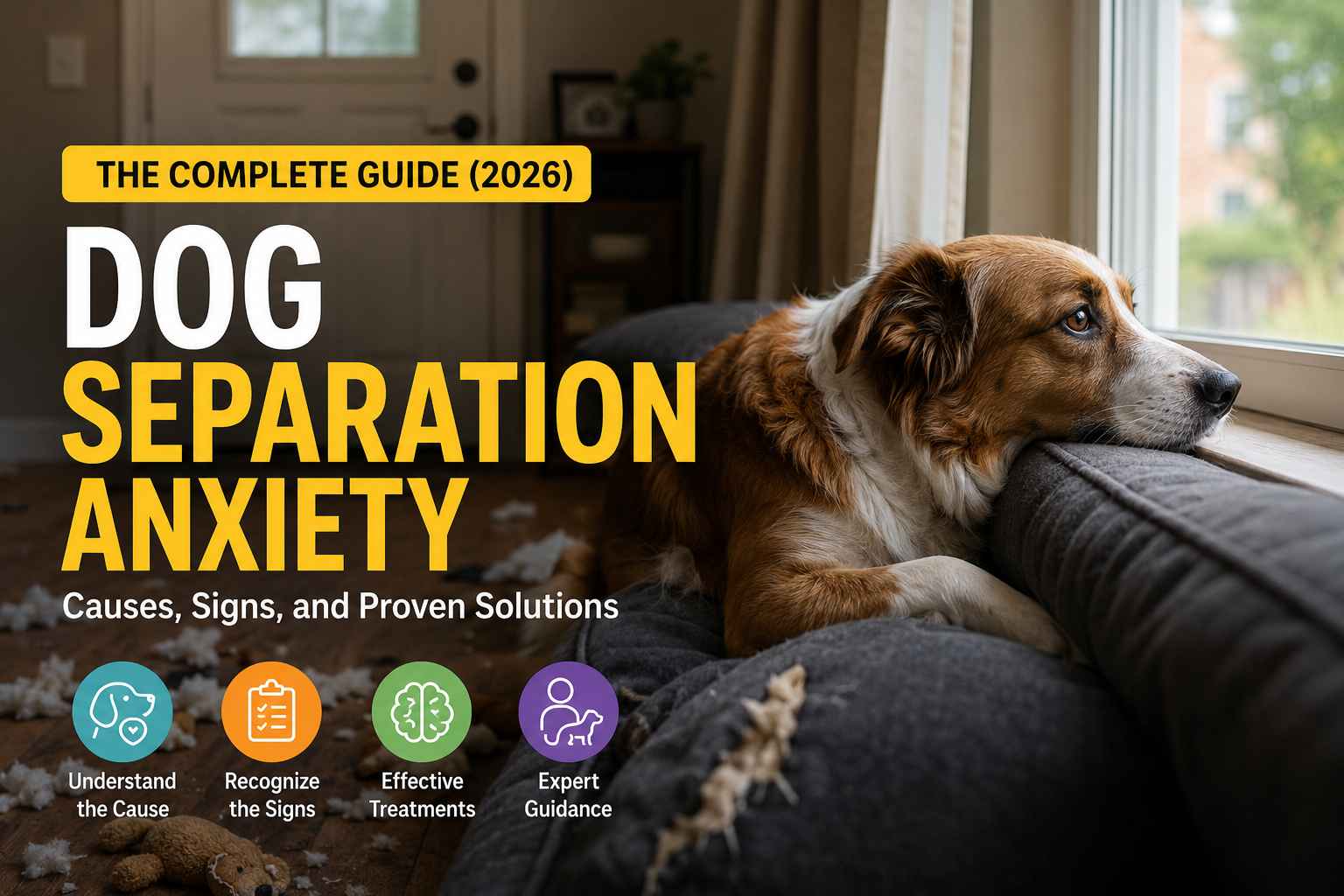
Signs and Symptoms: From Mild to Severe
Separation anxiety does not look the same in every dog. Some dogs whine and pace; others become destructive or injure themselves trying to escape. Knowing where your dog sits on the spectrum matters, because the treatment approach changes significantly between mild and severe cases.
According to Veterinary Partner (VIN), the peak intensity of separation-related behaviours typically occurs shortly after the owner leaves — not hours into the absence. This distinguishes anxiety from boredom, which tends to build gradually through the day.
- Brief whining when you leave
- Restlessness for 15–30 mins
- Occasional accidents
- Mild pacing near exits
- Settles on their own
- Persistent barking or howling
- Destructive chewing near exits
- Frequent indoor accidents
- Panting, drooling, trembling
- Does not settle without returning
- Frantic escape; self-injury
- Breaking through windows or crates
- Severe destructive behaviour
- Won’t eat even favourite treats
- Panic starts before you leave
Pre-Departure Anxiety: When It Starts Before You Leave
One of the most telling signs of separation anxiety is that the distress begins before you even step out of the door. Your dog may start pacing, panting, or whining the moment you pick up your keys, put on your coat, or reach for your bag. According to the ASPCA, dogs with predeparture anxiety can become so sensitised to these cues that they are already in a heightened state of distress well before you physically leave.
Behaviours That Are Often Misread
The RSPCA (UK) notes that research suggests as many as eight out of ten dogs find it hard to cope when left alone — but around half of them will show no obvious signs while the owner is present. This means an owner can genuinely be unaware of the problem until a neighbour reports the barking or they happen to check a camera. The dog who seems perfectly relaxed when you are home may be miserable when you are not.
A few signs that are often missed because they seem subtle: yawning repeatedly as you prepare to leave, losing interest in food, licking lips, low-grade whining that stops when you come back, or appearing unusually subdued the rest of the day after an anxious episode.
Why Dogs Develop Separation Anxiety
There is no single agreed cause of dog separation anxiety. What the research does show is a set of risk factors and triggering circumstances — some of which are within your control, and some of which are not.
Factors That Increase Risk
A 2020 review published in the journal Veterinary Medicine: Research and Reports (via PubMed Central) found that dogs are more likely to develop separation-related behaviour problems if they are male, sourced from animal shelters, or were separated from their litter before 60 days of age. Dogs in apartments and those in households with no children also appeared at higher risk. The review notes, however, that research in this area is sometimes equivocal — these are risk associations, not certainties.
The ASPCA lists the following life changes as commonly associated with the development of separation anxiety: being surrendered to a shelter or rehomed; an abrupt change in schedule (for example, an owner who had been working from home returning to office work); a change in family membership through divorce, death, or a child leaving home; and moving to a new home.
The Role of Routine Changes
Dogs are highly attuned to routine. When the predictable rhythms of a household shift — especially where the owner’s presence is concerned — anxiety can follow. One frequently observed pattern in recent years was the surge in separation anxiety cases when owners who had been working from home during periods of extended leave returned to their offices. The dog had adapted to almost constant human presence, and the sudden shift felt overwhelming.
⚠️ Note on Breed Claims
While some sources suggest certain breeds are more prone to anxiety (Border Collies, German Shepherds, and Chihuahuas are frequently mentioned), current behavioural science does not fully support breed-specific predictions. Any dog, of any breed or mix, can develop separation anxiety. Breed tendencies around attachment and sensitivity may play a role, but individual history and environment appear to be more important factors.
When It Appears With No Obvious Trigger
Some dogs develop separation anxiety without any obvious life event. According to Veterinary Partner, some dogs have trouble being alone from a very early age and develop the condition despite never going through any major upheaval. It is also worth noting that if left untreated, the condition tends to worsen over time rather than resolving on its own.
Rescue Dog Anxiety: What’s Different
Adopting a rescue dog is one of the most rewarding things you can do. It is also one of the most likely paths to encountering separation anxiety. Understanding why — and why it often goes undetected until the dog arrives in your home — can save you a lot of confusion and frustration.
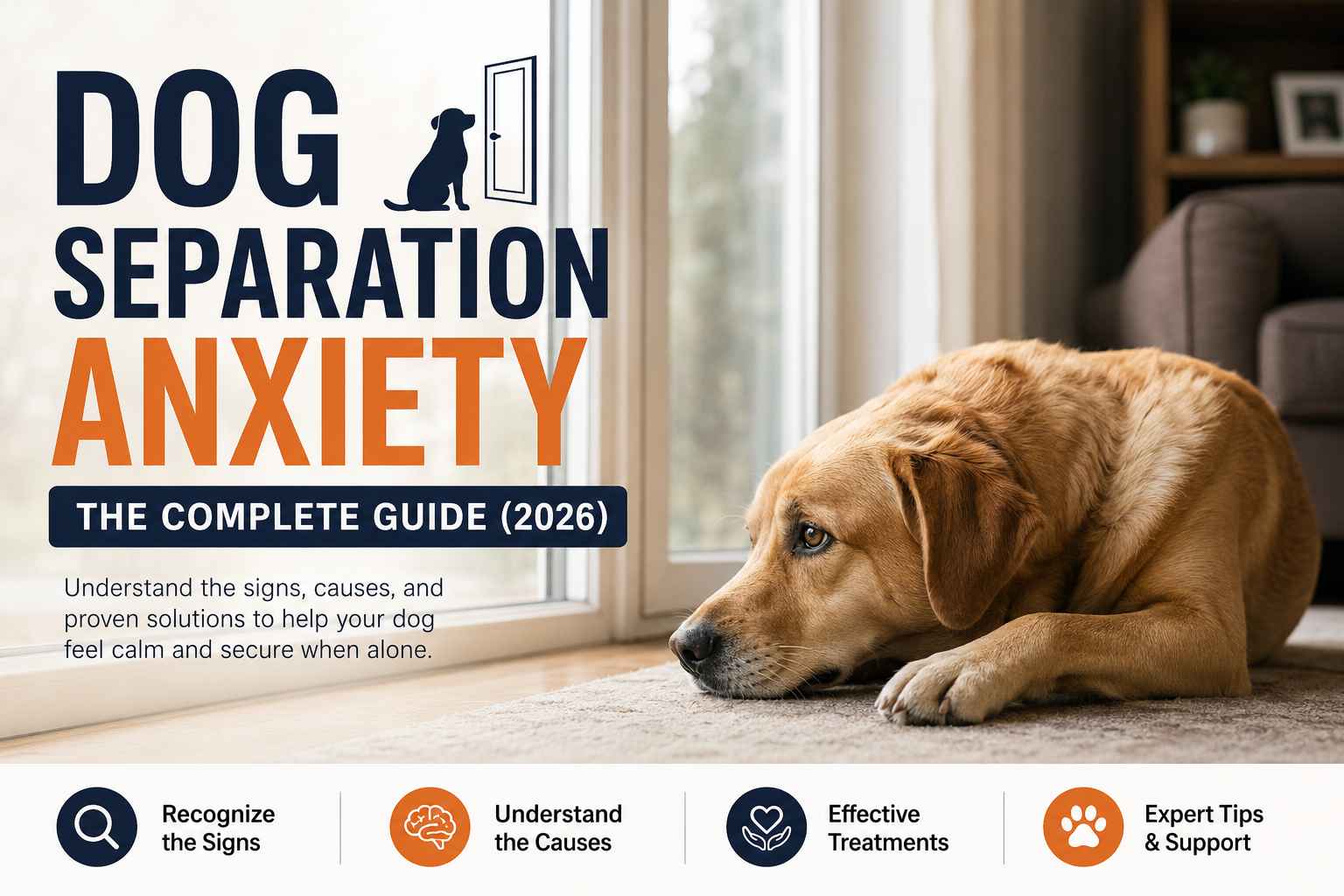
Why Shelters Often Cannot Predict It
The behaviour of a dog in a shelter environment is heavily shaped by that environment. As Home Alone Canine notes, shelter stress — the constant noise, smell, and disruption of kennels — can suppress or mask the kinds of behaviours that signal separation anxiety. Some dogs shut down entirely as a coping mechanism. Others show intense stress in the kennel that disappears in a home setting. Neither pattern tells you reliably what the dog will do when left alone in a quiet house.
Why Rescue Dogs Are at Higher Risk
The ASPCA notes that there is no conclusive evidence about exactly why some dogs develop separation anxiety while others do not. However, dogs adopted from shelters are affected at a far higher rate than dogs kept by a single family from puppyhood. The loss of a trusted person or familiar environment is believed to play a significant role.
For a rescue dog, what looks like “gratitude” in the first days — following you everywhere, pressing close, never wanting to leave your side — can actually be an early sign of over-attachment that will become difficult when you eventually leave. This is not a reason not to comfort your new dog; connection is important. But it is a reason to begin building healthy independence early.
The “Honeymoon” Period and What Comes After
Many owners report that their rescue dog seemed to do fine in the first days, then became dramatically more anxious after the first week or two. This is common. In the initial period, the dog may be too overwhelmed — or too in shock — to display full anxiety. As they settle in and begin to form attachment to you, the prospect of you leaving becomes genuinely threatening. The Houston SPCA advises that rescue owners should start building independent alone-time in small, positive increments from day one — before the first full absence.
What to Do First With a New Rescue
Record the first several times you leave your rescue dog alone — even for a few minutes. Compare the footage. Begin with very short absences (30 seconds to a few minutes) and a high-value treat or puzzle toy, and build up gradually. Contact your vet within the first month, especially if distress behaviours are visible, so you can get early professional guidance and rule out any physical health concerns.
How to Treat Dog Separation Anxiety
Treatment for dog separation anxiety is not one-size-fits-all. Mild cases can often be managed with consistent home-based techniques. Moderate to severe cases almost always require professional guidance and sometimes medication. Here is how the evidence-based approach works.
Step 1: Rule Out Medical Causes First
Before starting any behaviour programme, visit your vet. According to PetMD, your veterinarian may run blood work, urine tests, and hormonal panels to rule out conditions that can mimic anxiety symptoms — including thyroid problems, urinary tract infections, and pain conditions. This step is not optional; it protects your dog and ensures you are treating the right problem.
Step 2: Desensitisation to Predeparture Cues
If your dog shows signs of distress before you even leave — pacing, whining, trembling as you put on your shoes or pick up your keys — the ASPCA recommends breaking the predictive power of those cues first. Do this by performing departure actions (picking up keys, putting on a coat) but then not leaving — sit back down, make tea, watch television. Over many repetitions across several weeks, these cues stop reliably predicting your departure and your dog’s anxiety around them decreases.
Step 3: Graduated Departures
This is the core treatment technique: starting with absences so short they produce no anxiety at all — sometimes just a few seconds — and then building up the duration very slowly. The ASPCA notes that most separation-related distress occurs within the first 40 minutes, so reaching that threshold gradually is the critical phase. Progress may mean extending absence by only a few seconds per session, or every couple of sessions, depending on how your dog tolerates each level.
Once your dog can tolerate 40 minutes alone without visible distress, the ASPCA advises that they can usually begin to tolerate four or more hours, and that extensions can then come in larger increments. This process can take several weeks of daily sessions — longer if the anxiety is more severe.
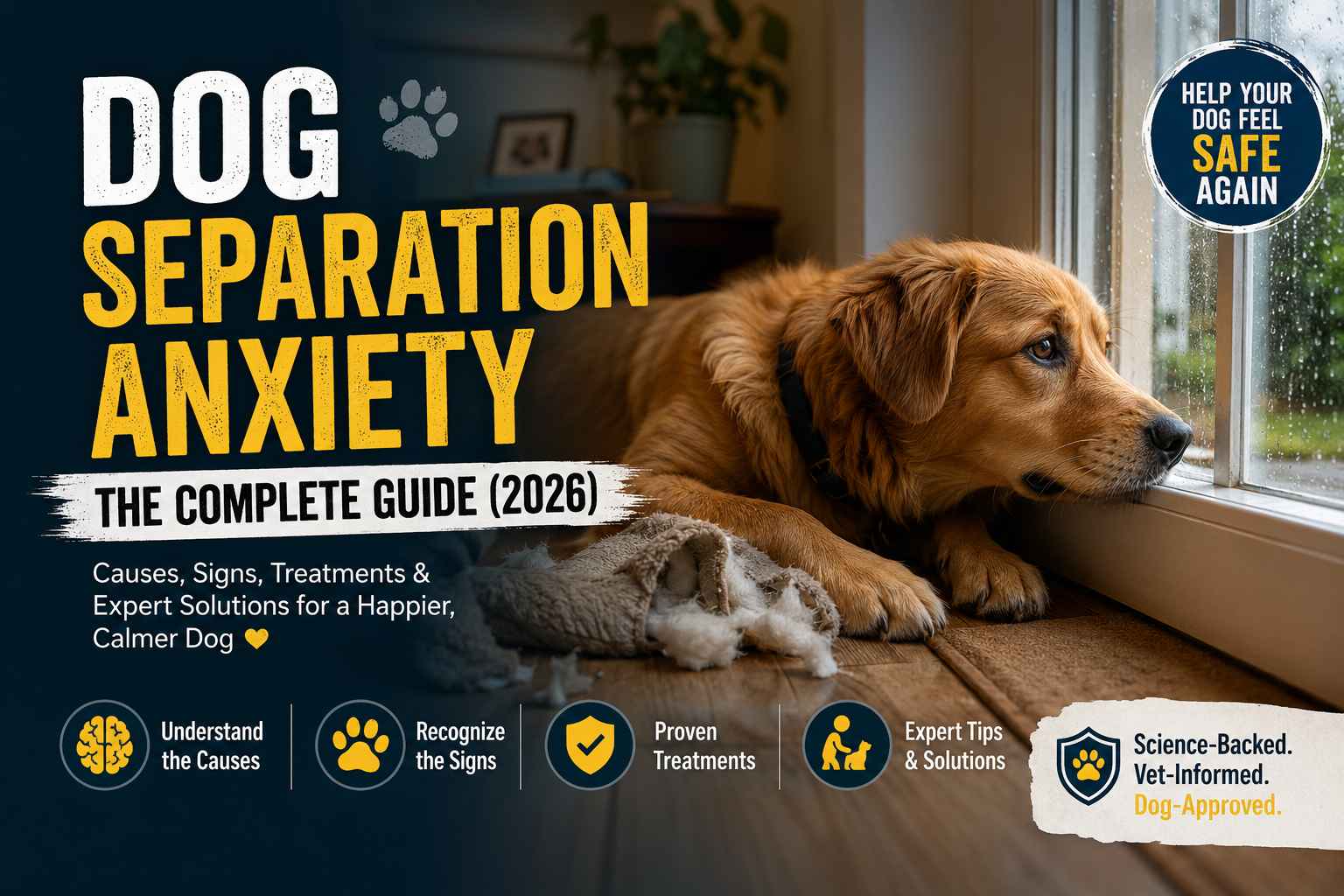
Step 4: Counterconditioning — Changing the Emotional Association
Counterconditioning is used alongside desensitisation to shift how the dog feels about being alone. Instead of departure predicting panic, departure begins to predict something genuinely pleasurable — typically a puzzle toy, a stuffed KONG, or frozen treats that the dog only receives when left alone. The ASPCA notes this approach works well for mild cases but is less effective for moderate to severe anxiety, because a highly anxious dog will often refuse to eat at all once alone.
To Crate or Not to Crate?
Many owners assume that crating a dog with separation anxiety will keep them safe and prevent destruction. In most cases, this makes the problem significantly worse. The ASPCA advises clearly that if a dog shows distress during crate training — frantic escape attempts, persistent howling, excessive panting — confinement in a crate is not appropriate. A better option is a larger space such as one room, gated off, where the dog cannot access exit points but is not rigidly confined. Some dogs do find a crate genuinely calming if it has been introduced positively and is associated with safety — but this is not the norm for a dog already in a state of panic.
Exercise, Enrichment, and Routine
Physical exercise and mental stimulation are not cures for separation anxiety, but they support every other intervention. A dog who has had a walk and some mental engagement before being left alone is better positioned to settle than one who has had neither. Puzzle feeders, sniff games, and training sessions all help reduce the baseline stress level. A consistent daily routine — predictable feeding, walking, and rest times — gives anxious dogs additional security.
🕐 Be Realistic About Timelines
There is no standard timeline for treating separation anxiety. Mild cases with consistent work may show improvement in a few weeks. Moderate to severe cases typically require months of daily training. Treating it as a long-term project, not a quick training fix, is the most realistic and ultimately most successful mindset. Celebrate incremental progress: ten minutes alone calmly is genuinely meaningful progress for a dog who couldn’t manage thirty seconds.
How to Stop Dog Barking Caused by Anxiety
Barking that is driven by separation anxiety is one of the most distressing aspects of the condition — for your dog, for you, and often for your neighbours. It is also one of the most commonly mishandled. Understanding why the standard advice (“ignore the barking” or “punish them when you return”) does not work helps you avoid the approaches that make things worse.
Why Barking Won’t Respond to Punishment
Separation anxiety barking is not a deliberate choice or a bid for attention in the conventional sense. It is a distress vocalisation from a dog who genuinely cannot cope with being alone. Shouting at, punishing, or ignoring a dog in this state does not teach them to be calm — it adds an additional source of fear (the owner’s anger or unpredictability) to an already frightening situation, and typically worsens the behaviour over time. The RSPCA advises that even showing disappointment when you return home can increase your dog’s anxiety about your next departure.
What Actually Works for Anxiety-Driven Barking
The underlying treatment is always the same: desensitisation and counterconditioning (see the treatment section above). The barking stops when the dog’s emotional state changes — when being alone stops triggering a panic response. There is no shortcut to this. Tools like citronella collars, noise devices, or barking suppressants address the symptom but not the cause, and may add further stress. For a dog who is already in distress, adding a punishment contingency to barking can create additional fear responses and compound the problem.
Practical interim measures that can reduce the intensity (not cure) while training is in progress include background radio or television at low volume, which reduces the stark contrast between your-being-home sounds and silence; and the use of calming pheromone products (DAP/Adaptil diffusers). The VCA Animal Hospitals resource on separation anxiety notes that pheromone products may have some calming effect, though evidence is mixed and they should be used alongside, not instead of, behaviour modification.
Practical Interim Steps While You Train
While you work through desensitisation, there are also practical management steps that can reduce the impact on neighbours and landlords. If possible, arrange for a dog walker, friend, neighbour, or doggy day-care to cover the longest absences while your dog is still unable to manage them. Be honest with neighbours about what you are working on. Keeping absences within your dog’s current tolerance threshold — even if this is inconvenient — is the only way to prevent the anxiety from deepening during the training period.
When to Consider Medication
Medication for separation anxiety is not a shortcut or a sign of failure. For moderate to severe cases, it is often the thing that makes behaviour training possible in the first place — by reducing the dog’s baseline anxiety enough that they can actually learn from the gradual desensitisation process.
FDA-Approved Options (USA) and Equivalents Elsewhere
According to the Merck Veterinary Manual, two medications are approved by the US FDA specifically for canine separation anxiety when used as part of a comprehensive behaviour management programme: fluoxetine (an SSRI, available under the brand name Reconcile in the USA) and clomipramine (a tricyclic antidepressant, available under the brand name Clomicalm). Both require a veterinary prescription.
These are not sedatives. They work by modifying brain chemistry over time — typically taking four to six weeks to reach their full effect. As PetMD explains in its guide to Clomicalm, the medication helps reduce the anxiety associated with separation rather than simply making the dog drowsy or suppressed. This means they still need behaviour training alongside the medication.
In June 2026, the US FDA approved the first generic form of clomipramine hydrochloride tablets for canine separation anxiety — potentially making this treatment more accessible for dog owners in the USA. In the UK, Canada, Australia, and New Zealand, equivalent medications are available by prescription from a veterinarian; consult your vet about what is approved or commonly used in your region.
Situational / Short-Term Medications
Alongside longer-term medications, some veterinarians prescribe shorter-acting medications for specific predictably anxiety-provoking situations. According to veterinary behaviourist guidance reported by dvm360, options like trazodone and certain benzodiazepines can be used for short-term situations while longer-term treatment is established. These should only ever be used under veterinary direction.
⚠️ Never Self-Medicate Your Dog
Human medications — even those with similar names to veterinary formulations — can be dangerous or fatal for dogs at incorrect doses. Never give your dog any prescription medication without direct veterinary guidance. This includes over-the-counter sedatives or supplements intended for human use.
Finding Professional Help by Country
For moderate to severe separation anxiety, professional guidance is not a luxury — it is a necessary part of effective treatment. Desensitisation and counterconditioning are difficult to carry out without expert support because they must be calibrated precisely to the individual dog’s reactions. Progressing too fast sets the training back; professional eyes help you read your dog accurately.
Your first call should always be your veterinarian. They can rule out medical causes, prescribe medication if appropriate, and refer you to a qualified behaviourist. Below is a guide to the professional bodies and credentials to look for in each of our five target countries. Always verify that a specific trainer or behaviourist holds a current credential from the stated body before booking.
| Country | Who to Look For | Where to Search |
|---|---|---|
| 🇺🇸 USA | CPDT-KA (Certified Professional Dog Trainer – Knowledge Assessed) via CCPDT; or a Certified Applied Animal Behaviourist (CAAB) or board-certified veterinary behaviourist (DACVB) for complex cases | ccpdt.org · iaabc.org |
| 🇬🇧 UK | IMDT-qualified trainer (Institute of Modern Dog Trainers) or an ABTC-registered Clinical Animal Behaviourist for behaviour cases | imdt.uk.com |
| 🇨🇦 Canada | CPDT-KA (the CCPDT exam is available in Canada); PPG-affiliated trainers committed to force-free methods | ccpdt.org · petprofessionalguild.com |
| 🇦🇺 Australia | PPGA member trainer (Pet Professional Guild Australia) committed to science-based, force-free methods; or vet-referred veterinary behaviourist | ppgaustralia.net.au |
| 🇳🇿 New Zealand | Referral via your vet to a registered veterinary behaviourist (VCNZ register); PPG-affiliated trainers also operate in NZ | nzva.org.nz · petprofessionalguild.com |
Note: The RSPCA in Australia and the RSPCA in the UK are separate organisations with independent governance and guidance. Always check with your local organisation for country-specific recommendations.
🔬 What Recent Research Shows (2026 Update)
A peer-reviewed review published in Veterinary Medicine: Research and Reports and indexed on PubMed Central identified systematic desensitisation and counterconditioning (DSCC) as the most effective behavioural treatment currently available for canine separation-related problems. The same review noted that behaviour modification can be enhanced when combined with appropriate medication in moderate to severe cases.
Research on risk factors has identified that dogs separated from their litter before 60 days of age show higher rates of separation-related behaviour problems. The review also found evidence that certain protective factors may reduce risk: socialising puppies widely with different people and environments between the ages of approximately 5 and 10 months, maintaining stable household routines, and avoiding punishment-based training methods.
In June 2026, the US FDA approved the first generic form of clomipramine hydrochloride tablets for treating canine separation anxiety — as reported by dvm360. This widens access to one of the two FDA-approved pharmacological treatments, which may reduce cost for owners in the USA.
A large Finnish study published in Scientific Reports and indexed on PubMed, which surveyed over 13,700 dogs, found separation-related behaviour to be among the most common anxiety presentations in pet dogs. The study also noted high rates of comorbidity — dogs with separation anxiety frequently also showed hyperactivity, compulsive behaviour, or sensitivity to noise. This comorbidity pattern underlines why professional assessment is important: treating only one aspect of a more complex anxiety profile is unlikely to result in lasting improvement.
Research is ongoing in several areas, including the role of the human-animal attachment bond, the effectiveness of remote training methods, and better diagnostic tools. The current evidence base supports behaviour modification as the primary treatment — but the field continues to develop. As always, guidance from a qualified professional familiar with current evidence is preferable to following generalist internet advice alone.
6 Common Mistakes Owners Make
Your dog cannot connect punishment delivered minutes after the fact to what they did while you were away. What they register is that your return — which was supposed to be safe and positive — is now unpredictable and scary. This increases their anxiety about future departures.
For most dogs with separation anxiety, confinement to a crate intensifies distress rather than creating safety. Dogs can injure themselves badly — broken teeth, cut paws, even cardiac stress — attempting to escape from a small enclosure while in a state of panic.
A tired dog is not necessarily an anxiety-free dog. While physical exercise genuinely helps support treatment and reduces baseline stress, it does not address the core fear response that drives separation anxiety. Dogs who have been thoroughly exercised can still panic when left alone.
Owners are naturally impatient to leave for longer periods. But extending absences faster than the dog can tolerate causes the anxiety response to spike, and the training effectively resets. Progress that takes weeks can be undone in a single session that pushes beyond the dog’s threshold.
This is one of the most common well-meaning suggestions that often backfires. Separation anxiety is about attachment to a person, not about loneliness in the abstract. A second dog can reduce boredom in some mild cases, but for a dog with true separation anxiety, the problem typically persists regardless of whether another dog is present.
Separation anxiety symptoms overlap with a range of medical conditions — from pain and urinary tract infections to thyroid dysfunction. Beginning an intensive behaviour programme without ruling out a physical cause can mean months of effort that addresses the wrong problem.
Evidence-Based Recommendations for Dog Owners
Rule out medical causes before starting any behaviour programme. Your vet is also the gateway to prescription medication for moderate to severe cases, and can refer you to a qualified behaviourist.
Set up a camera or phone to capture the first 45–60 minutes after you leave. This is the most valuable diagnostic tool you have — and it shows you exactly where to focus your training efforts.
Find the threshold at which your dog shows absolutely no anxiety when left (even if that is only 5 or 10 seconds), and start there. Build up only when they are consistently calm at each level — not when you feel they “should” be ready.
Puzzle feeders, sniff games, and regular training sessions reduce baseline stress and provide a more stable emotional platform for treatment. These help but do not replace graduated desensitisation.
Predictable feeding, walking, and rest times help anxious dogs feel safer. Erratic schedules — especially variable departure times — can maintain or worsen anxiety by making your movements unpredictable.
The ASPCA explicitly states that desensitisation and counterconditioning are complex to carry out correctly, and that fear must be avoided or the process will backfire. A qualified behaviourist protects your progress and your dog.
For dogs whose anxiety is so severe that they cannot engage with training at all, medication may be the bridge that makes behaviour modification possible. It is not a last resort — in severe cases, it is often a first step.
Separation anxiety treatment is genuinely one of the more challenging things to work through as a dog owner. It requires time, consistency, and often sacrifice of convenience. Progress is real even when it feels slow. Your dog’s quality of life — and yours — improves every step of the way.
Frequently Asked Questions
What are the first signs of separation anxiety in dogs?
The earliest signs often appear before you even leave the house. Watch for pacing, panting, whining, or following you from room to room as you pick up your keys or put on your shoes. Once alone, common signs include persistent barking or howling, destructive chewing near doors and windows, indoor accidents in an otherwise house-trained dog, and frantic escape attempts.
Recording your dog with a phone or camera during the first 30–60 minutes after you leave is one of the most reliable ways to see what is actually happening. Many owners discover the behaviour is more or less severe than they imagined.
How do I stop my dog from barking when I leave?
Barking caused by separation anxiety is not a simple obedience problem — punishing your dog after the fact, or shouting at them before you leave, will make the anxiety worse by adding another source of fear. The most evidence-backed approach is desensitisation and counterconditioning: starting with very short departures (even just seconds), pairing your departure cues with high-value treats, and very gradually building up time away.
For mild cases, a stuffed puzzle toy may help bridge short absences. For moderate to severe anxiety-driven barking, the ASPCA recommends working with a certified behaviourist, because the training process must progress according to the individual dog’s reactions.
Is my rescue dog’s behaviour normal or is it separation anxiety?
Some distress when a rescue dog first settles in is completely normal — they are adjusting to a new environment, routine, and family. Normal adjustment usually improves within a few weeks as the dog settles. True separation anxiety tends to remain intense, often peaking within the first 30–40 minutes you are gone, and does not improve on its own without a structured behaviour plan.
A vet visit and a video of your dog’s behaviour while alone will help distinguish between general adjustment stress and clinical separation anxiety. The sooner this is assessed, the earlier effective support can begin.
How long does it take to treat dog separation anxiety?
There is no fixed timeline, and anyone who promises a quick fix should be approached with caution. Mild cases treated consistently can show meaningful improvement within a few weeks. Moderate to severe cases typically require months of daily training, and some dogs benefit from long-term management rather than a complete resolution.
Progress depends on the severity of the dog’s anxiety, their individual history, the consistency of the training, and whether medication is used alongside behaviour modification. Setting realistic expectations and celebrating small steps forward makes the process more sustainable for both dog and owner.
Should I crate my dog if they have separation anxiety?
Crating is generally not recommended for dogs with separation anxiety. For a dog already experiencing panic, confinement in a crate intensifies distress and significantly increases the risk of self-injury — broken teeth from biting the bars, cut and scraped paws from frantic scratching, and in severe cases, more serious harm.
The ASPCA advises that if a dog shows signs of distress during crate training (frantic escape attempts, persistent howling, excessive panting or drooling), confinement is not the right option. A safer alternative is confining the dog to one room behind a baby gate, where they have space to move but cannot reach exit points.
Can medication help a dog with separation anxiety?
Yes, in moderate to severe cases. Two medications are FDA-approved in the USA for canine separation anxiety when used alongside a behaviour plan: fluoxetine (Reconcile) and clomipramine (Clomicalm). According to the Merck Veterinary Manual, these typically take four to six weeks to reach full effect. They are not sedatives — they reduce baseline anxiety enough for training to be effective.
Equivalent medications are available by prescription in the UK, Canada, Australia, and New Zealand. Medication should always be prescribed and monitored by a veterinarian and used as part of a comprehensive treatment plan, not as a standalone solution.
What is the difference between separation anxiety and boredom in dogs?
The timing and intensity of the behaviour is usually the key clue. Boredom tends to produce relatively calm, exploratory destructive behaviour — a dog may gradually chew something or knock over the bin at some point during the day. Separation anxiety behaviour is intense, typically focused near exit points (doors and windows), and peaks within the first 30–40 minutes after the owner leaves.
A bored dog on camera will appear relatively settled much of the time; an anxious dog often shows continuous panting, pacing, whining, or frantic movement. Camera footage of the first hour alone is the most reliable tool for telling the difference.
How do I find a qualified dog behaviourist for separation anxiety?
Always start with your own vet, who can rule out medical causes and provide a referral. For qualified trainers and behaviourists by country:
USA: CPDT-KA via ccpdt.org, or a CAAB / veterinary behaviourist via iaabc.org. UK: IMDT-qualified trainer at imdt.uk.com. Canada: CPDT-KA (ccpdt.org) or PPG members at petprofessionalguild.com. Australia: PPGA members at ppgaustralia.net.au. New Zealand: Vet referral to a VCNZ-registered veterinary behaviourist via nzva.org.nz.
Conclusion: Your Dog Can Get Better
Dog separation anxiety is not a character flaw, a sign of bad ownership, or a permanent sentence. It is a condition — one that responds to the right combination of patience, consistency, and professional support.
The most important things to take away from this guide: your veterinarian is your first stop, not your last. Recording your dog while alone is the cheapest and most diagnostic thing you can do today. Desensitisation and counterconditioning work — but they require you to meet your dog where they are, not where you wish they were. Punishment worsens the problem. Medication is a legitimate and evidence-based tool, not a shortcut or a failure. And whatever country you are in, there are certified professionals who specialise in exactly this.
Progress with separation anxiety is often slow and non-linear. There will be good weeks and bad weeks. But the direction of travel, with the right approach, is consistently towards a calmer, more confident dog — one who can be alone without it being a crisis, and come back to you happily when you return.
If you are early in this journey, be gentle with yourself and your dog. What you are working through is genuinely hard. What you are working towards is genuinely worth it.
If you found this guide helpful, consider sharing it with other dog owners who might be struggling with the same issue. For questions specific to your dog’s situation, please consult your veterinarian or a qualified behaviourist in your area.
– Breed-Specific Dog Care: The Ultimate Guide (2026)
– Senior Dog Nutrition & Joint Care: The 2026 Owner’s Guide
– Pet Supplements & Wellness: The Complete 2026 Guide
– Probiotics for Dogs: The Complete 2026 Gut Health Guide
References
- ASPCA — Separation Anxiety — American Society for the Prevention of Cruelty to Animals — 2026 — https://www.aspca.org/pet-care/dog-care/common-dog-behavior-issues/separation-anxiety
- American Kennel Club — Separation Anxiety in Dogs: Causes, Prevention, and How to Solve It — AKC — 2025 — https://www.akc.org/expert-advice/training/dog-separation-anxiety/
- PetMD — Separation Anxiety in Dogs — PetMD — 2025 — https://www.petmd.com/dog/conditions/behavioral/separation-anxiety-dogs
- Merck Veterinary Manual — Behavior Problems of Dogs — Merck — 2025 — https://www.merckvetmanual.com/behavior/behavior-of-dogs/behavior-problems-of-dogs
- VCA Animal Hospitals — Separation Anxiety in Dogs — VCA — (current) — https://vcahospitals.com/know-your-pet/separation-anxiety-in-dogs
- Veterinary Partner (VIN) — Separation Anxiety: The Fear of Being Alone — VIN — (current) — https://veterinarypartner.vin.com/default.aspx?pid=19239&id=10375180
- RSPCA UK — Separation-Related Behaviour in Dogs — RSPCA — (current) — https://www.rspca.org.uk/adviceandwelfare/pets/dogs/behaviour/separationrelatedbehaviour
- Blackwell, E.J. — Canine separation anxiety: strategies for treatment and management — Veterinary Medicine: Research and Reports — PubMed Central — 2020 — https://pmc.ncbi.nlm.nih.gov/articles/PMC7521022/
- Salonen, M. et al. — Prevalence, comorbidity, and breed differences in canine anxiety in 13,700 Finnish pet dogs — Scientific Reports — PubMed Central — 2020 — https://www.ncbi.nlm.nih.gov/pmc/articles/PMC7058607/
- FDA Center for Veterinary Medicine — FDA Approves First Generic Clomipramine Hydrochloride Tablets to Treat Separation Anxiety in Dogs — US FDA — (current) — https://www.fda.gov/animal-veterinary/cvm-updates/fda-approves-clomipramine-hydrochloride-tablets-treat-separation-anxiety-dogs
- dvm360 — Just Approved: Generic Clomipramine for Canine Separation Anxiety — dvm360 — June 2026 — https://www.dvm360.com/view/just-approved-generic-clomipramine-canine-separation-anxiety
- dvm360 — Medical Management Considerations for Separation Anxiety — dvm360 — 2026 — https://www.dvm360.com/view/medical-management-considerations-for-separation-anxiety
- PetMD — Clomicalm (Clomipramine) for Dogs — PetMD — 2025 — https://www.petmd.com/pet-medication/clomipramine-hcl-clomicalm-dogs
- Houston SPCA — Addressing Separation Anxiety in Rescue Dogs — Houston SPCA — 2024 — https://houstonspca.org/addressing-separation-anxiety-in-rescue-dogs/
- Home Alone Canine — The Challenge of Identifying Separation Anxiety in Shelters and Rescues — 2025 — https://homealonecanine.com/post/the-challenge-of-identifying-separation-anxiety-in-shelters-and-rescues/
- Best Friends Animal Society — Separation Anxiety in Dogs: Causes, Signs, and Solutions — (current) — https://bestfriends.org/pet-care-resources/separation-anxiety-dogs-causes-signs-and-solutions
- AKC — Anxiety in Dogs: Signs, Symptoms, and Treatment — American Kennel Club — 2026 — https://www.akc.org/expert-advice/health/treating-dog-anxiety/
- CCPDT — How to Become a Certified Dog Trainer — Certification Council for Professional Dog Trainers — 2026 — https://www.ccpdt.org/certification/dog-trainer-certification/
- IMDT — Find a Qualified IMDT Trainer — Institute of Modern Dog Trainers — (current) — https://www.imdt.uk.com/find-a-qualified-imdt-trainer
- Pet Professional Guild Australia — Find a Professional — PPGA — (current) — https://www.ppgaustralia.net.au/Owners/Find
- NZVA — Find a Vet — New Zealand Veterinary Association — (current) — https://nzva.org.nz/public/find-a-vet/
- Pet Professional Guild — Find a PPG Training and Behaviour Professional — PPG — (current) — https://www.petprofessionalguild.com/find-a-ppg-professional/