
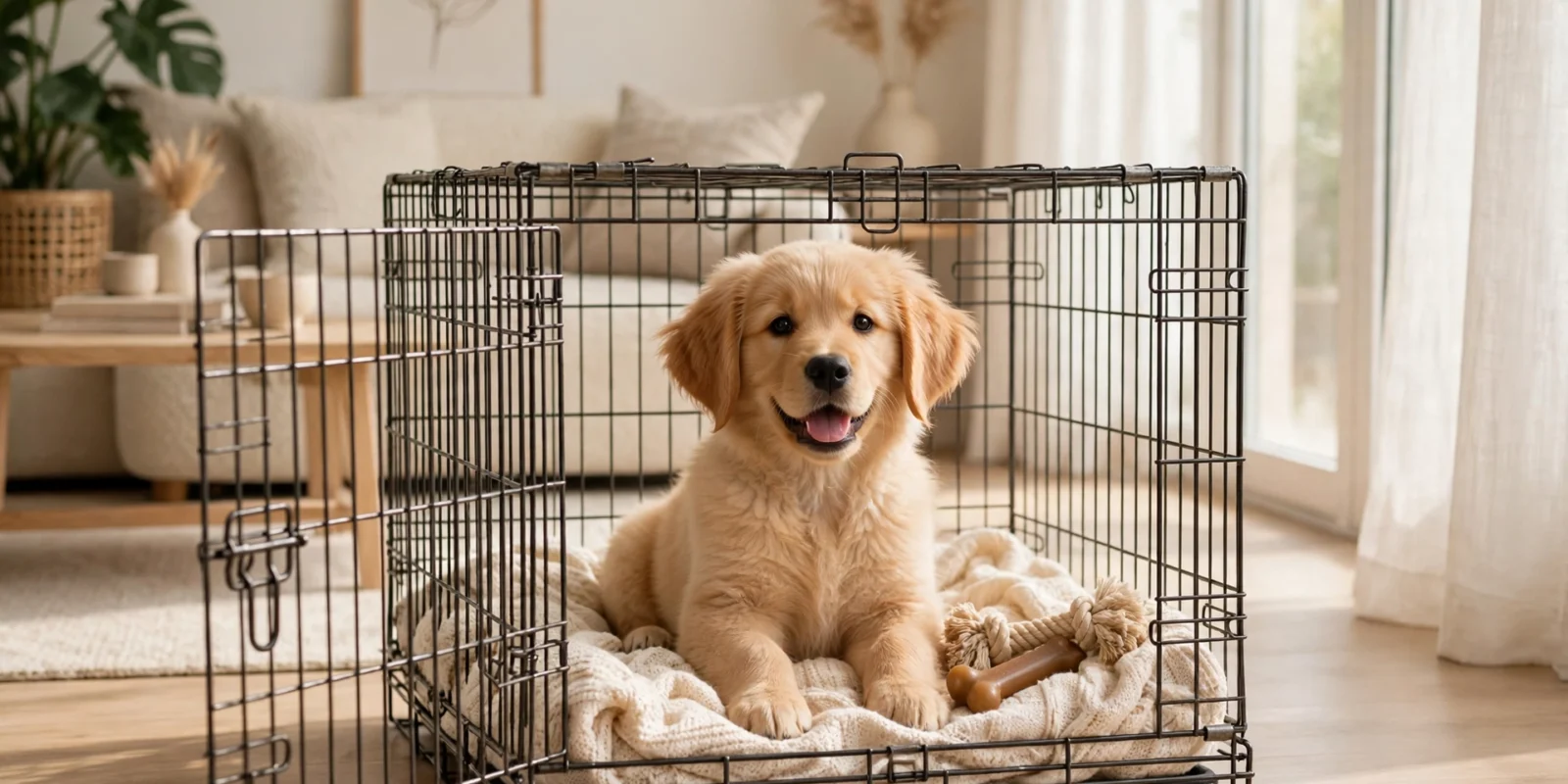
Your puppy has just come home, and the first night is already looming. You have read that a crate helps with toilet training, keeps a chewing puppy safe, and gives them a den of their own — and you have also read that crates are cruel, that puppies scream all night, and that one wrong move ruins the whole thing. Learning how to crate train a puppy is mostly about pace: introduce the crate slowly, pair every step with something good, and never ask your puppy to cope with more than they can handle. Get that right and most puppies settle into their crate within a couple of weeks, treating it as the place they choose for a nap.
This guide walks you through the whole process, from choosing the right size crate to surviving the first nights, with a by-age schedule, a plan for working owners, and the crying fixes that actually work. It is written by Md Masud Rana based on published expert sources, including the American Kennel Club, VCA Animal Hospitals, and the Humane Society.
Written by Md Masud Rana based on published expert sources. This article has not been professionally reviewed. See our sources below.
Quick answer
To crate train a puppy, set up a crate just big enough for them to stand, turn and lie down, leave the door open, and reward every approach with treats. Feed meals inside, then close the door for seconds at a time and build up slowly. Keep the crate by your bed for the first nights, expect one or two toilet trips, and never use the crate as punishment. Most puppies adjust within one to two weeks.
What this guide covers
- Why crate train a puppy at all?
- What size crate does my puppy need?
- How to crate train a puppy, step by step
- Crate training a puppy at night
- How long can a puppy stay in a crate?
- Crate games: teaching your puppy to love the crate
- Crate or playpen: which suits your day?
- What recent research and expert guidance shows
- Common crate training mistakes
- Final recommendations
- Frequently asked questions
Why crate train a puppy at all?
A crate is a den, not a cage. Dogs are den animals by instinct, and a properly introduced crate gives a puppy a small, predictable space that smells familiar and feels safe. When the crate works, your puppy walks into it by choice — to sleep, to escape the noise of a busy household, or to chew a toy in peace.
The practical benefits are real. A crate speeds up toilet training because puppies naturally avoid soiling where they sleep, so a correctly sized crate encourages them to hold on until you take them outside. It keeps a young puppy safe when you cannot watch them: no chewed cables, no swallowed socks, no toppled bins. And it prepares them for the many times in life when confinement is unavoidable — vet stays, travel, boarding, or an emergency evacuation. The American Kennel Club makes exactly this point: a dog already comfortable in a crate is far less stressed when one is suddenly needed.
None of that makes a crate a storage box. A crate is a tool for short, structured periods — naps, quiet time, and nights — not a place to park a puppy for a whole working day. The Humane Society is blunt: a crate is not a magical solution to behaviour problems, and used wrongly it can leave a dog feeling trapped and frustrated. Puppies under six months should not stay in a crate for more than three or four hours at a time.
Is crate training cruel?
Crate training is not cruel when it is done the way this guide describes: gradual introduction, the puppy’s choice, short sessions, and never as punishment. It becomes cruel when a puppy is shut in for hours on end, forced inside, or sent there after misbehaving. The difference is not the crate. It is how the crate is used. Many owners describe the same turning point: in the second week, the puppy starts wandering into the crate on their own to sleep. That voluntary choice is the test. If your puppy never chooses the crate, slow down — do not add force.
When a crate is not the answer
Some puppies genuinely struggle with confinement. If your puppy panics — drooling heavily, trying to chew through the bars, howling without stopping, or injuring themselves — stop crate training and speak to your veterinarian or a qualified behaviour professional before continuing. The American Kennel Club gives the same advice. A puppy with true separation anxiety needs a different plan, and a crate can make it worse. Our guide to dog separation anxiety explains the signs and what to do next.
What size crate does my puppy need?
Size is the single most common thing owners get wrong. The rule from every major source is the same: the crate should be just big enough for your puppy to stand up without hunching, turn around, and lie down stretched out. No bigger. A crate that is too large defeats the toilet-training benefit, because a puppy in an oversized crate will use one end as a toilet and sleep in the other. If you buy a crate sized for your puppy’s adult weight, use the divider panel that comes with most wire crates to block off the extra space, then move it back as they grow.
Wire, plastic or soft-sided?
Wire crates fold flat, are easy to move, and let you see your puppy. Their downsides are that determined chewers can damage their teeth on the bars, and they are not approved for airline travel. Plastic crates are easy to clean, contain messes, reduce visual stimulation for nervous puppies, and work for air travel — but they are bulky and harder to see into. Soft-sided fabric crates are light and portable but only suit a puppy you are supervising, since a determined chewer can escape through the fabric. VCA Animal Hospitals lays out these trade-offs in its crate guide, and for most families a wire crate with a divider is the practical choice at home.
Setting the crate up
Place the crate where your family actually spends time, such as the living room, not in a distant spare room. Dogs are social animals, and a puppy banished to isolation will not learn to love their crate. Put a soft blanket inside, add a safe chew toy, and keep the door tied fully open for the first day or two so it cannot swing shut and startle them. Covering the crate with a light blanket can help some puppies settle by making it feel more den-like. One safety rule from the American Kennel Club: remove your puppy’s collar whenever they are in the crate, because collars can catch on bars.
How to crate train a puppy, step by step
The method below follows the American Kennel Club’s step-by-step approach, cross-checked against the Humane Society’s four-step process and VCA’s behaviourist guidance. Different sources number the steps differently, but the sequence is the same everywhere: comfort first, entry second, door third, duration last. Move on only when your puppy is relaxed; if they seem worried, go back a step.
Plan short sessions, two or three times a day, of five to ten minutes each. Train when your puppy is calm or a little sleepy, and always after a toilet break, some play and a meal, so the crate never competes with an urgent need.
Step 1: Make the crate a good place to be near
Before your puppy ever goes inside, they need to feel good about the crate. With the door tied open, feed meals near the entrance and scatter treats around the outside for them to discover. The American Kennel Club suggests sitting beside the crate with a handful of food and tossing a treat inside whenever your puppy approaches, then dropping another every five to ten seconds while they stay near. Some puppies walk straight in; others need a day or two just to sniff the doorway.
Step 2: Lure them inside, with the door open
Once your puppy is relaxed around the crate, start luring them in. Toss a high-value treat just inside the doorway and let them walk in, eat it, and walk back out with no pressure. Repeat until they trot in happily, then place treats further back until their whole body is inside. Feed meals inside next, starting with the bowl in the doorway and moving it back at each meal. A frozen food-stuffed chew toy works well here. Never push, lift or drag them in — one forced entry can undo days of patient work.
Step 3: Close the door for seconds, not minutes
Only start closing the door when your puppy is enthusiastically entering the crate on their own. Take this step extra slowly: a loud bang from the door can instantly reverse the positive associations you have built. Move the door an inch or two toward closed, then secure it open again. If your puppy seems unfazed, move it a few more inches, until you can gently close it all the way, marking and treating the moment it shuts, then opening it again right away. Do not latch the door until your puppy is happy to see it swing shut. The Humane Society’s version is to close the door while your puppy eats, then open it the moment they finish, leaving it closed a little longer at each feeding.
Step 4: Build duration while you stay close
Now build how long your puppy stays inside, starting with a few seconds behind a closed door and rewarding them through the bars. The golden rule is this: only raise the difficulty from a calm, quiet puppy. If they are whining, you have asked for too much too soon — go back to the last duration they handled easily. Work on one dimension at a time. First build duration with you sitting beside the crate, then add distance: take one step back for one second, return, reward, and open the door. Walk a little further each time until you can leave the room, then build duration again.
Step 5: Short absences from the house
Once your puppy settles for around 30 minutes with you out of sight, try a brief trip out. Put them in the crate with a treat or a stuffed chew toy, five to twenty minutes before you leave, and keep your departure low-key. When you return, stay calm too. Keep crating your puppy for short periods while you are at home, so they never learn that the crate means you are leaving. VCA’s behaviour team suggests monitoring with a camera during the first separations.
Step 6: Teach the cue and make it a habit
When your puppy reliably trots into the crate, add a word. Say “crate” or “kennel” just before they enter, then treat as usual. Over time they will associate the word with entering and receiving a reward, and you can ask them to enter without a lure. VCA’s guide adds a useful finishing touch: teach a calm exit. Ask your puppy to sit inside the crate, open the door, and release them with a word such as “free”. If they rush out, calmly close the door and try again.
How long does all of this take? The American Kennel Club says crate training can take as little as a day or as long as several months, depending on the dog’s personality and past experience. VCA’s puppy guide says most puppies get used to their crate within one to two months. For a typical eight-week-old puppy with patient, daily practice, expect real progress in one to two weeks and genuine reliability over the following month.
Crate training a puppy at night
Night is where most crate training falls apart. The first three nights are usually the hardest: your puppy has just left their mother and littermates and is now alone in a strange, dark house. Some crying is normal. The goal is not zero crying on night one — it is a puppy who learns, over a few nights, that the crate is safe and you will answer real needs.
The first-night setup
Put the crate right next to your bed for the first nights, so your puppy can hear and smell you. A ticking clock or a heartbeat toy can help, and an old T-shirt that smells of you in the bedding is worth more than any gadget. Run a calm bedtime routine: a last play session, a toilet trip outside, a small chew in the crate, and lights down. Expect one or two toilet trips during the night for the first couple of weeks. A rough guide used by many vets is that a puppy can hold their bladder for about one hour per month of age, plus one — so a two-month-old puppy may need a break every three hours. Set an alarm rather than waiting for crying, take them straight outside on the lead, praise softly, and put them straight back in. Keep it boring: night toilet trips are business, not playtime.
Cry or toilet? How to tell the difference
If your puppy has been asleep for two or three hours and starts crying, they probably need to go out — take them, quietly. If they have just been out, have just eaten, and are crying within minutes of being crated, they are most likely protesting the confinement. For protest crying, wait for a few seconds of quiet before you open the door, then reward them inside the crate and let them out. If you open the door while they are crying, you teach them that crying opens doors. But do not let a puppy scream for hours either. If they are still crying after 15 to 30 minutes without settling, go to them calmly, settle them again, and consider that you moved too fast during the day. A veterinarian quoted by Adopt-a-Pet says the whining usually diminishes within five nights. If a month has gone by and your puppy is still in distress every night, go back to daytime practice, or speak to your vet.
Moving the crate away from your bed
Once your puppy sleeps well beside you, gradually move the crate to its permanent spot — a few feet further away each night. If the crying returns, move it back for another night or two. There is no prize for rushing this.
How long can a puppy stay in a crate?
Published advice disagrees here, and you deserve to see the disagreement honestly rather than being handed one number as if it were settled science. The Humane Society’s rule is the simplest: puppies under six months should not stay in a crate for more than three or four hours at a time. VCA’s house-training guide says puppies left alone for very short periods — no more than three hours — can usually be confined in a crate successfully, and anything longer needs a potty break or a larger space with a toilet area. The American Kennel Club frames it by bladder capacity: a puppy can hold on for roughly their age in months, up to about six hours at six months, and most puppies can sleep through the night without a break by four months.
The safe way to plan is to treat the shortest number as your daytime rule and the longest as a sleeping-night guide only. Daytime, when your puppy is awake, drinking and playing, use the conservative limits below. Overnight, when they are asleep and not drinking, they can usually stretch longer. Treat every number as a ceiling, not a target.
| Puppy age | Daytime crate limit | Night stretch between breaks |
|---|---|---|
| 8–10 weeks | 30–60 minutes, up to 1–2 hours for a nap | Every 2–3 hours |
| 11–14 weeks | 1–2 hours | Every 3–4 hours |
| 3–4 months | 2–3 hours | Often one break, or sleeping through by 4 months |
| 5–6 months | 3–4 hours | Usually the whole night |
| 6+ months | 4–6 hours | Whole night |
Small breeds, puppies who have just drunk a lot of water, and puppies on medication will need shorter intervals. The table is a starting guide, not a promise.
Can I crate my puppy while I work full-time?
The short answer is no — not in a crate alone, all day. An eight-week-old puppy cannot hold on for an eight-hour workday, and asking them to try will set back toilet training and cause real distress. If you work outside the home, hire a dog walker or ask a neighbour to come by every two to three hours, or set up a secure exercise pen with the crate inside it, door open, plus a toilet area. For more on daytime routines, see our puppy potty training guide.
A sample day for a 10-week-old puppy
A realistic day runs on a loop: toilet, play, crate nap, toilet again. Wake up and go straight outside. Breakfast in the crate. Play and training for 30–45 minutes. A crate nap of 30–60 minutes. Outside again the moment they wake. Lunch in the crate. Afternoon play, another nap, dinner, evening play, a final toilet trip, and bed in the crate beside you. Puppies need 18 to 20 hours of sleep a day, and the crate is what makes that sleep happen — an overtired puppy is the one who bites, races around the house and cannot settle at night.
Crate games: teaching your puppy to love the crate
There is a more playful approach with a real name behind it: Crate Games, developed by the well-known dog trainer Susan Garrett. The idea is simple — turn the crate into a game your puppy wants to win. The first game teaches your puppy that staying in the crate pays better than running out: with your puppy inside, crack the door open a little and feed a treat at the back, then close the door again. Repeat, opening the door a little further each time, feeding only while your puppy stays put. A second game builds enthusiasm for running into the crate: toss a treat in, let your puppy dash in, then toss one out, and repeat until they are bouncing in and out happily. You do not need Garrett’s full programme to benefit — make the crate the place where the best things happen, keep sessions short, and end while your puppy still wants more.
Crate or playpen: which suits your day?
A playpen is not a rival to the crate. It is a different tool, and many owners use both: the crate as the bed, inside or beside the pen. The choice depends on how long your puppy will be unsupervised. A crate is best for naps, nights, short absences, travel and vet visits, and it strongly supports toilet training because a puppy avoids soiling their den. A pen is better for longer absences and workdays with breaks, because it can hold a toilet area and water — but it is weaker for toilet training, since a puppy can toilet away from the bed. Most trainers recommend a pen with the crate inside it, door open, for the daytime when you are out, and the crate alone at night.
What recent research and expert guidance shows
There is no single landmark study on crate training, and you should be suspicious of any article that claims otherwise. What exists is a steady consensus across veterinary behaviourists, animal welfare organisations and professional trainers: reward-based, gradual crate introduction works; flooding a puppy with long confinement does not; and the crate must never be used as punishment. Two points in current guidance matter because older advice got them wrong. First, the “cry it out” approach is no longer recommended: the American Kennel Club advises waiting for a few seconds of quiet before opening the door — and, separately, letting a puppy out at night when they fuss, because they most likely need the toilet. Second, VCA’s behaviour team recommends a camera for the first separations, because a puppy who panics alone needs help, not more crate time.
Common crate training mistakes
1. Moving too fast. Shutting a puppy in for an hour on day one teaches them the crate is a trap. Build duration in seconds and minutes, and only from a calm puppy.
2. Using the crate as punishment. Sending a puppy to the crate after they chew your shoes links the crate with being in trouble. The crate must always mean good things.
3. Letting them out while they cry. Opening the door mid-whine teaches them that crying opens doors. Wait for a few seconds of quiet first — unless they need the toilet.
4. Buying a crate that is too big. An oversized crate lets a puppy toilet in one corner and sleep in the other, which breaks the toilet-training benefit. Use a divider.
5. Crating for too long. A young puppy crated for a full workday will soil the crate, become distressed, and learn to fear it. Arrange breaks or use a pen.
6. Skipping the daytime practice. If the first time your puppy spends real time in the crate is a lonely night, they will panic. Build the association during the day first.
Final recommendations
- Start on day one, with the door open and treats flowing — do not wait for a “better time”.
- Feed every meal in the crate for the first two weeks; it is the easiest positive association there is.
- Keep sessions short, two or three times a day, and end while your puppy is still happy.
- Put the crate beside your bed for the first nights and set an alarm for toilet trips.
- Never crate longer than your puppy can hold on — use the age table as a ceiling.
- Use a camera for the first absences so you know whether your puppy settles or panics.
- If your puppy shows signs of panic or true separation anxiety, stop and speak to your vet.
- Be patient: most puppies take one to two weeks to settle and up to two months to be fully reliable.
Frequently asked questions
Most puppies show real progress in one to two weeks of patient daily practice, and VCA's puppy guide says most get used to the crate within one to two months. The American Kennel Club notes it can take as little as a day or as long as several months, depending on the puppy. Go at your puppy's pace.
Most puppies cry for the first few nights, then settle faster each night. A veterinarian quoted by Adopt-a-Pet says the whining usually diminishes within five nights. By the end of the first or second week most puppies sleep well. If distress continues after a month, go back to daytime practice or speak to your vet.
For protest crying during the day, wait for a few seconds of quiet before opening the door, so you reward calm rather than crying. Do not leave a puppy to scream for hours. If they are still crying after 15 to 30 minutes, settle them calmly and slow your training down.
Choose a crate just big enough for your puppy to stand up, turn around and lie down stretched out. If you buy one sized for their adult weight, use the divider panel to block off the extra space and move it back as they grow. A crate that is too big lets them toilet in one end and sleep in the other.
Not in a crate alone all day. A young puppy cannot hold on for eight hours. Arrange a dog walker or neighbour to visit every two to three hours, or set up a secure exercise pen with the crate inside it, door open, plus a toilet area. A pen is far kinder than a long crate day.
A light cover can help some puppies settle by making the crate feel more den-like, but others get warmer or more restless. Try it for a few nights and watch your puppy's response. Make sure air can still flow freely, and never cover a crate in a hot room.
Stay calm and clean it without fuss. It usually means the crate is too big, the puppy was left too long, or they were unwell. Check the sizing, shorten the crate time, and take them out more often. Never punish a puppy for soiling the crate — it teaches fear, not cleanliness.
No, when done properly. Gradual introduction, short sessions, the puppy's choice and never using the crate as punishment make it a safe den. It becomes cruel when a puppy is forced inside, shut in for hours, or sent there after misbehaving. If your puppy panics, stop and speak to your vet.
This content is for educational purposes only and does not replace professional veterinary advice. Always consult your veterinarian before making health decisions for your pet.
Conclusion
Crate training a puppy is not a race, and it is not a test of wills. It is a slow build of trust: a crate that smells familiar, a treat every time they step inside, a door that closes gently and opens again, and a person nearby who answers real needs. Most puppies take a week or two to settle and a month or two to be fully reliable — and the owners who get there fastest are usually the ones who moved slowest at the start.
Start tonight. Set the crate up where your family gathers, tie the door open, and scatter a few treats around it. Feed the next meal a little closer to the doorway. That small first step is the whole method in miniature. Keep going, keep it kind, and your puppy will choose the crate on their own. For the next step, read our puppy potty training guide and our guide to stopping barking.
References
- American Kennel Club — Step-by-Step Crate Training for Your Dog — https://www.akc.org/expert-advice/training/crate-training-step-by-step/
- American Kennel Club — How to Crate Train Your Dog — https://www.akc.org/expert-advice/training/how-to-crate-train-dog/
- VCA Canada Animal Hospitals — Life Skills for Pets: Crate Training and Confinement for Puppies and Dogs — https://vcacanada.com/know-your-pet/general-dog-care/training-your-dog
- The Humane Society for Tacoma & Pierce County — Crate Training — https://www.thehumanesociety.org/crate-training/
- VCA Animal Hospitals — Housetraining for Puppies and Dogs — https://vcahospitals.com/know-your-pet/house-training-your-puppy
- Petful — Crate Training Schedule by Age — https://www.petful.com/behaviors/crate-training-schedule-by-age/
- Adopt-a-Pet — Why Is Your Puppy Crying at Night? — https://www.adoptapet.com/blog/behavior-training/puppy-crying-at-night