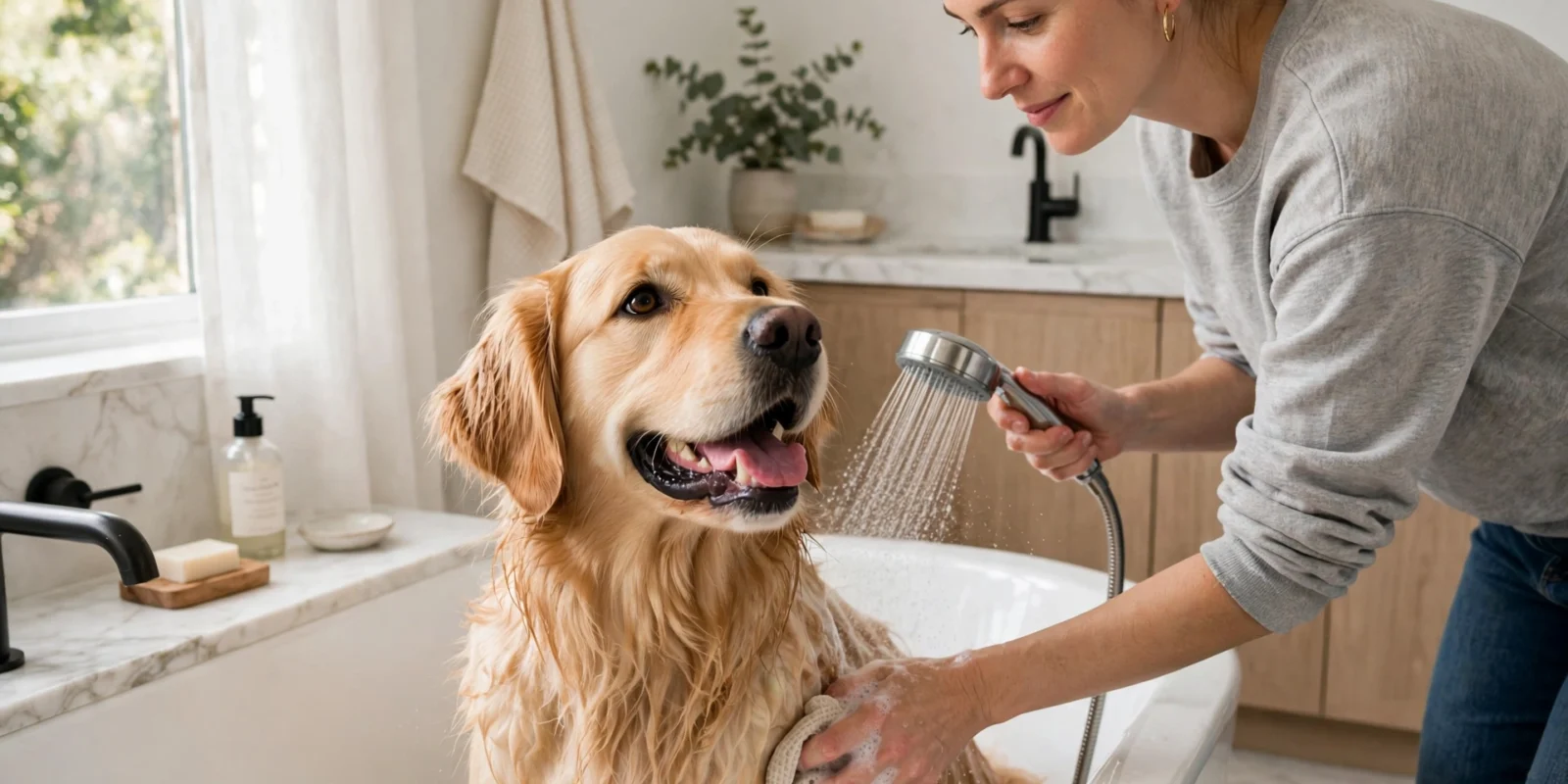
Your dog smells. Not the end-of-a-long-walk smell, either — the kind that follows them onto the sofa and into the car. You reach for the shampoo, then stop. Wasn’t it only three weeks since the last bath? Is once a month too much, or not enough? And why does every website seem to give a different answer?
Here’s the honest truth: there is no single number that works for every dog. How often you should bathe a dog depends on the coat they were born with, the life they live, and the state of their skin. A hairless Chinese Crested and a mud-loving Labrador live in completely different bath worlds.
This guide pulls together what veterinary and grooming sources actually say, so you can stop guessing: a clear baseline, a coat-by-coat schedule, what changes with allergies or a puppy, and the signs that tell you you’re bathing too much — or too little.
Written by Md Masud Rana based on published expert sources. This article has not been professionally reviewed. See our sources below.
Quick Answer: How Often Should You Bathe a Dog?
Most healthy adult dogs do well with a bath every four to eight weeks. Short-coated dogs often need only two to four baths a year, while curly and long-coated breeds usually need one every four to six weeks, and hairless breeds may need a weekly wash. Dogs with allergies or skin conditions are the exception — they often need more frequent, vet-guided baths. The rule is simpler than any calendar: bathe when the coat is dirty or smelly, and let your dog’s skin tell you the rest.
Contents
- How Often Should You Bathe a Dog? The Short Answer
- What Decides How Often Your Dog Needs a Bath?
- How Often to Bathe a Dog by Coat Type
- How Often Should You Bathe a Puppy?
- How Often Should You Bathe a Dog With Allergies or Sensitive Skin?
- Can You Bathe a Dog Too Much?
- When Should You Skip a Bath?
- How to Bathe Your Dog the Right Way
- What the Newest Guidance Shows
- Common Mistakes to Avoid
- Final Recommendations
- Frequently Asked Questions
- Conclusion
How Often Should You Bathe a Dog? The Short Answer
If you want one number to start from, make it this: every four to eight weeks. That is the range most veterinary and grooming sources land on for a healthy adult dog with normal skin. Rover’s guide, written with a professional groomer, puts the general rule at every four to six weeks, while PetMD notes the honest range is far wider — anywhere from once a week to only a few times a year.
That wide range is the point. A bath is not like a vaccine with a fixed schedule. It is a judgement call you make from the coat in front of you, and the calendar is the least useful tool for making it.
Most owners bathe too often, not too rarely — because the dog smells a bit, because guests are coming, or because it feels responsible. But a dog’s skin is not human skin. It carries a layer of natural oils that keeps the skin barrier working and the coat glossy. Wash those oils away too often and the skin dries out, flakes, and itches. Never bathing is not the answer either: dirt builds up and mats trap moisture against the skin.
So instead of asking “how often?”, ask “what does my dog’s coat need this week?” If the coat is clean, smells fine, and the skin looks calm, there is no reason to bathe. If the dog rolled in something foul or came home caked in mud, it is bath day — even if the last one was only a fortnight ago. One extra bath after a muddy walk will not harm a healthy dog. A bath every week for no reason very well might.
The baseline most dogs can start from
For a healthy adult dog with no skin condition, start with a bath every four to six weeks and adjust from there. Watch the skin for a month or two: calm skin, a shiny coat, and no smell means you have found your interval. Grease or smell after three weeks means a shorter gap; flakes after every bath means a longer one.
What Decides How Often Your Dog Needs a Bath?
Five things decide the answer for your dog. Skin health runs through all of them: healthy skin tolerates a normal schedule, while allergic or damaged skin changes everything.
1. Coat type
Coat type is the single biggest factor. A short, smooth coat sheds dirt easily and holds little odour. A long or curly coat traps dirt, tangles, and moisture, and needs washing more often. Hairless breeds have no coat to absorb skin oils, so the skin itself needs regular washing.
2. Lifestyle and activity
A dog that spends its days on the sofa and a short pavement walk will stay clean far longer than one that swims, hikes, and rolls in whatever it finds. Adoptapet’s bathing guide makes a useful point: dogs sweat almost entirely through their paw pads and cool themselves by panting, so exercise alone does not make a dog smelly the way it does a person. What matters is what the dog gets into — mud, stagnant water, tall grass — not how far it ran.
3. The season
Summer brings grease, stronger odour, and more parasites. PetMD notes that dog odour is more obvious in warm months, and dogs that swim need a rinse in clean water afterwards even if they do not need a full shampoo. Winter usually means less dirt but drier skin, so many dogs do better with fewer baths and a moisturising shampoo in the colder months.
4. Age
Puppies get dirty more often and need gentle, more frequent baths once they are old enough — but never before eight weeks. Senior dogs usually need fewer baths, and the ones they do get should be shorter and gentler, with a non-slip surface under their paws.
How Often to Bathe a Dog by Coat Type
This is where the general advice turns into something you can actually use. The table below combines the schedules from Adoptapet, Rover, and PetMD.
| Coat type | Typical breeds | Starting interval | Between baths |
|---|---|---|---|
| Short, smooth | Beagle, Boxer, Great Dane | Every 6–8 weeks, or 2–4 times a year | Weekly brushing; damp-cloth wipe-down |
| Double coat | Labrador, Husky, German Shepherd | Every 6–8 weeks | Brush 2–3 times a week; daily when shedding |
| Long, silky | Yorkshire Terrier, Maltese, Shih Tzu | Every 3–4 weeks | Daily to weekly brushing |
| Curly or wavy | Poodle, Bichon Frise, Cocker Spaniel | Every 4–6 weeks | Regular brushing; professional grooming every 6–8 weeks |
| Combination (Doodles) | Goldendoodle, Labradoodle, Cockapoo | Every 3–6 weeks | Daily to weekly brushing |
| Wire coat | Jack Russell Terrier, Brussels Griffon | Every 6–8 weeks | Wire coats repel dirt naturally |
| Hairless | Chinese Crested, Xoloitzcuintli | About once a week | Gentle moisturising products as your vet advises |
Short, smooth coats: the easy keepers
Short-coated dogs are the lowest maintenance of all. Their hair lies flat, sheds dirt easily, and rarely mats — Adoptapet puts their need at as little as two to four baths a year. A weekly brush with a rubber curry comb and a wipe-down with a damp cloth usually keeps a Beagle or a Boxer fresh between baths.
Double coats: brushing matters more than bathing
Labradors, Huskies, and German Shepherds carry two layers: a coarse topcoat and a soft, dense undercoat. The topcoat repels dirt, so these dogs often look clean long after a bath. What they really need is brushing — two or three times a week, daily when they blow their coat in spring and autumn. A bath every six to eight weeks is plenty. Never shave a double coat: it regulates temperature and protects against sunburn.
Long, curly, and Doodle coats: the mat risk
Long hair tangles, curly hair traps dirt, and Doodle coats combine both problems and mat faster than either parent breed. For these dogs, the bath is part of coat maintenance — waiting longer than six to eight weeks can leave mats so tight that the only fix is shaving the coat off. Treat the bath as a scheduled appointment, not a reaction to smell.
Hairless breeds: skincare, not dog bathing
A Chinese Crested or Xoloitzcuintli has no fur to absorb the oils its skin produces, so dirt and oil sit directly on the skin. These dogs genuinely need a bath about once a week with a gentle, moisturising shampoo. Follow your vet’s product advice rather than any general guide.
How Often Should You Bathe a Puppy?
Puppies are the exception to almost every rule in this guide, and the first rule is the most important: do not give a puppy a full bath before eight weeks old. Young puppies struggle to regulate their body temperature, and a soaking can leave them dangerously cold. Adoptapet and Rover both draw the line at eight weeks. Before that age, spot-clean with a warm, damp cloth and dry the puppy immediately.
Once a puppy passes eight weeks, the schedule depends on the breed and coat, just like an adult — usually every three to four weeks. But the early baths have a second job that matters more than cleanliness: teaching the puppy that bath time is safe. A puppy that learns baths are calm and brief grows into an adult that stands still in the tub.
Keep those first baths short. Lukewarm water, a gentle puppy shampoo, no water near the face or ears, and lots of calm praise. Some groomers suggest a weekly bath while a puppy is still learning to enjoy the experience, then dropping to a monthly rhythm once the puppy is comfortable — provided the shampoo is genuinely gentle and the skin shows no sign of dryness. If flakes appear, slow down.
How Often Should You Bathe a Dog With Allergies or Sensitive Skin?
This is where the usual advice flips. For a healthy dog, more baths mean drier skin. For a dog with environmental allergies, more baths can mean less itching — because the bath physically washes pollen, dust, and other allergens off the coat. The trick is that frequency and product have to change together: bathing an allergic dog weekly with a harsh, heavily scented shampoo will make things worse, not better.
A staged schedule for sensitive skin
Stratford Animal Care’s guide to bathing sensitive-skinned dogs lays out a staged approach that matches what veterinary dermatologists recommend:
| Skin stage | Suggested frequency |
|---|---|
| Maintenance, no active irritation | Every 2 to 4 weeks |
| Mild sensitivity or occasional itching | Every 1 to 2 weeks with a hypoallergenic shampoo |
| Active flare-up | Every 3 to 5 days — only as your vet directs |
During an active flare-up, the schedule belongs to your vet, not to a blog post. A flare-up may need a medicated shampoo with a specific contact time — the shampoo has to sit on the skin for several minutes to work. If your dog’s skin shows sores, smell, grease, or crusts, that is a vet visit, not a bathing decision.
Choosing the right shampoo
For sensitive skin, look for a soap-free, fragrance-light, pH-balanced dog shampoo. Colloidal oatmeal and aloe vera are the ingredients that come up again and again in veterinary guidance for calming irritated skin. What to skip: heavy fragrance, harsh sulfates, dyes — and human shampoo, including baby shampoo. Dog skin sits at a different pH from human skin. Adoptapet is blunt on this point: some scents in human shampoos, such as tea tree oil, can be toxic to dogs.
Can You Bathe a Dog Too Much?
Yes — and it is one of the most common grooming mistakes owners make. Over-bathing strips the natural oils (sebum) from the skin faster than the body can replace them. Once that layer is gone, the skin becomes dry, itchy, and more open to infection.
PetMD’s guide to dry skin in dogs lists frequent over-bathing as a direct cause of dry, flaky skin, and recommends a bath every two to four weeks as a good goal for dogs whose skin is already dry. Dry skin can also bring hair loss, redness, dandruff, and scabs — and any change in the skin is worth a vet visit, because allergies, parasites, poor diet, and hormonal conditions can all look similar at first.
Signs you may be over-bathing your dog
Watch for these in the days after a bath, and compare what you see over several grooming sessions:
- Dry, flaky skin or dandruff — white or grey flakes between washes
- Itching that starts or worsens after a bath — scratching that lasts more than an hour after drying
- A dull, brittle coat — the shine fades and tangles form easily
- Red or irritated patches — often on the paws, belly, and groin
- Odour that comes back faster than before — a damaged skin barrier lets odour-causing bacteria grow more quickly
- Recurring hot spots or skin infections — a weakened barrier is an open door for bacteria
If you spot two or more of these, stretch the gap between baths by a week or two, switch to a gentler, fragrance-free dog shampoo, and rinse until the water runs completely clear. If the skin does not settle within a few weeks, talk to your vet. Unless your vet has prescribed a specific routine, do not bathe a healthy dog more than once a week.
The opposite problem has its own signs too: a strong smell that brushing cannot shift, a greasy coat, and matted fur.
When Should You Skip a Bath?
Sometimes the right bathing decision is not to bathe at all. These are the situations where a bath should wait:
After surgery
Do not bathe a dog for at least two weeks after surgery, or until your vet gives the all-clear. The incision must stay dry so the stitches hold and infection stays out — no baths, no swimming, no rolling in wet grass. A damp cloth, kept away from the surgical area, is enough for cleaning in the meantime.
After topical flea or tick treatment
Most topical preventatives need around 48 hours to dry and absorb into the skin. Bathing too soon washes the treatment off. Check the label on your specific product for its wait time, because it varies.
Puppies under eight weeks
As covered above, a full bath can chill a very young puppy dangerously. Spot-clean only, and dry them straight away.
Open wounds, incisions, or skin being treated with creams
Water and shampoo can interfere with healing and wash topical medication off the skin. If your dog has an open wound, a fresh incision, or a rash being treated with a cream or ointment, ask your vet before bathing.
In all of these cases, spot-cleaning is your friend. A damp cloth on muddy paws and a wipe around the belly will keep a dog comfortable without the risks of a full bath.
How to Bathe Your Dog the Right Way
Frequency is only half the story — a badly done bath can undo the benefit of a well-chosen schedule.
Before the bath
Brush first, always. Wet mats tighten and become almost impossible to remove without cutting, and a matted coat traps moisture against the skin. PetMD recommends brushing daily for long-coated breeds and at least weekly for short coats. While you are there, check the ears and skin for anything new: redness, lumps, sores, or parasites.
Pick the right shampoo. Always a product formulated for dogs: a basic gentle shampoo for most healthy dogs, a deodorising one for the genuinely smelly, an oatmeal-based soothing one for puppies, seniors, and sensitive skin, and medicated shampoo only on your vet’s advice. The same rule as dental care applies — the right product for the species beats a human product every time.
During the bath
- Use lukewarm water — never hot. Aim for roughly your dog’s body temperature, around 37°C (98°F).
- Wet the coat thoroughly, then work the shampoo in gently and let it sit for the contact time on the label. Keep water away from the face, eyes, and ears.
- Rinse longer than feels necessary, until the water runs completely clear, then rinse once more. Leftover shampoo is a leading cause of itchy skin after a bath.
- Provide a non-slip surface. A rubber mat in the tub stops slipping, which is the main reason nervous dogs panic — and it is essential for senior dogs with stiff joints.
After the bath
Dry thoroughly, especially for thick and double-coated dogs. Towel-dry first, then let the coat air-dry in a warm room or use a dryer on a low, cool setting if your dog tolerates it. A dense coat left damp can develop a musty smell and skin problems from trapped moisture. Finish with a gentle brush-out once the coat is dry, and a calm reward. If your dog finds baths stressful, pairing the end with something pleasant helps build a better association next time. For dogs that are genuinely anxious about water, calming routines and treats can take the edge off, though a dog that panics in the bath is worth discussing with your vet or a trainer rather than pushing through.
Keeping your dog fresh between baths
Stretching the gap between baths does not mean living with a dirty dog. Brush regularly — it removes dirt and loose fur and distributes the skin’s natural oils. Spot-clean muddy paws and bellies with a damp cloth after walks. Use dog-safe pet wipes for quick freshening (never household or baby wipes), or a dry dog shampoo for a light refresh. Wash the dog’s bedding regularly.
What the Newest Guidance Shows
Bathing advice has shifted noticeably in the last couple of years, and the shift runs in two opposite directions at once — which is why the old “bathe once a month, no exceptions” rule no longer holds.
For healthy dogs, the direction is less. PetMD’s dry-skin guidance, updated in June 2025, puts reducing bathing frequency first among the remedies for dry, flaky skin, with a bath every two to four weeks as the goal. Rover’s guide, updated in October 2026 with a professional groomer’s input, keeps the four-to-six-week baseline for healthy adults but stresses that coat type, activity, and skin condition should set the real schedule.
For allergic dogs, the direction is more — but more of the right kind. Modern veterinary dermatology treats bathing as part of treatment for atopic dogs: frequent gentle baths wash allergens off the skin before they can trigger a flare. That is a real change from the older advice to bathe allergic dogs as rarely as possible. The key word is gentle — the benefit disappears if the shampoo strips the skin barrier it is meant to protect.
Common Mistakes to Avoid
1. Bathing on a fixed calendar instead of reading the coat. A rigid “every Saturday” routine ignores what the coat actually needs. Let dirt, smell, and skin condition decide.
2. Using human or baby shampoo. Dog skin has a different pH from human skin, and human products strip its oils and irritate it. Some ingredients in human shampoos, like tea tree oil, can be toxic to dogs. Always use a shampoo made for dogs.
3. Bathing too often. Weekly baths for a healthy coated dog usually do more harm than good. Over-bathing dries the skin, dulls the coat, and can make odour worse. Unless your vet directs otherwise, once a week is the absolute ceiling — and most dogs need far less.
4. Skipping the brush-out before the bath. Bathing a tangled coat turns loose knots into tight mats. Brush first, bathe second, brush again when dry.
5. Leaving the coat damp. Thick and double coats hold water deep inside. Dry thoroughly every time, right down to the undercoat.
6. Bathing right after topical flea or tick treatment. Wait about 48 hours, or the treatment washes straight off.
7. Bathing a puppy under eight weeks. Young puppies cannot regulate their body temperature well, and a full bath can chill them dangerously. Spot-clean with a warm cloth instead.
8. Punishing a dog that panics in the bath. Fear makes the next bath worse, not better. Keep baths short, calm, and rewarded, and get professional help if the fear is severe.
Final Recommendations
1. Start from your dog’s coat type. Use the table in this guide as your starting point, then adjust. A Beagle and a Poodle do not share a bathing schedule.
2. Use a shampoo made for dogs — and only dogs. Gentle everyday shampoo for healthy skin, oatmeal or hypoallergenic for sensitive skin, medicated only on your vet’s advice.
3. Brush before every bath. It prevents mats, removes loose fur, and lets you check the skin. For long and curly coats, brushing matters more than the bath itself.
4. Keep a simple log. Note the date of each bath and how the skin looked a few days later. Within two or three months you will see your dog’s real interval.
5. Spot-clean between baths. Muddy paws, a dirty belly, a smelly patch — a damp cloth or dog-safe wipe handles most of it without a full wash.
6. Rinse until the water runs clear, then rinse again. Leftover shampoo is a common cause of itching after a bath, and it is entirely avoidable.
7. Dry thoroughly, right down to the undercoat. Towel-dry, then air-dry in a warm room or use a dryer on low.
8. Let the skin set the schedule. Flakes or itching after baths means longer gaps or a gentler product. Grease and smell that brushing cannot shift means it is bath day.
9. Ask your vet about anything unusual. New itching, sores, smell, grease, or crusts are not bathing problems to solve at home. A regular wellness plan makes these conversations easy, because your vet already knows your dog.
10. Keep the basics covered. Bathing is one part of grooming, not the whole of it. Brushing, nail trims, ear checks, and teeth all matter — our complete pet care basics guide brings them together.
This content is for educational purposes only and does not replace professional veterinary advice. Always consult your veterinarian before making health decisions for your pet.
Frequently Asked Questions
Most healthy adult dogs do well with a bath every four to eight weeks. Short-coated dogs may need only two to four baths a year, while curly, long-coated, and Doodle breeds usually need one every four to six weeks. Hairless breeds are the exception and may need a weekly wash. Dogs with allergies or skin conditions follow a vet-guided schedule instead.
Do not give a puppy a full bath before eight weeks old, as young puppies cannot regulate their body temperature. After eight weeks, bathe every three to four weeks with a gentle puppy shampoo. Keep early baths short and calm so the puppy learns that bath time is safe, and adjust the schedule once the adult coat grows in at around five to six months.
Only in specific cases. Hairless breeds genuinely need weekly bathing, and dogs with allergies or skin conditions may be bathed weekly or more often on a vet's advice. For a healthy coated dog, weekly baths are too frequent and can strip the skin's natural oils, causing dryness, itching, and a dull coat.
Yes. Over-bathing strips the natural oils that protect the skin, weakening its barrier. Signs include dry or flaky skin, itching that worsens after a bath, a dull and brittle coat, red patches, and odour that returns faster than before. If you see these signs, stretch the gap between baths and switch to a gentler, fragrance-free dog shampoo.
No. Baby shampoo can dry out a dog's skin and coat, and human shampoos in general are made for a different skin pH. Some ingredients in human products, such as tea tree oil, can be toxic to dogs. Always use a shampoo formulated for dogs, and choose a gentle or oatmeal-based one for puppies, seniors, and sensitive skin.
Dogs with environmental allergies often do best with a bath every one to two weeks using a gentle, hypoallergenic or oatmeal shampoo, because bathing washes pollen and dust off the coat. During an active flare-up, your vet may advise bathing every three to five days with a medicated shampoo. Always follow your vet's schedule rather than a general guide.
Most dogs need fewer baths in winter. They get less dirty, and cold, dry air — plus indoor heating — already dries the skin out. A moisturising dog shampoo helps, and brushing and spot-cleaning can stretch the gap between baths. If your dog's skin looks dry or flaky in winter, try bathing less often rather than more.
A good grooming session usually includes a bath, and the bath normally comes before the haircut — a clean, dry coat is easier to cut evenly. Brushing should happen before the bath, not after, because wet tangles tighten into mats. If you use a professional groomer, they will handle the order for you.
Start by making the bathing area a calm place outside of bath time — let your dog hop into the empty tub for treats. Keep baths short, use lukewarm water and a non-slip mat, and reward calm behaviour at the end. Never punish panic, as it makes the next bath worse. If the fear is severe, talk to your vet or a trainer about a gradual desensitisation plan.
Conclusion
So, how often should you bathe a dog? For most healthy dogs, every four to eight weeks is the honest answer — and the real skill is knowing when to move away from that number. A short-coated indoor dog might go months between baths; a Doodle needs one every month; a hairless dog needs one every week; an allergic dog needs a schedule written by a vet.
The pattern underneath all of it is simple. Bathing is not a chore to do on a schedule; it is a response to the coat in front of you.
Start with your dog’s coat type, pick a shampoo made for dogs, brush before you bathe, rinse until the water runs clear, and dry the coat properly. Then watch the skin for a few weeks. If anything looks unusual — new itching, sores, a smell that will not go away, flakes that keep coming back — that is a conversation for your vet, not another bottle of shampoo.
Get the rhythm right and bath time stops being a guessing game.
References
- Adoptapet — How Often Should Dogs Be Bathed? — https://www.adoptapet.com/blog/health/how-often-should-you-bathe-your-dog
- Rover — How Often Should I Wash My Dog? Professional Groomers Explain — https://www.rover.com/blog/how-often-should-i-wash-my-dog/
- PetMD — How Often Should You Bathe Your Dog? — https://www.petmd.com/dog/general-health/how-often-should-you-bathe-your-dog
- PetMD — Dog Dry Skin: Causes, Treatments, and Prevention — https://www.petmd.com/dog/symptoms/dry-flaky-skin-dogs
- VCA Animal Hospitals — Grooming Tips to Keep Dogs & Cats Cool in Summer — https://vcahospitals.com/resources/conditions-dog/skin-coat/groom-your-pet-to-stay-cool-this-summer
- Stratford Animal Care — How Often to Bathe a Dog With Sensitive Skin — https://www.stratfordrx.com/pages/how-often-should-you-bathe-a-dog-with-sensitive-skin