
Cat Peeing Outside the Litter Box: The Complete Guide (2026)
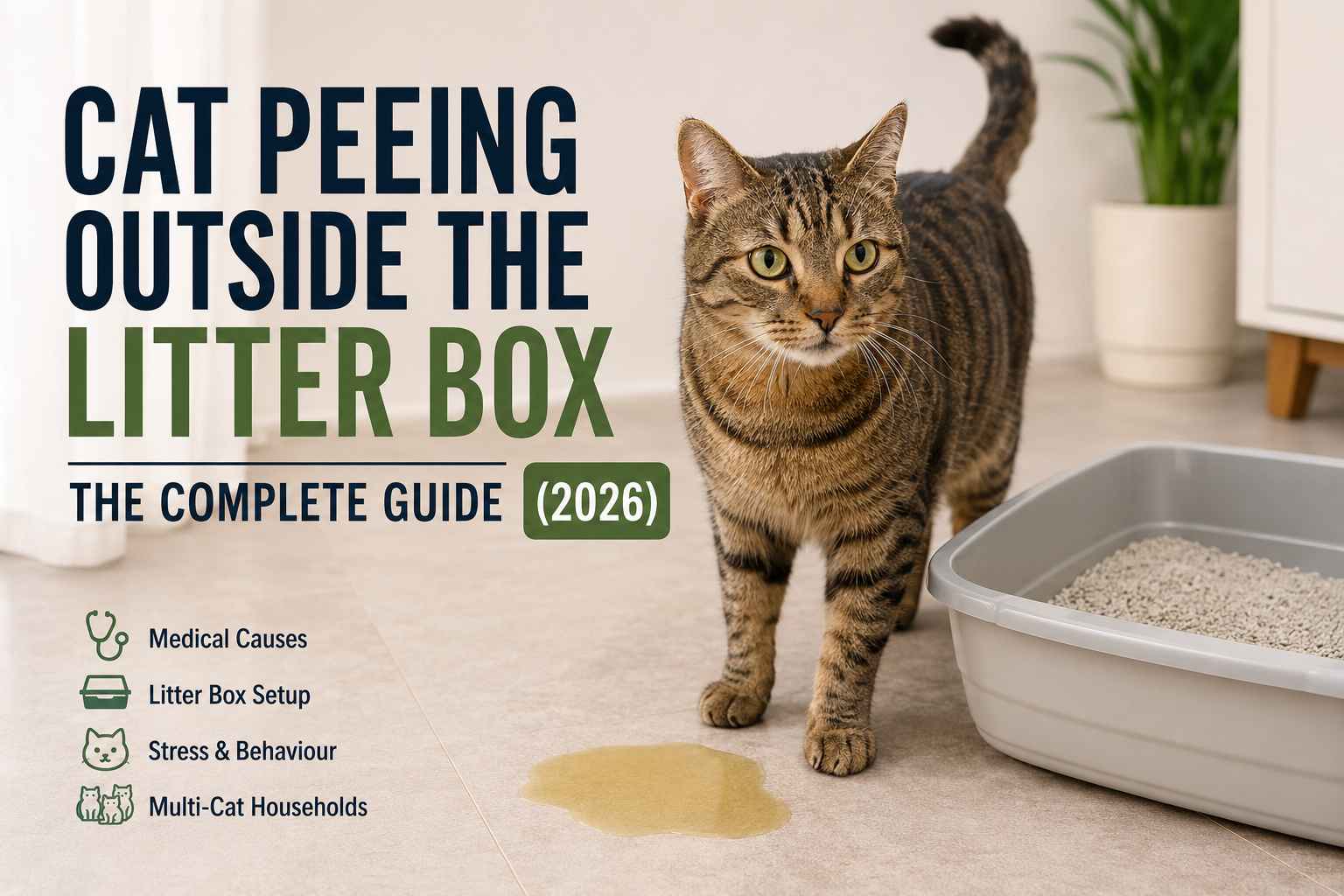
You found a puddle on the duvet at 3 a.m. Or a damp patch behind the sofa. Or, bafflingly, your cat has decided the bath mat is the new bathroom. If your cat is peeing outside the litter box, you are not alone — and you are not being punished. This is one of the most common problems cat owners face worldwide, and the good news is that it almost always has a fixable cause once you find it.
First, the most important thing to understand: a cat that eliminates outside its box is almost never being spiteful. As Cornell University’s College of Veterinary Medicine explains, house soiling is the most commonly reported cat behaviour problem — and it is always a signal, whether medical, environmental, or emotional.
This guide walks through every major reason a cat pees outside the litter box: from urinary tract infections to dirty litter, from territorial stress to the wrong box size. You will find clear explanations of when to call a vet, how to set up a litter box your cat will actually want to use, and what the latest research says about feline litter preferences. By the end, you will have a structured plan to address the problem — and help your cat feel comfortable and healthy again.
Why is my cat peeing outside the litter box? The most common reasons are a medical issue (urinary tract infection, feline idiopathic cystitis, kidney disease), a dirty or poorly positioned litter box, a litter type the cat dislikes, stress or a change at home, or territorial behaviour in a multi-cat household. A sudden change always warrants a vet visit first to rule out a health problem — then address environment and behaviour.
1. Medical Causes: Always Rule These Out First
Before anything else — before you buy new litter, before you rearrange boxes, before you consult a behaviourist — a sudden or new litter box avoidance problem needs a vet check. Medical conditions are responsible for a significant proportion of house-soiling cases, and treating the environment while an underlying illness goes untreated only delays recovery and adds stress for your cat.
As PetMD notes, if a cat suddenly begins peeing outside the litter box, a medical issue is the most likely first cause; environmental or behavioural causes come into play once health has been cleared.
Urinary Tract Infections (UTIs) and Bladder Inflammation
A urinary tract infection causes pain and urgency, meaning your cat may not reach the box in time — or may associate the box itself with the pain and start avoiding it. Symptoms to watch for include frequent trips to the box with little urine produced, visible straining, blood-tinged urine, or crying during urination. A urine analysis from your vet can diagnose a UTI quickly, and appropriate treatment usually resolves the litter-box aversion once the pain is gone. However, as noted in veterinary guidance on post-UTI behaviour, even after infection clears, some cats develop an ingrained habit of avoiding the box — so environmental re-assessment is worth doing alongside treatment.
Feline Idiopathic Cystitis (FIC)
This is one of the most commonly diagnosed conditions in cats presenting with litter box avoidance. FIC describes bladder inflammation where no single bacterial or structural cause is found — stress is understood to be a primary trigger. Chewy’s vetted health guide on FIC explains that the condition can wax and wane, often flaring during periods of environmental upheaval (a new pet, a house move, a change in routine). Signs are similar to a UTI: straining, frequent urination, and blood in urine. In male cats, FIC can cause a complete urethral blockage, which is a medical emergency.
According to a survey of veterinarians on FIC treatment published in a peer-reviewed journal, management typically combines litter box optimisation, a switch to wet food (to increase hydration), environmental enrichment, and stress reduction — sometimes with pheromone diffusers or prescription diets.
Kidney Disease, Diabetes, and Other Conditions
Kidney disease and diabetes both increase thirst and urination frequency. A cat who needs to urinate more often simply may not make it to the box every time. Arthritis is another overlooked culprit: PetMD points out that joint pain makes climbing into a high-sided box uncomfortable, particularly for older cats. Hyperthyroidism, bladder stones, and certain neurological conditions can also interfere with normal elimination patterns. This is why a vet check — including urinalysis and, where indicated, blood work — is the non-negotiable first step.
2. Litter Box Setup: The Most Underestimated Factor
Once medical causes are cleared, the litter box setup itself is usually the next place to investigate. Cats are private, fastidious, and remarkably particular — and what seems like a perfectly reasonable toilet to you can be actively off-putting to them.
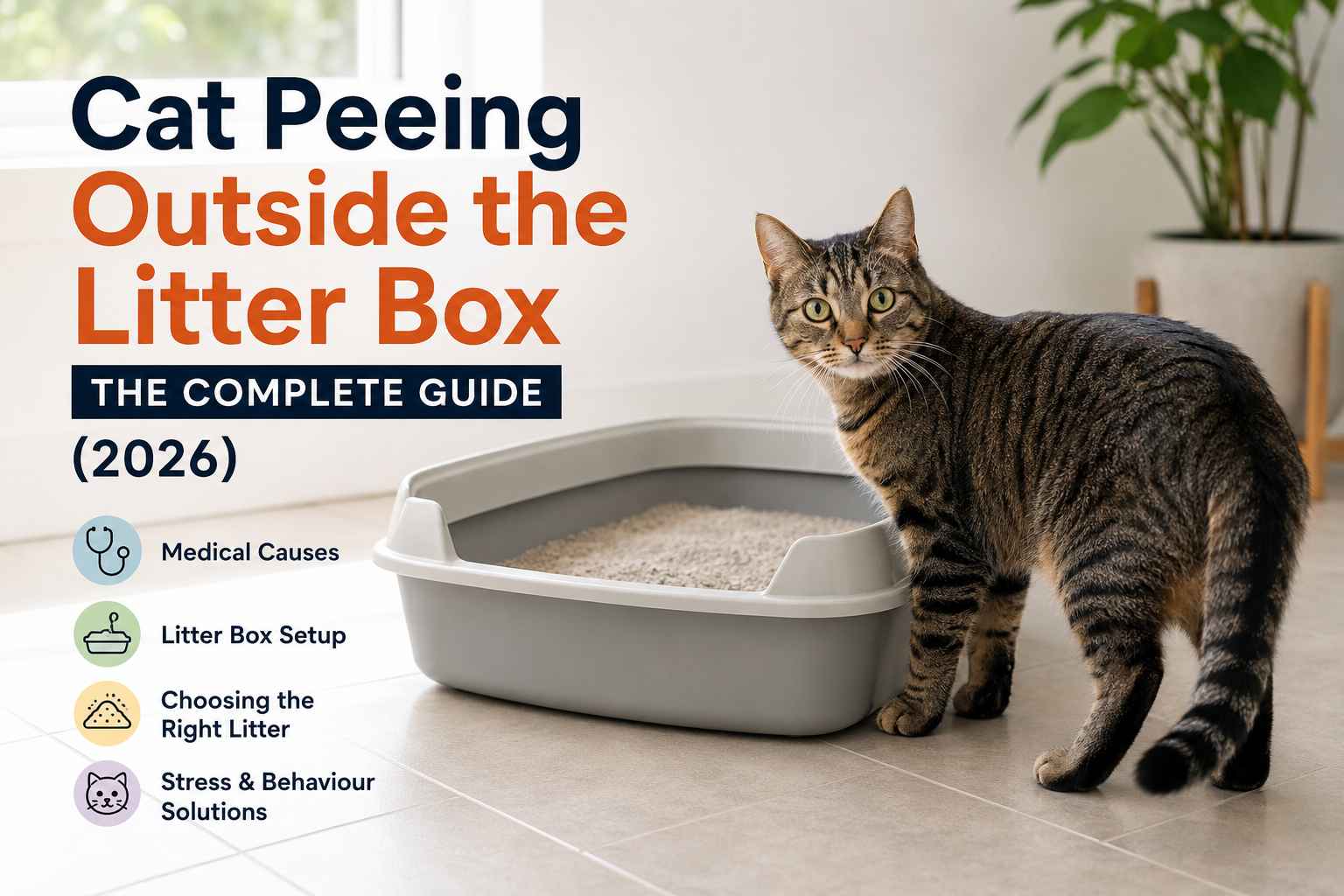
The Number Rule: One Per Cat, Plus One
The ASPCA recommends providing one litter box per cat in the household, plus one additional box. So for two cats, that means a minimum of three boxes. This rule exists because a single box shared among multiple cats fills up faster, smells more intensely, and becomes a source of territorial tension. Even single-cat households benefit from two boxes — it gives your cat options if one box has just been used, and reduces the chance of accidents if the single box gets too dirty between cleanings.
Location, Location, Location
Cats need to feel safe while eliminating — it is an instinctive vulnerability for them. A litter box placed next to a loud washing machine, in a high-traffic corridor, or directly next to a dog’s food bowl is likely to be avoided. The ASPCA advises placing boxes in quiet, accessible locations with at least two exit routes — so your cat never feels trapped. In multi-storey homes, at least one box per floor is good practice.
Size and Style: Bigger Usually Wins
Research published in a peer-reviewed study on litter box size and preference found that cats preferred boxes measuring at least 50 cm in length, and that offering a larger box improved house-soiling outcomes. If your cat is a larger breed or simply tends to hang over the edge, upsizing is a low-cost first intervention. Covered boxes can reduce scatter and odour for owners, but they trap smells inside, which may deter your cat — particularly if a scented litter is used. If your cat avoids a covered box, swapping to an open one is worth trying first.
Cleanliness: The Single Biggest Factor
A cat’s sense of smell is estimated to be many times more acute than ours. A box that you consider “fine” may be genuinely intolerable to your cat. Guidance from the ASPCA is clear: scoop at least once per day, clean the box weekly with warm water and mild unscented soap (or baking soda), and replace the litter completely at each cleaning. Avoid ammonia-based cleaners — urine contains ammonia, and cleaning with it can attract your cat back to the same spot to re-mark.
3. Choosing the Right Cat Litter
Not all cat litters are created equal — and more importantly, not all cats agree on what “equal” means. If the litter is uncomfortable, too strongly scented, or unfamiliar, your cat may simply choose not to use the box at all.
What Research Says About Litter Preferences
A 2025 peer-reviewed study on litter box preferences found cats consistently preferred clumping clay litter over wood and paper alternatives, with multiple prior studies describing the ideal litter as fine-grained, sand-like, unscented, and easily scoopable. The connection to cat evolution is clear: wild felid ancestors buried waste in fine soil, and domestic cats retain that preference. However, individual variation is real — some cats readily accept plant-based alternatives, particularly if introduced from kittenhood.
| Litter Type | Key Benefit | Potential Drawback | Cat Preference (Research) |
|---|---|---|---|
| Clumping clay (bentonite) | Easy scooping, strong odour control | Dusty; not eco-friendly; not for kittens | Generally highest preference in studies |
| Non-clumping clay | Lower cost, widely available | Urine pools; needs more frequent full changes | Acceptable to many cats |
| Silica gel crystals | Low dust, long-lasting absorbency | Pellet texture some cats dislike; higher cost | Mixed; some cats reject pellet texture |
| Wood / pine pellets | Natural odour absorption; eco-friendly | Pellet texture less preferred; strong scent | Lower in preference studies |
| Paper / recycled | Very low dust; good for post-surgery paws | Weaker clumping; softer feel may be disliked | Variable; generally lower preference |
| Corn / wheat / grass | Biodegradable; clumping available | Can attract insects if stored improperly | Limited research; individual variation high |
Sources: PMC litter box preference study; Animal Welfare Association litter guide.
Scent: Skip the Fragrance
Scented litters are marketed to owners, not cats. Cats’ olfactory systems are highly sensitive, and a strongly perfumed litter can make the box actively aversive. Multiple veterinary sources — including guidelines produced by the American Association of Feline Practitioners (AAFP) — recommend unscented litter as the default. If your box smells despite using unscented litter, the solution is more frequent cleaning, not a scented product.
Switching Litters
If you need to change litter types, Purina’s litter guidance recommends doing it gradually — replacing roughly one-third of the old litter with the new type, then increasing the proportion over 10–14 days. An abrupt switch can cause a previously reliable cat to reject the box entirely.
4. Stress, Anxiety, and Behavioural Causes
Even a perfectly set-up litter box can be avoided if your cat is anxious or stressed. Cats are creatures of routine, and relatively small environmental changes — ones that might seem trivial to us — can disrupt their sense of security enough to affect their litter box habits.
Common Stress Triggers
A new person in the home, a new baby, building work nearby, a house move, a new pet, a change in the owner’s working schedule, or even rearranging furniture can be enough to trigger litter box avoidance. PetMD specifically identifies feline idiopathic cystitis (FIC) as stress-related, meaning that chronic home stress can cause a physical, painful bladder condition — not just a behavioural one.
Urine Marking Versus Inappropriate Elimination
It is worth knowing the difference between these two behaviours, because their solutions differ. A cat that is eliminating outside the box usually squats and deposits larger amounts of urine on horizontal surfaces. A cat that is marking typically backs up to a vertical surface, holds its tail straight and quivering, and sprays smaller amounts of urine. As the ASPCA notes, urine marking is a communication behaviour — roughly 30% of cats that eliminate outside the box are marking, not having accidents. Neutering or spaying significantly reduces marking behaviour. Pheromone diffusers (such as synthetic feline facial pheromone products) can help reduce territorial anxiety in multi-cat homes.
Environmental Enrichment as Prevention
The American Association of Feline Practitioners (AAFP) and the International Society of Feline Medicine (ISFM) jointly released environmental needs guidelines that describe five pillars of a healthy feline environment: safe spaces, multiple separate resources (food, water, litter boxes), play and predatory opportunities, positive human interaction, and an environment that respects feline senses. Providing vertical spaces (cat trees, shelves), regular interactive play, and hiding spots reduces the ambient stress level that contributes to FIC and marking.
5. Multi-Cat Households and Territorial Dynamics
If you have more than one cat, the calculus becomes more complex. Even cats that appear to get along can have subtle territorial conflicts around resources — and the litter box is one of the most contested resources in a shared home.
The “Bully Cat” Problem
One cat may not be overtly aggressive but can still block or intimidate another cat’s access to the litter box. AAFP and ISFM house-soiling guidelines published in the Journal of Feline Medicine and Surgery describe how a “despot” cat can monopolise litter box resources, causing less confident cats to seek inappropriate elimination sites. If one of your cats is consistently soiling outside the box, watch whether another cat is guarding access.
Box Distribution in Multi-Cat Homes
Following the one-per-cat-plus-one rule is essential, but distribution matters as much as quantity. Two boxes in the same corner of a single room are effectively one location for a cat trying to avoid another. Spread boxes across different rooms and different floors. According to the ASPCA, each box should have at least two exit routes, so no cat can be ambushed while using it.
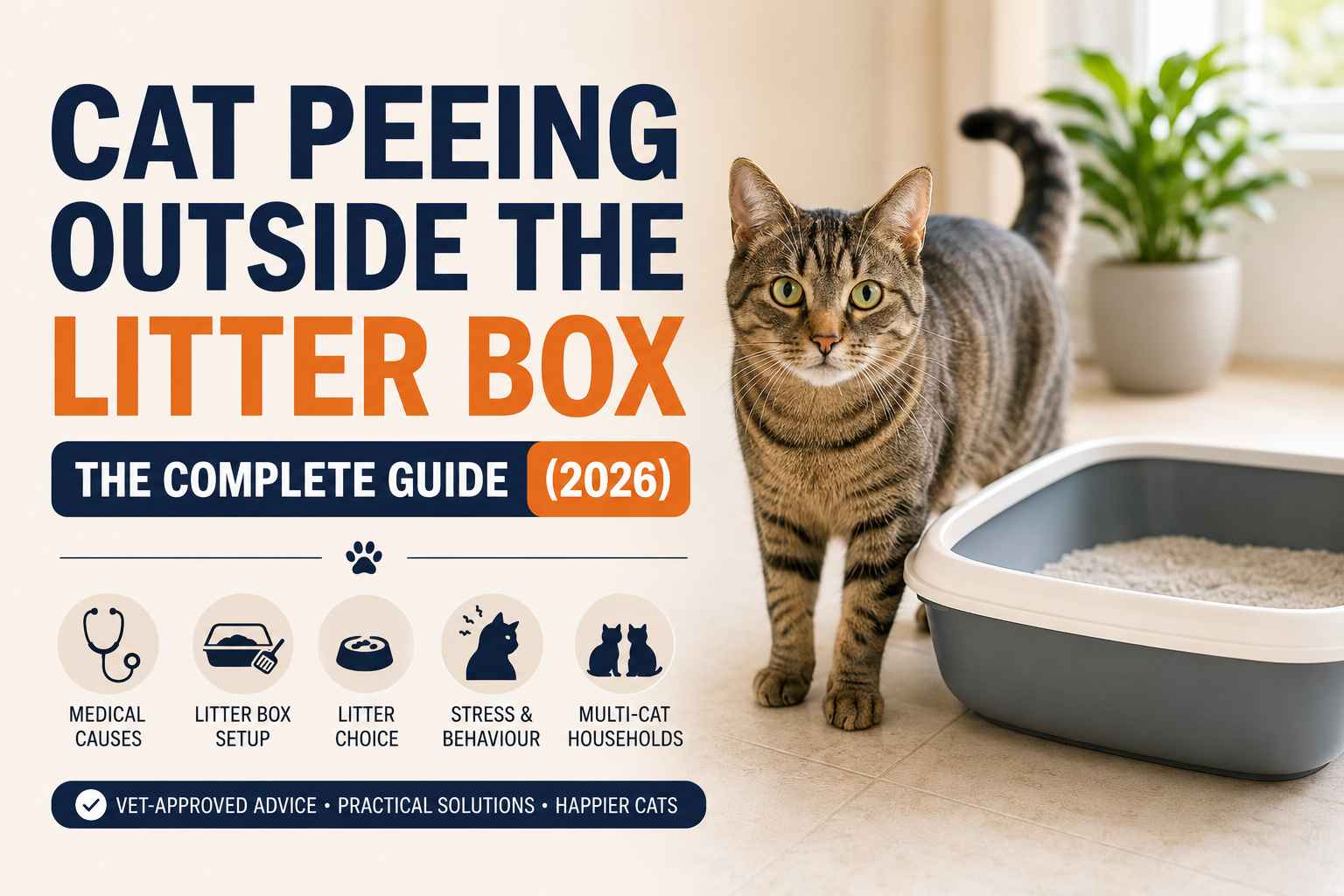
6. Special Considerations for Senior and Mobility-Impaired Cats
Older cats bring their own set of litter box challenges, and it is important not to misread a mobility issue as a behavioural problem.
Arthritis and the High-Sided Box
A cat with arthritis or other joint pain may simply be unable to climb comfortably into a standard litter box. If your older cat has started eliminating just outside the box — rather than in a completely different location — the most likely explanation is that they tried and could not quite make it. The ASPCA’s guidance on senior cat behaviour recommends low-sided boxes, placing at least one box on every floor of your home, and ensuring boxes are easy to locate. Large shallow storage containers with one end cut down make excellent low-entry litter boxes for arthritic cats.
Cognitive Decline
Feline cognitive dysfunction (FCD) — the feline equivalent of dementia — affects a significant proportion of cats aged 11 and above, according to ASPCA estimates. An affected cat may simply forget where the litter box is. Adding extra boxes in obvious, well-lit locations and keeping the cat’s environment consistent can reduce accidents. If you suspect cognitive decline, discuss it with your vet — there may be management options available.
7. What Recent Research Shows
The science of feline litter box behaviour has expanded meaningfully in recent years. Here is a summary of current evidence — each point is linked to a verifiable source.
Litter box size matters significantly. A peer-reviewed 2025 study found that cats showed a strong and consistent preference for boxes at least 50 cm in length, and that providing a larger box — combined with clumping clay litter — measurably improved house-soiling rates in cats with existing elimination problems. This is one of the more actionable findings of recent years, because upsizing a box is free or very low-cost.
Litter texture preference is real, but individual variation is high. Studies comparing multiple litter substrates — including a 2022 study on the behavioural impact of switching litter types — generally confirm that cats prefer fine-grained litter, while a smaller 2025 IAABC Foundation study found no strong group-level preference for texture in a nine-cat sample. The weight of evidence still favours fine-grained unscented litter as the safest default, but it highlights why individual cats should be allowed to demonstrate their own preferences where possible.
FIC treatment is moving toward environmental management. A 2024 survey of US veterinarians on FIC treatment approaches, published in a peer-reviewed journal, found broad support for a combination of litter box management, environmental modification, wet food diets, and hydration support — a system sometimes called MEMO (Multimodal Environmental Modification). Analgesics and prescription diets were also commonly used for acute presentations.
House soiling is a leading cause of cat relinquishment. A 2022 study noted that nearly 30% of cats surrendered to shelters had one or more behavioural concerns, and that a significant proportion of those involved inappropriate elimination. This underlines why addressing the problem thoroughly matters — not just for hygiene, but for the long-term wellbeing of your cat.
Multi-cat stress is a primary driver of territorial elimination. Research published in PMC on risk factors for urinary house soiling found that multi-cat households and free outside access (with cat flaps allowing neighbourhood cats to enter) were significant risk factors for territorial marking behaviour. Managing inter-cat conflict proactively — through resource distribution and environmental enrichment — appears to reduce this risk.
8. Six Common Mistakes Owners Make
- ⚠️ Common Mistake 1
Punishing the cat for accidents
Scolding, nose-rubbing in urine, or confining a cat after an accident does not work — and causes harm. Cats do not connect punishment with an act that happened even moments earlier, and adding stress can worsen the underlying problem, particularly if FIC or anxiety is involved.
Better approach: Clean the spot thoroughly with an enzymatic cleaner, identify the root cause, and make the litter box setup more appealing. Positive reinforcement when the cat uses the box correctly is far more effective.
- ⚠️ Common Mistake 2
Using ammonia-based cleaners on soiled areas
Urine contains ammonia. Cleaning an accident with an ammonia-based product leaves a scent that signals “here is a good toilet” to your cat. This is especially problematic if the accident happened on carpet or upholstery that absorbs odour deeply.
Better approach: Use an enzymatic pet odour cleaner, which breaks down the urine proteins that cause the scent rather than masking them. Enzymatic cleaners are widely available in pet shops and supermarkets in all five target countries. The ASPCA specifically recommends enzymatic cleaners for this reason.
- ⚠️ Common Mistake 3
Assuming the problem is behavioural without a vet check
It is tempting to jump straight to litter box changes or behaviour modification when your cat starts eliminating outside the box. But if the real cause is a UTI, FIC, kidney disease, or arthritis, environmental fixes will not solve it — and may delay treatment of a painful, worsening condition.
Better approach: Schedule a vet visit as the first step whenever the behaviour is new or sudden. Ask for a urinalysis and, for older cats, blood work. Address the environment and behaviour once medical causes have been ruled out or treated.
- ⚠️ Common Mistake 4
Placing the litter box next to the food and water
Cats instinctively separate their toilet sites from their eating areas — a survival behaviour from their wild ancestors. A litter box placed beside a food bowl sends conflicting signals and may cause litter box avoidance, or reluctance to eat from the nearby bowl.
Better approach: Keep litter boxes and feeding stations in separate rooms or, at minimum, opposite sides of a large room. As ARM & HAMMER’s litter guidance notes, if your cat has already chosen to eliminate in a spot, placing food there can help redirect the behaviour.
- ⚠️ Common Mistake 5
Switching litter brands abruptly
Cats often develop strong litter preferences in kittenhood. An abrupt switch — particularly to a different texture, granule size, or scent — can cause immediate rejection of the box. This is especially problematic if the owner switches for budget or eco reasons without considering the cat’s perspective.
Better approach: Transition over 10–14 days by gradually blending the new litter into the old, starting at about one-third new and increasing the proportion each week. If your cat rejects the new litter regardless, offer two boxes side-by-side — one with each litter — and follow their preference.
- ⚠️ Common Mistake 6
Using scented litter to cover odours
Strongly scented litters are designed to appeal to owners at the point of purchase. For cats, artificial fragrance can be actively off-putting, and covering the natural litter smell with a strong scent may cause litter box rejection — the opposite of the intended effect.
Better approach: Use unscented litter and control odour through more frequent scooping and regular full box cleans. The AAFP guidelines specifically recommend unscented clumping litter as the default for cats with any elimination issues.
9. Evidence-Based Recommendations
These recommendations are drawn from published veterinary and behavioural guidance. They reflect what is commonly advised — not personal clinical recommendations from our editorial team.
See a vet first. Any sudden change in litter box habits should be investigated medically before assuming a behavioural cause. A urinalysis is the most important first test.
Follow the one-per-cat-plus-one rule. Provide at least as many litter boxes as cats in the household, plus one extra, and distribute them in different locations across your home.
Offer large, low-sided, uncovered boxes. Research supports boxes of at least 50 cm in length. Older cats and those with joint issues especially benefit from low entry heights. Try uncovered boxes first if avoidance is occurring.
Use unscented, fine-grained clumping litter. This is the substrate most commonly preferred by cats across published preference studies. Avoid strong artificial fragrances.
Scoop at least once daily; clean weekly. Use warm water and mild unscented soap or baking soda. Never use ammonia-based or strongly scented cleaning products inside the box.
Clean accidents with enzymatic cleaner. This neutralises urine proteins rather than masking them, reducing the chance of repeat soiling in the same spot.
Reduce household stress proactively. Environmental enrichment — vertical space, hiding spots, interactive play, and predictable routines — lowers the ambient stress that can trigger FIC and stress-related marking, as recommended in the AAFP/ISFM Environmental Needs Guidelines.
Increase wet food and water intake. Better hydration is consistently recommended in FIC management protocols to dilute urine and reduce urinary tract inflammation. Water fountains can encourage cats who prefer running water to drink more.
Consult a certified feline behaviourist for persistent cases. If litter box problems continue after medical clearance and environmental changes, a qualified professional can help identify subtle triggers and devise a structured behaviour modification plan. In the USA, look for a CAAB (Certified Applied Animal Behaviourist) or veterinary behaviourist via the DACVB. In the UK, seek an ABTC-accredited clinical animal behaviourist. In Canada, consider a CASI-certified or PPG Canada-affiliated trainer. In Australia, look for a PPGA (Pet Professional Guild Australia) member or vet-referred behaviourist. In New Zealand, your vet can refer to an NZVA-recognised behaviourist. (Note: Professional body names and accreditations change — verify current credentials via your vet or the respective national body’s website before booking.)
Never punish for accidents. Punishment increases stress, may worsen the underlying cause, and does not teach alternative behaviour. Consistent positive reinforcement when the cat uses the box is far more effective.
Frequently Asked Questions
- Why is my cat suddenly peeing outside the litter box?
A sudden change in litter box habits is most often a medical signal. Common causes include urinary tract infections, feline idiopathic cystitis (FIC), kidney disease, diabetes, bladder stones, and arthritis. If the change is abrupt, your first step should be a veterinary visit to rule out a health problem before assuming it is behavioural. PetMD’s guide to litter box avoidance covers the full medical differential in detail.
- How many litter boxes should I have for one cat?
The widely recommended guideline is one litter box per cat, plus one extra. For a single-cat household, that means two boxes. For two cats, three boxes. The ASPCA and Cornell Feline Health Center both endorse this formula to reduce territorial stress and ensure your cat always has a clean option available.
- What type of litter do cats prefer?
Research published in peer-reviewed journals suggests most cats prefer unscented, fine-grained, clumping litter — a texture that mimics natural sand or soil. A 2025 study comparing multiple litter types found cats used clumping clay litter significantly more than wood pellet or paper alternatives. That said, individual cats vary, and some adapt readily to plant-based litters, particularly if introduced from kittenhood.
- When should I take my cat to the vet for litter box problems?
See a vet promptly if your cat strains to urinate and produces little or no urine (this can be a life-threatening urethral blockage, especially in male cats), has blood-tinged urine, cries while urinating, or has not urinated in 24 hours. Even without these emergency signs, any sudden change in elimination habits warrants a vet check to rule out medical causes before addressing environmental or behavioural factors.
- Is my cat peeing outside the litter box out of spite?
No. This is one of the most persistent misconceptions in cat care. Veterinary behavioural sources — including the Cornell Feline Health Center — are clear that cats do not urinate outside the box as revenge or punishment. The behaviour is almost always a signal: pain, stress, a disliked litter setup, or a health condition. Punishing a cat for accidents is counterproductive and can intensify stress-related elimination problems.
- What is feline idiopathic cystitis (FIC) and how does it relate to litter box avoidance?
Feline idiopathic cystitis (FIC) is bladder inflammation without a single identified cause, though environmental stress is considered a major contributing factor. Affected cats experience painful, frequent urination and may start associating the litter box with pain, causing them to eliminate elsewhere. A 2024 veterinarian survey found management most commonly combines stress reduction, wet food diets, increased hydration, and litter box optimisation.
- Does a dirty litter box cause cats to pee elsewhere?
Yes — it is one of the most common and easily corrected causes. Cats have a far more acute sense of smell than humans. A box that seems manageable to you may be genuinely aversive to your cat. Veterinary guidance universally recommends scooping at least once daily, doing a full litter change weekly, and washing the box with mild unscented soap monthly. See the ASPCA litter box guidelines for a detailed cleaning protocol.
- How do I stop my cat from peeing on the carpet or bed?
Start with a vet check to rule out medical causes. Then clean the soiled area thoroughly with an enzymatic cleaner. Add extra litter boxes in accessible locations, try unscented fine-grained litter, and reduce stressors in the home. Placing a food bowl near the accident spot can deter re-soiling, as cats instinctively avoid eliminating near food. If the problem persists after environmental changes, consult your vet or a certified feline behaviourist. Detailed guidance is available from the ASPCA.
Conclusion: Small Changes, Big Difference
A cat peeing outside the litter box is one of the most stressful situations a pet owner can face — but it is also one of the most solvable. In the majority of cases, it comes down to something specific: a health condition that needs treatment, a box that is too dirty, a litter the cat dislikes, or a stressor in the home that nobody noticed was affecting the cat.
The path forward is methodical. Start with a vet visit — no amount of litter-box rearranging will fix a UTI or FIC. Once health is cleared, work through the environment systematically: increase the number of boxes, move them to quieter spots, try a larger uncovered model, switch to unscented fine-grained litter, and clean more frequently. In multi-cat homes, watch for territorial dynamics and spread resources generously.
The key mindset shift is this: your cat is not being difficult on purpose. They are telling you something. The cleaner and more comfortable you make the litter box experience, and the lower the stress in their environment, the more reliably they will use it.
If you have worked through every environmental change and the problem persists, consult a certified feline behaviourist or veterinary behavioural specialist in your country. These professionals can identify subtle triggers that are easy to miss and build a structured plan for your specific household. The investment is almost always worth it.
For more on related topics, explore our guides on cat dental care and cat health and wellbeing on LifeWellGuide.
References
- Cornell University College of Veterinary Medicine — Feline Behavior Problems: House Soiling — Cornell Feline Health Center — https://www.vet.cornell.edu/…/feline-behavior-problems-house-soiling
- ASPCA — Litter Box Problems — American Society for the Prevention of Cruelty to Animals — https://www.aspca.org/pet-care/cat-care/common-cat-behavior-issues/litter-box-problems
- ASPCA — Urine Marking in Cats — American Society for the Prevention of Cruelty to Animals — https://www.aspca.org/pet-care/cat-care/common-cat-behavior-issues/urine-marking-cats
- ASPCA — Older Cats with Behavior Problems — American Society for the Prevention of Cruelty to Animals — https://www.aspca.org/pet-care/cat-care/common-cat-behavior-issues/older-cats-behavior-problems
- PetMD — 6 Reasons Your Cat Is Peeing Outside the Litter Box — PetMD — Updated March 2024 — https://www.petmd.com/cat/behavior/reasons-your-cat-peeing-outside-litter-box
- Chewy — Feline Idiopathic Cystitis (FIC) in Cats — Chewy Education — April 2025 — https://www.chewy.com/education/cat/health-and-wellness/thoroughly-vetted-feline-idiopathic-cystitis
- PMC / Journal of Feline Medicine and Surgery — AAFP and ISFM Guidelines for Diagnosing and Solving House-Soiling Behavior in Cats — 2014 — https://pmc.ncbi.nlm.nih.gov/articles/PMC11148882/
- PMC — Survey of Veterinarians in the USA on Non-Obstructive Feline Idiopathic Cystitis Treatment — 2024 — https://pmc.ncbi.nlm.nih.gov/articles/PMC11418619/
- PMC — Litter Box Size and Litter Type Preference and Their Associated Behavioral Changes in Cats — 2025 — https://pmc.ncbi.nlm.nih.gov/articles/PMC12169895/
- PMC — The Behavioural Impact on Cats during a Transition from a Clay-Based Litter to a Plant-Based Litter — 2022 — https://www.ncbi.nlm.nih.gov/pmc/articles/PMC9029339/
- PMC — Common Risk Factors for Urinary House Soiling (Periuria) in Cats — https://www.ncbi.nlm.nih.gov/pmc/articles/PMC5985598/
- IAABC Foundation Journal — Evaluating Litter Substrate Preferences in a Population of Cats — 2025 — https://journal.iaabcfoundation.org/evaluating-litter-substrate-preferences-in-a-population-of-cats/
- dvm360 — Feline Idiopathic Cystitis (clinical overview with AAFP guidelines) — https://www.dvm360.com/view/feline-idiopathic-cystitis
- AAFP/ISFM — Environmental Needs Guidelines (catvets.com) — American Association of Feline Practitioners — https://www.catvets.com/guidelines/practice-guidelines/environmental-needs-guidelines
- Humane World — How to Litter Train a Kitten or Cat — https://www.humaneworld.org/en/resources/how-litter-train-kitten-or-cat
- Purina — Cat Litter Box Tips — Purina — January 2026 — https://www.purina.com/articles/cat/behavior/litter/cat-litter-box-tips
- ARM & HAMMER — 5 Litter Box Tips for Litter Box Problems — https://www.armandhammer.com/en/articles/tips-getting-cat-use-litter-box
- Animal Welfare Association — The Ultimate Guide to Cat Litter — March 2025 — https://www.awanj.org/news/ultimate-guide-to-cat-litter/
- ScienceDirect — Field Assessment of Cats’ Litter Box Substrate Preferences — 2018 — https://www.sciencedirect.com/science/article/abs/pii/S1558787817302320