There is a particular kind of tiredness that only parents of toddlers know: the 6 a.m. nappy change, the bag packed with spares, the mental maths of how many wipes are left. So when potty training comes up — at the nursery gate, in a group chat, from a well-meaning relative — it lands with real weight. Is it time? Are we late? What if we get it wrong?
Here is the short version: learning how to potty train a toddler is less about the calendar and more about your child. Most children show the first signs of readiness somewhere between 18 and 24 months, and most are reliably dry in the daytime by around three to three and a half.
Written by Md Masud Rana based on published expert sources. This article has not been professionally reviewed. See our sources below.
Quick Answer: How to Potty Train a Toddler
Wait until your toddler shows clear signs of readiness — staying dry for about two hours, telling you when they need to go, following simple instructions and showing interest in the toilet. Then introduce a potty chair, build a simple routine around waking, meals and bedtime, use practice runs every couple of hours, praise every attempt, and stay calm about accidents. Most children take three to six months to become reliably dry in the daytime, and night-time dryness follows months later, on its own timetable.
Contents
- When to Start Potty Training: Readiness Beats the Calendar
- What You Need Before Day One
- How to Potty Train a Toddler, Step by Step
- Does the 3-Day Potty Training Method Really Work?
- Potty Training Boys vs Girls: What the Research Says
- Night-Time Dryness Is a Separate Skill
- Accidents, Regression and Poo Refusal
- Potty Training at Daycare, Nursery and Out and About
- What Recent Research Shows
- Common Mistakes to Avoid
- Final Recommendations
- Frequently Asked Questions
When to Start Potty Training: Readiness Beats the Calendar
There is no prize for finishing first, and no penalty for starting later. The Mayo Clinic puts it plainly — potty training success hinges on physical and emotional readiness, not a specific age.
Most children begin to show signs of bladder and bowel control between 18 and 24 months, according to the American Academy of Pediatrics, and most children in the United States are bowel and bladder trained by age four. The MedlinePlus guide from the US National Library of Medicine gives a similar window: most children start to show signs they are ready between 18 and 30 months, and before 18 months most cannot fully control their bladder and bowel muscles at all. In the UK, the NHS says most parents start thinking about potty training between two and two and a half.
The readiness signs that actually matter
Look for a cluster of these signs — three or four together mean your child is probably ready to try:
- Stays dry for two hours or more.
- Knows when they are going. They pause mid-play, grunt, squat, go quiet or hide behind the sofa.
- Tells you — in words, signs or gestures. They say “wee” or “poo”, point, or tug at their nappy. They do not need full sentences.
- Can follow simple instructions. “Bring me your shoes” or “sit on the potty”. If they can follow those, they can follow the steps of using the toilet.
- Can pull pants up and down.
- Shows interest in the toilet or in “big kid” underwear. They follow you into the bathroom and watch you flush. Curiosity is a green light.
- Dislikes a wet or dirty nappy. They ask to be changed, or try to take the nappy off themselves.
KidsHealth lists the same signs and adds that boys often start later and take longer than girls — which the research in this guide backs up.
When to wait, even if the signs are there
Timing matters as much as readiness. The week you move house, the week a new baby arrives, the week your child starts nursery — that is not the week to begin. Put it off during travel, a house move, the birth of a sibling, a switch from cot to bed, or illness.
If you have already started and it is clearly not working — daily distress, outright refusal, holding in wee or poo for hours — the honest move is to stop. MedlinePlus says it directly: if your child resists the training, it means they are not ready yet, so back off and wait a few weeks before trying again.
What You Need Before Day One
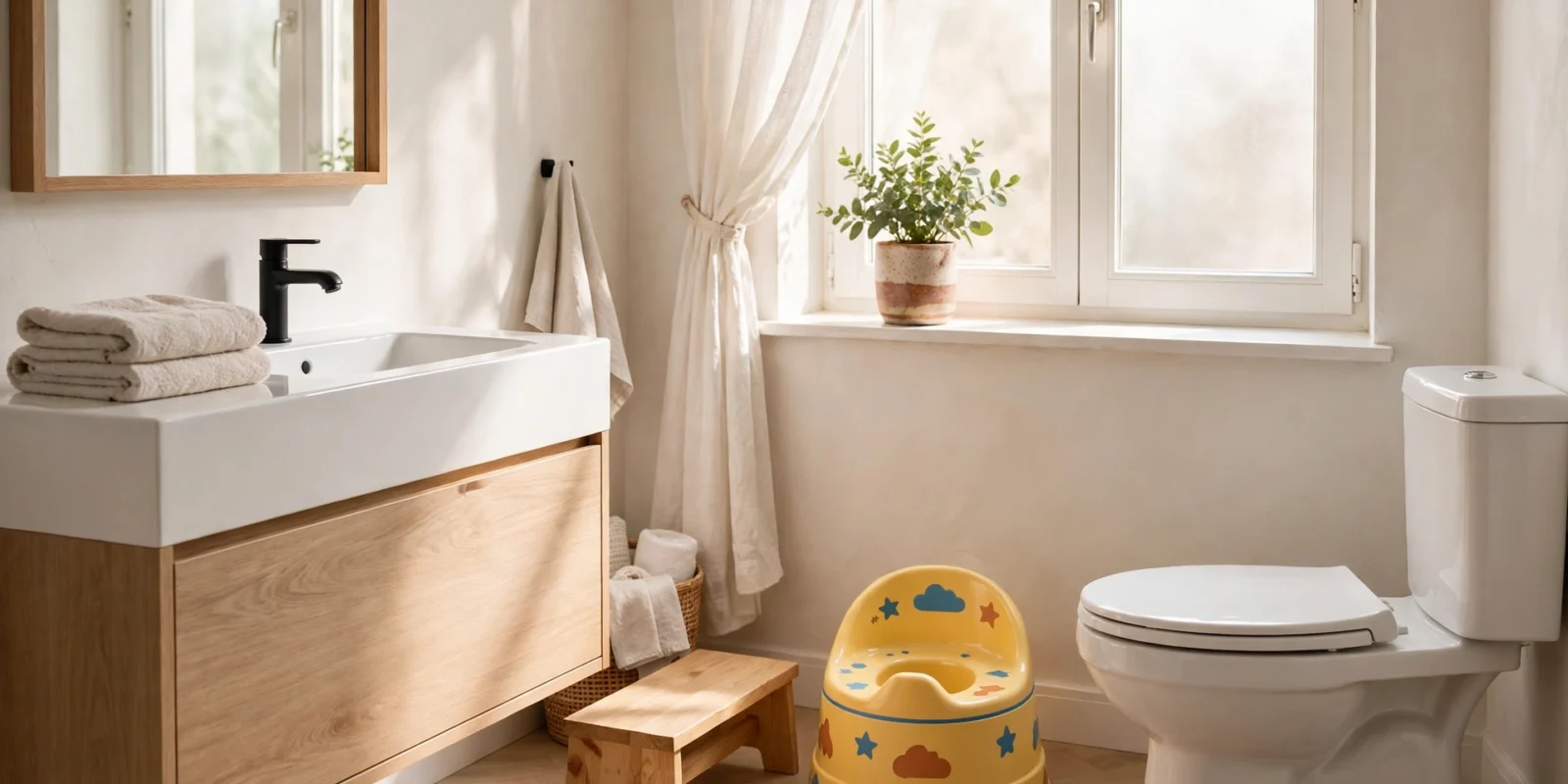
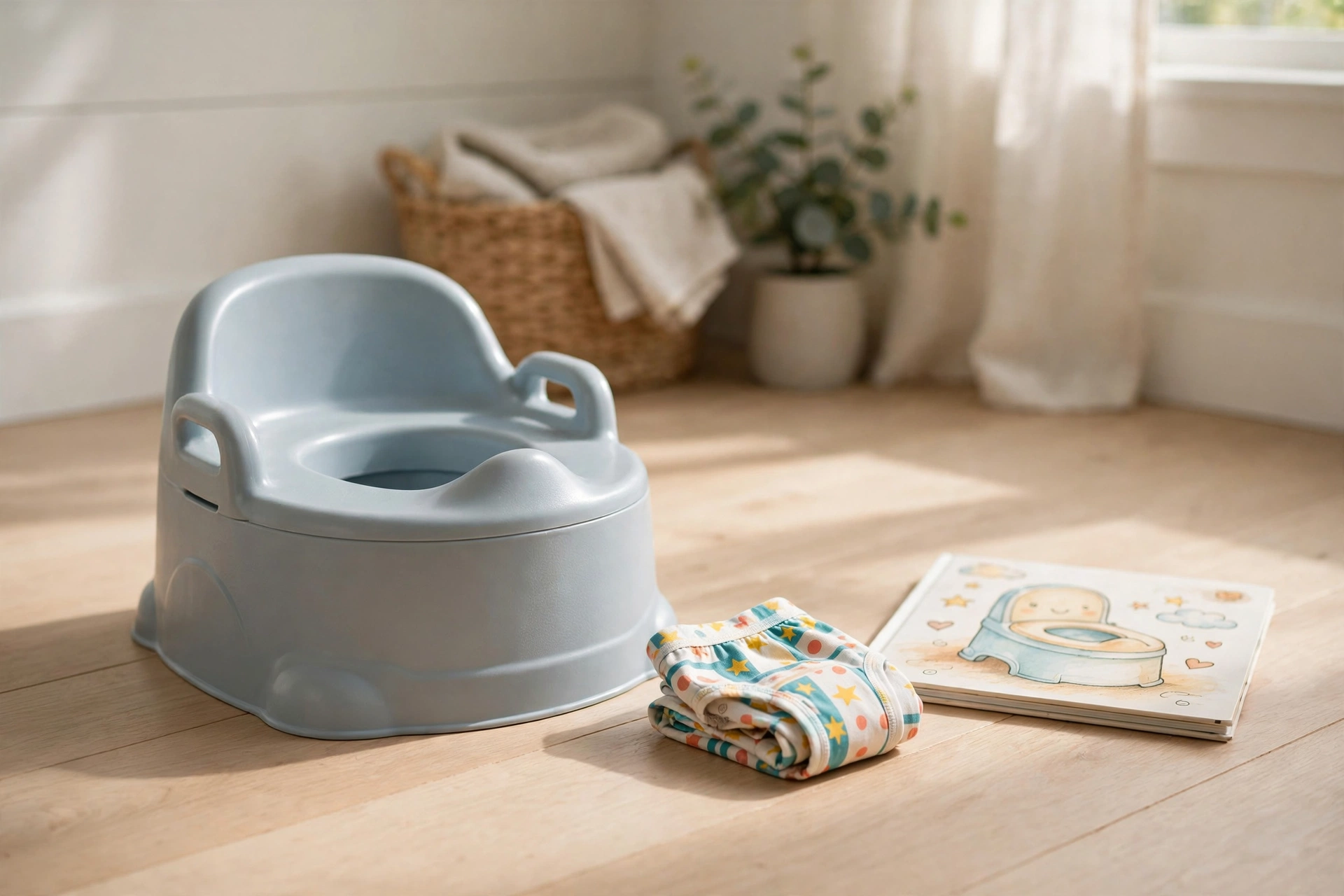
You need little equipment: a potty your child can reach, clothes they can manage alone, and a safe bathroom. There are two basic potty options. A standalone potty chair is low and stable, with a bowl you empty into the toilet; children like them because their feet touch the floor, which makes pushing easier. A child seat on the family toilet, plus a step stool, skips the transition from potty to toilet later. The step stool matters either way: feet need support, and dangling legs make it physically harder to relax the muscles that release wee and poo.
Let your child help choose if you can — a potty in a colour they picked is a potty they are more willing to sit on. Let them sit on it fully clothed before training starts, so it becomes familiar — MedlinePlus recommends exactly this.
Buy easy-off clothes — loose trousers with elastic waists, no dungarees, no belts, no poppers at the crotch — plus a dozen pairs of cheap underwear and washable waterproof mattress protectors for the bed and the car seat. Make the bathroom safe and reachable: a non-slip step, a night light, and anything dangerous locked away. Our baby proofing checklist covers the locks, latches and hazards worth sorting before your toddler starts spending unsupervised minutes in there. Finally, agree the words — “wee”, “poo”, “potty” — and use the same words everywhere, at home, at nursery and with grandparents.
How to Potty Train a Toddler, Step by Step
There is no single “right” method, and the guides that claim otherwise are selling something. What the major paediatric sources agree on is a shape: prepare, practise, build a routine, praise the trying, and let the child take over gradually. The American Academy of Pediatrics advises building a plan that fits your particular child.
Step 1: Talk about it first
A week or two before you start, read a picture book about using the potty together. Let your child watch you — or an older sibling — use the toilet, and narrate what is happening in plain words.
Step 2: Start with practice runs
The Mayo Clinic describes “practice runs”: you lead your child to the bathroom, seat them on the potty chair with their nappy off, and do it when they show signs of needing to go — a certain face, holding themselves, pacing, squatting, grunting, or dancing in place. Keep each sit short — five minutes at most — and let them get up when they want to. Even if nothing happens, praise them for trying. Praise your child for telling you they need to go, rather than praising the wee or poo itself.
Step 3: Build a routine around the body’s clock
Most children need to go within 15 to 30 minutes after a meal — the body’s natural gastro-colic reflex — and many have a regular time of day for a bowel movement. KidsHealth recommends sitting your child on the potty within 15 to 30 minutes after meals for exactly this reason. Try first thing in the morning, after each meal, before and after naps, and before bed.
Step 4: Make the connection visible
When your child does a poo in their nappy, tip it into the potty or the toilet and say, “Poo goes in the potty.” Let them watch you flush — but do not flush while they are sitting on the potty, because the noise and the swirl can frighten a small child. MedlinePlus recommends exactly this little ritual, and it works because it is concrete: the child sees where the poo belongs.
Step 5: Praise effort, stay boring about accidents
Small rewards help — a sticker, a star on a chart — kept immediate and small. What matters far more is your reaction to accidents, because accidents are not a failure of the method — they are the method. A child learning to use the toilet will have accidents for weeks, and the worst thing you can do is make a fuss. The Mayo Clinic advises staying calm when accidents happen, never getting angry and never punishing your child. MedlinePlus agrees: stay calm, clean up, gently remind your child to use the toilet next time, and never scold.
Step 6: Ditch the nappies, then let your child lead
After a couple of weeks of successful potty breaks and dry days, try underwear in the daytime. Training pants (pull-ups) are a useful middle step, especially for outings and naps, because they are easy to pull up and down. KidsHealth suggests asking your doctor whether your child would benefit from disposable training pants, and switching to underwear once the training pants stay dry for a few days.
The Mayo Clinic says that once your child starts going without prompting, you can do fewer practice runs, and over time only step in when your child ignores a clear signal.
Does the 3-Day Potty Training Method Really Work?
Search for potty training advice and you will trip over the three-day method within minutes. The promise is seductive: clear a long weekend, ditch the nappies, stay home, watch your child like a hawk, and by Sunday night they are trained.
Pick three days at home. Your child goes bare-bottomed or in underwear during waking hours. You offer extra fluids so there are many chances to practise. You watch closely and rush to the potty at the first sign. You celebrate successes and clean up accidents without comment.
What it gets right — and what the label gets wrong
Three focused days of concentrated attention, immediate feedback and no nappy absorbing the evidence will teach most ready children the basic connection.
But three days is the beginning, not the finish. KidsHealth puts the realistic timeline at three to six months for most children to learn to use the toilet reliably, and notes that it can take months to years to master staying dry at night. MedlinePlus gives the same three-to-six-month figure.
There is also a real risk worth naming. A child who cannot yet relax on command can end up holding in bowel movements for days, and constipation makes everything harder — including potty training itself. If your child is distressed, frightened of the potty, or showing no progress after three days, the method’s own honest answer is to stop and leave it a few weeks before trying again, not to push through.
So should you try it? If your child is showing clear readiness signs, you have a free long weekend, and you can commit three days of undivided attention without turning it into a high-stakes performance, the intensive weekend is a reasonable way to begin.
Potty Training Boys vs Girls: What the Research Says
Every parent group has someone who will tell you that girls train earlier than boys, and on this one the folk wisdom happens to be backed by research. The largest study to track the whole sequence of toilet-training skills was published in Pediatrics in 2002. Researchers followed 267 children with weekly parent surveys for over a year. Reported by the American Academy of Pediatrics when the study was published, the findings were clear: girls achieved nearly all toilet-training skills earlier than boys.
The numbers: the median age for “staying dry during the day” was 32.5 months for girls and 35 months for boys. The gap is real but small, about two to three months on average, and it says nothing about any individual child.
What does this mean in practice? Almost nothing that should change your approach, and one thing that should change your expectations. If you are training a boy, expect the process to take a little longer on average, and do not compare him with a sister or a friend’s daughter who finished at two. The one practical difference: for boys, it is usually best to master weeing sitting down first, and only move to standing up once poo training is complete, as both the Mayo Clinic and KidsHealth advise. Sitting helps a boy empty his bladder properly.
Night-Time Dryness Is a Separate Skill
Here is the fact that surprises most parents, and the one that saves the most unnecessary worry: staying dry at night is not something you can teach. It is a biological milestone — and it arrives on its own timetable, usually months or even years after daytime dryness.
MedlinePlus states it plainly: even after staying dry during the day, most children need more time to be able to sleep through the night without wetting the bed, and this is the last stage of toilet training. KidsHealth agrees, noting that it can take months to even years to master staying dry at night.
That has practical consequences. Do not try to train nights at the same time as days. Do not restrict fluids in the evening; a thirsty child sleeps worse, and dehydration does not teach bladder control. Use nappies or training pants at night without apology, and keep a waterproof mattress protector on the bed. Night dryness most commonly arrives between the ages of five and seven for the last children to get there, and that is normal. If your child is still regularly wetting the bed past five or six, talk to your child’s doctor. A settled bedtime routine helps in the background — our baby sleep schedule by age guide covers routines that make the last wee of the day a habit rather than a negotiation.
Accidents, Regression and Poo Refusal
Most potty training guides spend their energy on starting. The hard part, for most families, is what happens in the middle: the accidents that keep coming, the week where everything goes backwards, and the child who will happily wee on the potty but absolutely will not poo there.
Accidents after seeming trained
A child who was using the toilet reliably and has started having accidents again is one of the most common concerns parents raise — and the first thing to check is not behaviour but the body. Constipation is the usual suspect: a child with hard, painful stools will avoid pooing, and a full bowel presses on the bladder, which makes wee accidents more likely. Rule out constipation before you change anything else. A diet with enough fibre and fluids helps, and if your child is regularly constipated, talk to your child’s doctor rather than trying to fix it with diet alone. Our starting solids guide covers fibre-rich first foods — the same principles apply to toddlers.
Regression: when a trained child goes backwards
Regression is when a child who had been using the potty successfully for weeks or months starts having frequent accidents, avoids sitting, or asks for nappies again. It is different from the ordinary bumpiness of early training, which involves accidents throughout. Regression has a cause, and finding it matters more than fixing the accidents.
The usual triggers are emotional: a new sibling, a house move, starting nursery or preschool, a change in childcare, parental conflict, or an illness. Pampers’ guide to regression, which draws on paediatric sources, lists the same set: life changes, emotional stress, and medical issues such as urinary tract infections or constipation. Most regressions are temporary and resolve within a few weeks.
What not to do matters just as much. Never threaten to put a child back in nappies as a punishment — it adds shame and no upside. And if the regression is sudden and extreme, or tied to pain when weeing or pooing, check in with your child’s doctor — pain and frequent wetting can be a sign of a urinary infection, which needs treatment, not training.
Poo refusal: the most common specific problem
A child who wees on the toilet reliably but will not poo there is so common it has its own name in the parenting literature, and it affects up to one in four children at some point. The cause is usually fear or discomfort — a hard stool once, a splash of cold water, the strange sensation of something leaving the body while sitting on a big white bowl.
The fix is patience and a lowering of the stakes. Let them poo in a nappy if they need to — but in the bathroom, sitting on or near the potty, so the routine stays connected to the place. Never force a child to sit and strain, and never make pooing a test. Treat constipation first, because a child who is afraid of pain will not relax, and no behavioural trick works on a child who is physically unable to go comfortably. If withholding goes on for days, or your child is clearly in pain, that is a doctor’s visit, not a parenting problem.
Potty Training at Daycare, Nursery and Out and About
Potty training does not happen in one place, and a plan that only works at home is a plan that will stall on Monday morning. Before you start, talk to your child’s nursery or daycare. Ask how they handle it and what they need from you — usually spare clothes and a labelled potty seat. The American Academy of Pediatrics stresses this point: your approach needs to be consistent with the approach of your child’s other caregivers, or the child gets two different sets of rules and learns neither.
Most nurseries will not start potty training for you, but good ones will support a child who has started at home. Send more spare clothes than you think you need, including shoes and socks. Dress your child in clothes the nursery staff can manage quickly. Label everything.
For outings, pack a small kit: spare underwear, spare trousers, a few plastic bags for wet clothes, wipes, and a travel potty seat or a foldable potty if you use one. Stop every hour or two on long journeys. Know where the toilets are before you need them.
What Recent Research Shows
The research on toilet training has not been rewritten in the last few years. The readiness-based approach described by the Mayo Clinic, the American Academy of Pediatrics and the NHS remains the consensus. Two findings are worth knowing. First, starting earlier does not mean finishing earlier: research found that children who began training between 18 and 24 months took 13 to 14 months on average to complete the process, while children who started after 27 months took ten months or less. The early starters spent longer in the messy middle and finished at roughly the same age as the later starters. Second, the sequence of skills is remarkably consistent — readiness skills first, self-help skills in the middle, completion milestones last — and wiping properly was the very last skill to emerge, with a median age of around four years. The UK charity ERIC reports that around one in four children in England and Wales are starting school not yet toilet trained — a real trend, but not evidence that later training is harmful.
Common Mistakes to Avoid
Here are the five that come up most often:
1. Starting because of the calendar, not the child
Starting at eighteen months because a book said so, or at three because nursery expects it. Children started before they are ready do not finish sooner — they just spend longer in the messy middle. Wait for the signs.
2. Turning it into a power struggle
The more you insist, the more a toddler resists — that is their job at this age. Keep it low-key. Offer, don’t order. If they say no, say “Okay, we’ll try later” and mean it.
3. Punishing accidents or showing disappointment
Scolding or sighing loudly does not speed anything up. It teaches the child that accidents are shameful, which makes them hide accidents, hold in wee and poo, and avoid the potty altogether. Stay boring about accidents. Clean up, move on.
4. Expecting night-time dryness on the same schedule as daytime
Night dryness is biological, not teachable, and trying to train it causes needless stress — for the child and for you. Keep the nappy at night and let it arrive when it arrives.
5. Ignoring constipation
Hard, painful stools are the single most common physical cause of potty training problems, and the easiest to miss. If your child is pooing less than every couple of days, straining, or avoiding pooing altogether, sort that out first — with enough fibre and fluids, and with your child’s doctor if it persists.
Final Recommendations
Take these:
- Wait for readiness, not a birthday. Three or four signs together matter more than any age.
- Start when life is calm. No house moves, new babies or nursery starts in the same fortnight.
- Build a simple routine. Potty sits after waking, after meals, before and after naps, and before bed.
- Praise the telling, not just the result. Reward your child for communicating the need to go.
- Stay calm about accidents. They are part of learning, not a failure. Clean up without a fuss, and never punish or shame.
- Keep every caregiver on the same page. Same words, same routine, same approach at home, at nursery and with grandparents.
- Treat night-time as a separate milestone. Keep nappies at night and do not try to train what biology has not yet delivered.
- Rule out constipation and pain early. If pooing hurts, or accidents come with pain or frequent wetting, talk to your child’s doctor.
- Know when to pause. If your child is distressed or refusing outright, stop for a few weeks and try again.
This content is for educational purposes only and does not replace professional medical advice. Always consult a qualified health professional before making health decisions for your child.
Frequently Asked Questions
Most children show signs of readiness between 18 and 24 months, and most are reliably dry in the daytime by around three to three and a half. Look for a cluster of signs — staying dry for about two hours, telling you when they need to go, following simple instructions, pulling pants up and down, and showing interest in the toilet.
For most children it takes three to six months to become reliably dry in the daytime. The core daytime skill often clicks within days or weeks for a ready child, then accidents taper over the following weeks, and self-initiation firms up over a month or two. Night-time dryness is separate and usually arrives months or years later.
For many ready children, three focused days at home are enough to learn the basic connection between the feeling of needing to go and the potty. But three days is the beginning, not the finish. If your child is distressed or shows no progress after three days, stop and wait a few weeks before trying again.
There is no single age, and the range of normal is wide. Research published in Pediatrics found the median age for staying dry during the day was 32.5 months for girls and 35 months for boys. Most children in the United States are bowel and bladder trained by age four. If your child is four or older and not yet using the toilet, talk with your child's doctor.
This is called regression, and it is common and usually temporary. The usual causes are a big change (a new sibling, a house move, starting nursery), emotional stress, or a physical issue — most often constipation or a urinary tract infection. Rule out medical causes with your child's doctor and go back to a reminder schedule for a while. Most regressions settle within a few weeks.
Poo refusal affects up to one in four children and is usually caused by fear or discomfort, often after one hard or painful stool. Let your child poo in a nappy in the bathroom if they need to. Never force them to sit and strain. Treat constipation first. If withholding lasts for days or your child is in pain, see your child's doctor.
Night-time dryness is a biological milestone, not something you can teach — it depends on the body's overnight urine production and bladder capacity. Most children stay dry at night months or years after daytime training. Keep nappies or training pants at night, use a waterproof mattress protector, and do not restrict evening fluids.
Conclusion
Potty training is one of those milestones that looks, from the outside, like a test — of your child, and quietly of you. It is not. It is a skill your child will learn, at their own pace, the way they learned to walk and to talk: unevenly, with falls, and then suddenly all at once.
So watch for the signs, pick a calm fortnight, set up a potty your child can reach, and start with practice runs and patience. Expect three to six months for daytime reliability, expect night-time dryness to arrive in its own time. If something feels off — pain, persistent constipation, regression that does not settle, or a child over four who is not yet using the toilet — talk to your child’s doctor. And when it clicks — when your toddler stops mid-game, announces they need the potty, and trots off to the bathroom alone — take a moment to notice it. You taught them that, slowly, one calm clean-up at a time. If you want a broader view of the toddler years, our baby and toddler care basics guide is a good next read.
References
- Mayo Clinic — Potty training: How to get the job done — Mayo Clinic — https://www.mayoclinic.org/healthy-lifestyle/infant-and-toddler-health/in-depth/potty-training/art-20045230
- MedlinePlus, US National Library of Medicine — Toilet training tips — MedlinePlus Medical Encyclopedia — https://medlineplus.gov/ency/patientinstructions/000944.htm
- American Academy of Pediatrics, HealthyChildren.org — Create a Potty Training Plan for Your Child — 2022 — https://www.healthychildren.org/English/ages-stages/toddler/toilet-training/pages/Creating-a-Toilet-Training-Plan.aspx
- Nemours KidsHealth — Potty Training — https://kidshealth.org/en/parents/toilet-teaching.html
- NHS Healthier Together — Toilet Training — https://www.healthiertogether.nhs.uk/child-under-5-years/toilet-training
- ERIC, The Children’s Bowel and Bladder Charity — https://eric.org.uk/
- Schum TR, Kolb TM, McAuliffe TL, Simms MD, Underhill RL, Lewis M — Sequential Acquisition of Toilet-Training Skills: A Descriptive Study of Gender and Age Differences in Normal Children — Pediatrics, 2002;109(3):e48 — via Newswise — https://www.newswise.com/articles/children-ready-to-toilet-train-later-than-cited-in-contemporary-medical-literature
- Pampers — Potty-Training Regression: Signs, Causes, and Tips — https://www.pampers.com/en-us/toddler/potty-training/article/potty-training-regression