
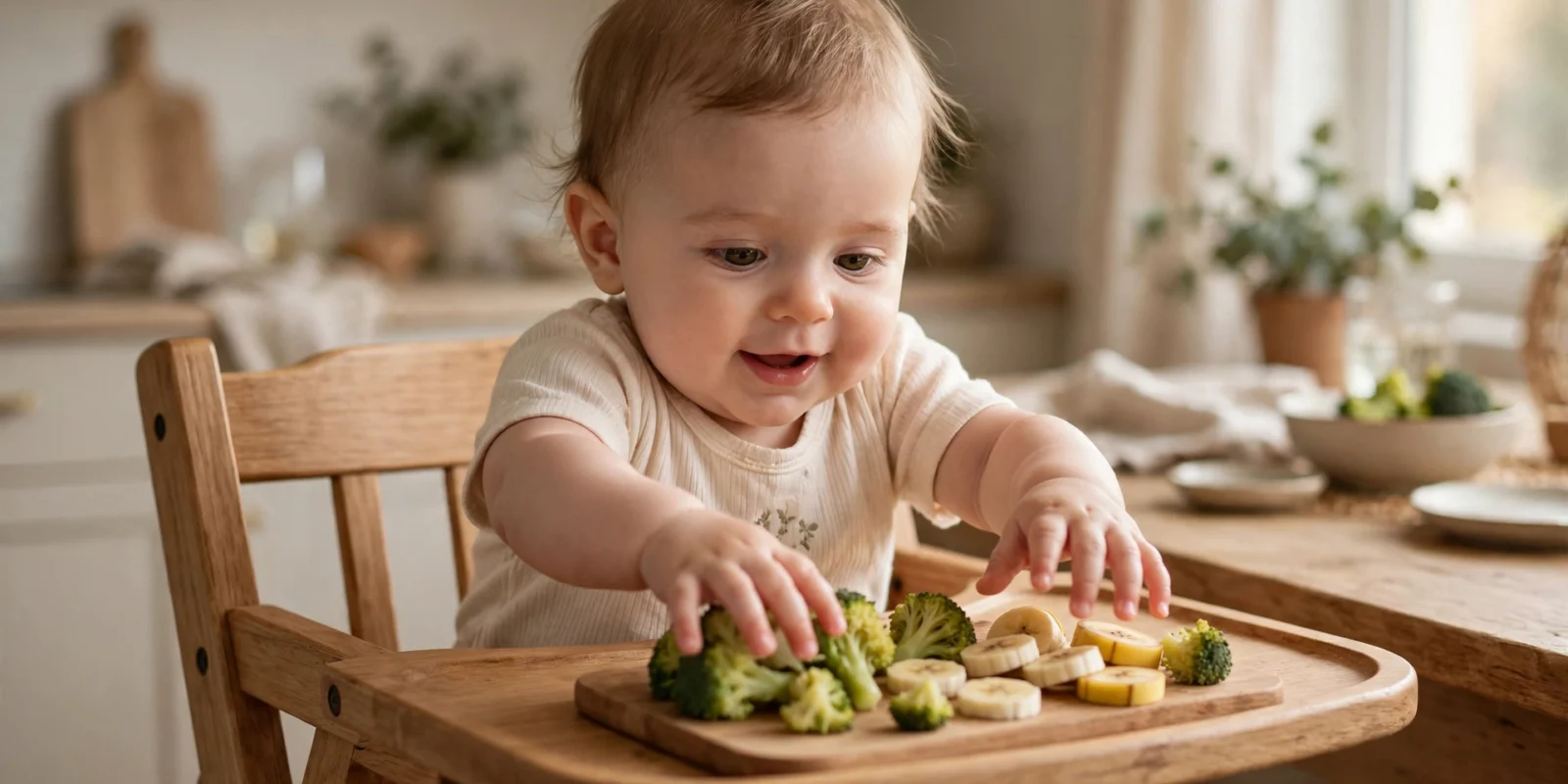
There is a particular kind of silence that falls over a kitchen table when a six-month-old meets their first piece of real food — not the silence of a baby asleep in a bouncer, but of a small person concentrating very hard on a strip of avocado, squashing it, tasting it, and wearing most of it on their cheek. If you have watched that happen, you already understand baby-led weaning.
Baby-led weaning — BLW for short — means skipping the spoon-fed purée stage and letting your baby feed themselves soft finger foods from the very start of solids. No jars, no blending, no aeroplane spoon. Just real food, cut into shapes a baby can grip, offered at family mealtimes while your baby decides how much goes in.
It sounds simple, and in many ways it is. But the questions pile up fast: is it safe? When do you start? What if your baby gags? What about iron and allergies? This guide answers all of it, drawing on guidance from the WHO, the AAP, the CDC, and the NHS.
Written by Md Masud Rana based on published expert sources. This article has not been professionally reviewed. See our sources below.
Quick Answer
Baby-led weaning is a way of starting solids in which your baby feeds themselves soft, finger-shaped pieces of real food instead of being spoon-fed purées. Most babies are ready at around 6 months, once they can sit up with good head control, bring food to their mouth, and swallow rather than push it back out. Offer soft foods your baby can mash with their gums — ripe banana, avocado, steamed vegetables, shredded meat, egg — and include an iron-rich food at most meals. Gagging is normal and noisy; choking is silent and is an emergency. Always stay with your baby, seated upright, while they eat.
Contents
- What Is Baby-Led Weaning?
- When to Start Baby-Led Weaning
- How to Start Baby-Led Weaning: A Simple First-Week Plan
- The Best First Foods for Baby-Led Weaning
- Gagging vs Choking: How to Tell the Difference
- Introducing Allergens the Safe Way
- Foods to Avoid in the First Year
- Baby-Led Weaning vs Purées: An Honest Comparison
- What Recent Research Shows
- Common Mistakes to Avoid
- Final Recommendations
- Frequently Asked Questions
What Is Baby-Led Weaning?
Baby-led weaning is exactly what it sounds like: your baby leads. Instead of you deciding what goes on the spoon and when, you put soft, graspable pieces of food within reach and let your baby pick them up, explore them, and eat as much — or as little — as they want. The approach was popularised by British midwife Gill Rapley.
The word “weaning” trips people up. Here it does not mean stopping breastfeeding — it means the gradual move from a milk-only diet to milk plus solid food. Breast milk or formula stays the main source of nutrition well into the first year. Solids are, at first, mostly practice.
In practice, your baby sits in a high chair at the family table, upright and buckled in, while you offer a few small portions of whatever the family is eating — soft, unsalted, cut into finger-shaped strips. Your baby self-feeds. You do not put food into their mouth, and you do not insist they finish anything. Some gets eaten; much gets squashed, dropped, or worn as a hat. That is not failure — it is the learning process working as intended.
It is not a ban on spoons, either. The American Academy of Pediatrics (AAP) notes that offering purées some of the time is perfectly fine — when travelling, when you are short on time, or when your baby prefers it that day. Many families do a mix, and the NHS says there is no right or wrong way, as long as your baby eats a wide variety of foods and gets the nutrients they need.
Why parents choose it
Parents who love it usually give the same reasons: less work, since your baby eats a version of what you are already cooking; real flavours and textures from day one; and mealtimes that are social, with your baby at the table watching and copying you. The AAP lists the possible benefits advocates point to — independence, more flavours and textures, whole foods, stopping when full, motor skills — but notes there are very few studies on the health advantages.
When to Start Baby-Led Weaning
Most babies are ready for solids at around 6 months — the position of the WHO, the AAP, the CDC, and the NHS. The CDC advises against starting any solids before 4 months, and the AAP says a few babies may be ready a little earlier than six months. For baby-led weaning in particular, waiting until your baby has the skills to sit and grab makes self-feeding safer.
Six months is a guide, not a starting gun — some babies are ready at five and a half months, plenty not until seven or eight. What matters is the developmental signs, not the date. The NHS describes three signs that should appear together:
- Your baby can stay in a sitting position and hold their head steady. An upright airway is the single biggest safety factor in self-feeding.
- Your baby can co-ordinate eyes, hands, and mouth — look at food, pick it up, and get it to their mouth. This is the “led” part: no reaching, no self-feeding.
- Your baby can swallow food rather than spit it straight back out. The tongue-thrust reflex that protects young babies usually fades at around four to five months; until it does, solids are a non-starter.
The CDC lists the same signs, adding that your baby should open their mouth when food is offered and try to grasp small objects. If all the signs are there together, your baby is ready.
Signs that are not signs
Three behaviours are routinely mistaken for readiness, and the NHS is explicit that they are not reliable: chewing on fists, waking more at night, and wanting extra milk feeds are all normal baby behaviour. None means your baby needs solid food, and starting solids will not make your baby sleep through the night. If night waking is the issue, our sleep training guide covers what actually helps.
If your baby was born prematurely, has difficulty sitting up, or struggles to chew and swallow even soft foods, talk with your paediatrician before starting. For premature babies, readiness is usually judged on corrected age.
How to Start Baby-Led Weaning: A Simple First-Week Plan
The first week sets the tone. Keep it calm, keep it short, and keep your expectations low: you are introducing a brand-new skill — eating — to a person who has spent their whole life drinking.
Set up the seat
Use a sturdy high chair with the harness buckled, your baby sitting fully upright. Never feed a baby who is lying back, in a car seat or stroller, crawling, or walking around. An upright baby can cough, gag, and clear their mouth effectively; a reclined baby cannot.
Pick a calm moment
Choose a time when your baby is alert but not ravenous or overtired. Many parents offer a little milk first, so their baby arrives at the table relaxed and curious rather than frantic. Mid-morning or lunchtime, when you are unhurried, beats late afternoon.
Offer two or three pieces
Put a few soft, finger-shaped pieces on the tray — or hand one to your baby. That is all; a whole plate is overwhelming and mostly ends up on the floor. Let your baby look, touch, squish, and taste. Do not put pieces into their mouth or pressure them to finish.
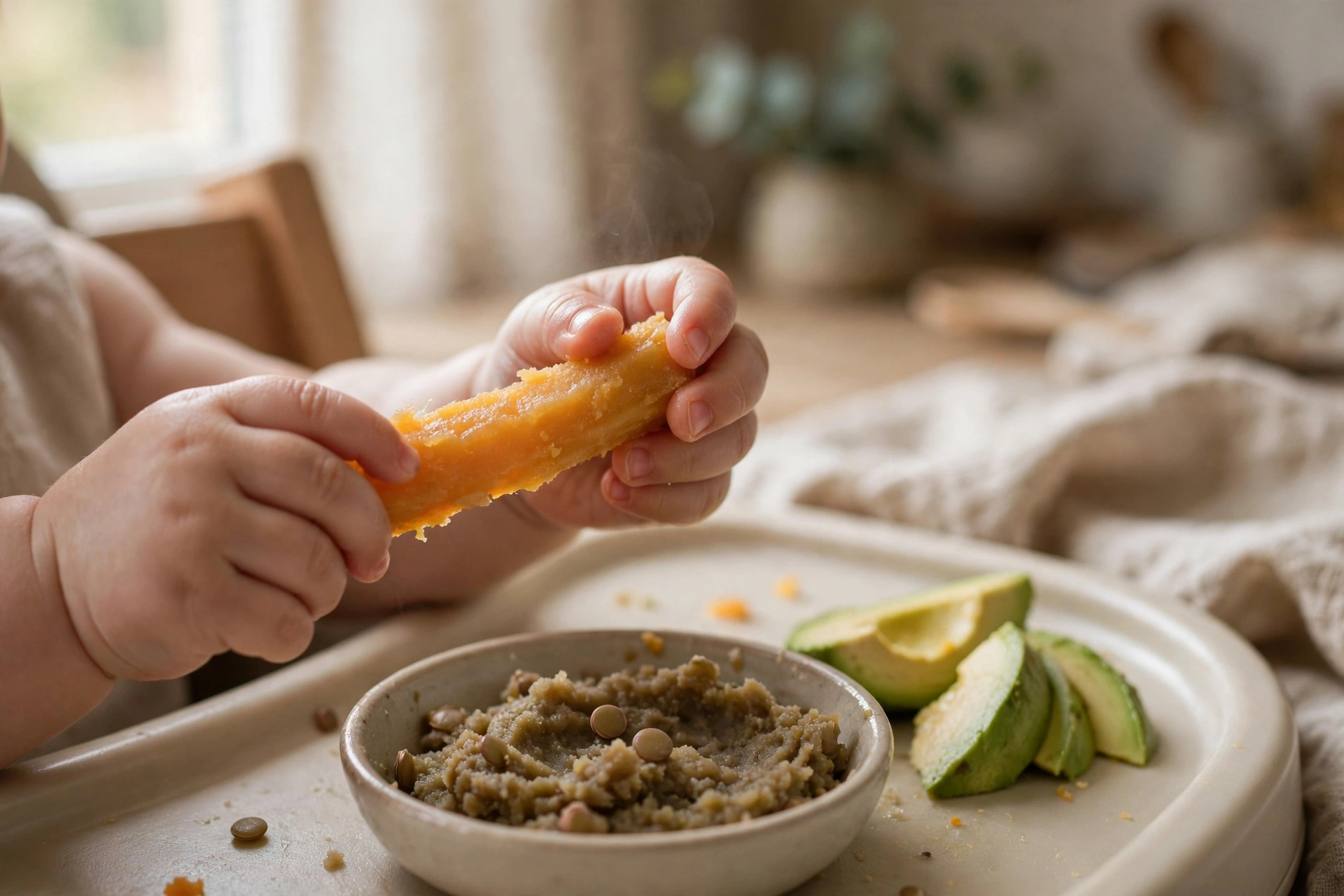
A useful rhythm: one food, one meal a day, for the first couple of days — steamed sweet potato sticks or ripe banana are gentle openers. Then add a second food, such as soft avocado or steamed broccoli. By day five or six, try a second meal. The WHO suggests two to three meals a day for infants aged six to eight months, building to three or four by nine to eleven months.
Sit down and eat your own meal at the same time. Babies learn by watching you chew and swallow, and a baby who sees you enjoying food is far more likely to try it.
The Best First Foods for Baby-Led Weaning
Good first foods are soft enough to squash between your thumb and finger, and cut into finger-sized strips, so your baby can grip one end and chew the other. Babies do not need teeth for these foods.
| Food group | Good first choices | How to serve them |
|---|---|---|
| Soft fruit | Ripe banana, avocado, ripe pear or peach, cooked apple | Thick strips; leave peel on banana for grip; roll avocado in crushed cereal |
| Vegetables | Steamed broccoli, sweet potato, carrot, squash, courgette | Cooked until very soft; broccoli florets with a stalk to hold; never raw carrot or apple |
| Protein | Shredded chicken or beef, flaked fish, egg, lentils, beans, tofu | Slow-cooked meat in strips; omelette fingers; mashed beans on toast; firm tofu strips |
| Grains & dairy | Toast strips, well-cooked pasta, porridge, iron-fortified cereal, plain yoghurt, pasteurised cheese | Toast with thin nut butter or avocado; large pasta shapes; cereal or yoghurt on a preloaded spoon; cheese grated or in thin strips |
There is no required order for introducing foods — the AAP and CDC both say so. The CDC still suggests one single-ingredient food at a time, waiting three to five days between new foods, to help you spot any reaction. Start with whatever your family eats, adapted for safety.
Don’t skip iron — it is the nutrient that matters most
Iron is the priority. Babies are born with iron stores built up during pregnancy, but those run low at around four to six months, and breast milk carries only a little iron. From seven to twelve months, a baby needs about 11 mg of iron a day — more than an adult man needs, according to the US National Institutes of Health.
The AAP warns that babies doing baby-led weaning often favour fruit and vegetables and eat little of the iron-rich foods like meat, eggs, and fortified cereal. This is the real nutritional risk of the method — not choking, as many parents fear, but iron. The fix is simple: offer an iron-rich food at most meals. The richest foods, per serving in the NIH food table, are lentils, cooked spinach, and firm tofu (about 3 mg per half cup), then beef, sardines, chickpeas, and kidney beans (about 2 mg), and chicken, turkey, egg, broccoli, and green peas (about 1 mg). Avo Parenting’s iron guide shows exactly how to serve each one as a finger food.
Two tips make iron work harder. First, pair plant iron with vitamin C in the same meal — lentils with soft roasted red pepper, tofu with broccoli, cereal with strawberries. Second, mix a little meat or fish into plant foods. If you breastfeed, the AAP recommends about 1 mg of iron per kilogram of body weight a day from four months until iron-rich foods are a regular part of your baby’s diet.
Gagging vs Choking: How to Tell the Difference
This is the number one worry parents have about baby-led weaning. Gagging and choking are different things, they look different, and they need different responses.
Gagging: normal, noisy, and protective
Gagging is a reflex: when food touches the back of the tongue or throat, the body pushes it forward so it can be spat out or chewed more before swallowing. In young babies the gag reflex sits far forward in the mouth, which is why it triggers so easily at first; as your baby practises, it moves further back.
A gagging baby is usually noisy — coughing, sputtering, retching, tongue pushing forward, eyes watering, face reddening — but still breathing. It looks alarming. It is not an emergency. Stay calm, give your baby time to work it out, and let them cough or spit the food out themselves. Do not rush in, and do not put your fingers into their mouth: a blind finger sweep can push food further back. The NHS puts it simply: gagging is a normal reflex as your baby learns to chew and swallow.
Choking: silent, and an emergency
Choking happens when food partly or fully blocks the airway and prevents normal breathing. It is a medical emergency, and a choking baby is often quiet rather than noisy — that is the crucial distinction. Watch for these signs: trouble breathing, with the chest and ribs pulling in; silent or very weak coughing, or an inability to cry or make noise; going very pale or blue, especially around the lips, face, or nails; a panicked or frozen expression, or becoming limp or unresponsive.
If your baby is coughing strongly and breathing effectively, encourage them to keep coughing and stay close. If their cough or cry is weak or silent, start infant choking first aid right away and call emergency services. For infants under twelve months, the American Red Cross recommends five firm back blows between the shoulder blades, followed by five chest thrusts, supporting the head and neck throughout, alternating until the blockage clears. Never use abdominal thrusts on an infant under one year old.
The reassuring part: studies so far suggest self-feeding does not carry a higher choking risk than spoon-feeding, provided foods are prepared safely and babies are supervised — the AAP and NHS both say this. The research is still limited, though, and safety depends on safe food preparation and constant supervision. Never leave your baby alone while eating, even for a moment.
When to call the doctor
Call your paediatrician if your baby choked and the object came out, even if they seem fine now; if gagging is constant or leads to vomiting at most meals; or if you notice a possible food reaction. Call emergency services right away if your baby cannot cry, cough, or breathe, turns blue or grey, or goes limp.
Introducing Allergens the Safe Way
The advice on allergens has reversed within the last decade: it used to be standard to delay peanut, egg, and fish, but current guidance says to introduce common allergens early, from around six months, rather than holding them back. The NHS says delaying peanut and hens’ eggs beyond six to twelve months may increase the risk of allergy, and the CDC advises introducing allergenic foods — eggs, shellfish, nut butters, wheat — when you introduce other foods.
Do it one allergen at a time, in small amounts, so you can spot any reaction, and keep offering it regularly once tolerated. Safe ways to offer them:
- Peanut: thin smooth peanut butter spread lightly on toast strips, or stirred into food your baby already eats. Never whole nuts or thick spoonfuls — both are choking hazards.
- Egg: well-cooked, as thin omelette strips or hard-boiled quarters. In the UK, eggs stamped with the red lion mark are considered very low risk for salmonella.
- Fish: flaked, boneless, well-cooked. Avoid shark, swordfish, and marlin, which contain high levels of mercury.
- Dairy: plain whole-milk yoghurt and pasteurised cheese from around six months. Cow’s milk can go into cooking, but not as a main drink until one year.
- Wheat, soya, sesame: toast fingers, hummus thinned and spread on toast, tahini thinned the same way.
One important exception: if your baby has severe eczema or an egg allergy, talk with your paediatrician before introducing peanut. The CDC and AAP both flag this, because those babies need a more careful plan.
Foods to Avoid in the First Year
Most foods to avoid come down to two risks: choking, and a baby’s immature gut and kidneys.
- Honey, in any form, until after age one — including honey baked into foods. Honey can contain the bacteria that cause infant botulism.
- Whole nuts and seeds, popcorn, hard sweets, marshmallows, and gummy candy — all serious choking hazards. Nut butters are fine only when thinned and spread.
- Whole grapes, cherry tomatoes, and whole berries — unless cut lengthways into quarters. Round foods can block a small airway exactly.
- Raw carrot or apple chunks, whole corn kernels, hot dog rounds, and chunks of meat or cheese — hard, round, or cylindrical shapes are the riskiest. Cut hot dogs into thin strips, never coins.
- Cow’s milk as a main drink before twelve months — it lacks enough iron and can irritate a baby’s gut. Yoghurt, cheese, and milk in cooking are fine.
- Juice before twelve months — it displaces more nutritious foods and is not recommended by the CDC or AAP.
- Added salt and sugar — salt is hard on a baby’s kidneys, and sugar can cause tooth decay. That includes stock cubes, gravy, and salty foods like bacon and sausages.
- Unpasteurised dairy, raw or lightly cooked shellfish, and mould-ripened soft cheeses like brie, camembert, and roquefort — listeria risk.
Also remove pits, seeds, skin, bones, and gristle, and let hot food cool fully before serving.
Baby-Led Weaning vs Purées: An Honest Comparison
Ask a parenting group which is better and you will get a war. Ask the research and you get a shrug: neither approach is objectively better, and most families end up combining them.
| Baby-led weaning | Purées / spoon-feeding | |
|---|---|---|
| How baby eats | Self-feeds soft, whole foods from the start | Spoon-fed smooth foods, textures thickened gradually |
| Choking risk | No higher than spoon-feeding when safety rules are followed | Same background risk; textures must advance by 8–9 months |
| Iron intake | Harder to guarantee early on; needs deliberate planning | Easier — fortified cereal and blended meat deliver measured iron |
| Weight gain | No meaningful difference in trials | No meaningful difference in trials |
| Workload & mess | Less cooking — baby eats what you eat; significantly messier | More prep early on; more contained, at least at first |
What matters more than the method is responsive feeding — paying attention to hunger and fullness cues, offering a variety of foods, and not turning mealtimes into a pressure test. A baby who is spoon-fed attentively, with textures advanced on time, will do just as well as a baby who self-feeds.
Most families land on a practical middle ground: finger foods at home, a pouch or purée when travelling; self-feeding at dinner, a preloaded spoon at breakfast. The AAP says you can flex the baby-led concept to fit your family.
What Recent Research Shows
The most useful study in this area is the BLISS trial — Baby-Led Introduction to SolidS — run at the University of Otago in New Zealand and published in the journal Pediatrics in 2016. It followed 206 families, randomly assigning them to either a modified baby-led approach or traditional spoon-feeding, and tracked outcomes through 24 months. On choking, the trial found no significant difference between the two groups — but only after the baby-led group received specific coaching on which foods and shapes to avoid. On weight, there was no meaningful difference. On iron, there was a real finding: babies in the baby-led group were at risk of low iron intake unless iron-rich foods were deliberately offered at every meal. The AAP’s summary is the honest one: there are very few studies on the health advantages of baby-led weaning. What the research does support is the surrounding advice — start at around six months, introduce allergens early, prioritise iron, and supervise every meal.
Common Mistakes to Avoid
1. Starting before your baby is ready. A baby who cannot sit up or still pushes food out with their tongue is not ready, however interested they seem. Starting early gives them frustration and gagging, not a head start. Wait for all the readiness signs together.
2. Treating gagging as choking — or ignoring choking. Panicking at every gag teaches your baby that eating is frightening, and lunging in with a finger sweep can make things worse. But assuming any noise means all is well is worse. Learn the difference before the first meal: noisy and breathing is gagging; silent and struggling is choking, and it needs first aid immediately.
3. Forgetting iron. A tray full of fruit and vegetables looks healthy. It is also low in iron. Put an iron-rich food on the tray at most meals — meat, egg, lentils, beans, tofu, or iron-fortified cereal — and pair plant iron with a vitamin C food.
4. Offering the wrong shapes. Whole grapes, coin-shaped carrot slices, chunks of cheese, and thick spoonfuls of nut butter cause the most trouble. Cut round foods lengthways into quarters, offer finger-shaped strips rather than coins, and spread nut butter thinly.
5. Leaving your baby alone, even briefly. Always stay with your baby while they eat. Not in the next room. Not checking your phone. Choking is silent, and seconds matter. If you need to leave the table, the meal pauses.
6. Delaying allergens. Holding back peanut and egg “to be safe” is now the risky choice, not the cautious one. Introduce them from around six months, one at a time, in small amounts. The exception is a baby with severe eczema or an egg allergy — in that case, talk to your paediatrician first.
Final Recommendations
- Wait for all the readiness signs together — sitting up, steady head, reaching and grasping, swallowing rather than pushing food out — at around six months, never before four months.
- Start with one meal a day and one or two foods, building to two or three meals a day by seven or eight months.
- Offer an iron-rich food at most meals — meat, egg, lentils, beans, tofu, or iron-fortified cereal — and pair plant iron with a vitamin C food.
- Cut food into finger-shaped strips, soft enough to squash between your fingers, and avoid hard, round, or sticky foods in the first year.
- Introduce common allergens from around six months, one at a time, and keep offering them once tolerated — unless your baby has severe eczema or an egg allergy, in which case ask your paediatrician first.
- Learn the difference between gagging and choking before the first meal, consider an infant first-aid course, and stay with your baby, seated upright, at every meal. Keep milk as the main nutrition through the first year. Mix methods without guilt.
This content is for educational purposes only and does not replace professional medical advice. Always consult a qualified healthcare professional before making health decisions for your baby.
Frequently Asked Questions
Most babies are ready at around 6 months, once they can sit up with good head control, bring food to their mouth, and swallow rather than push it back out. The CDC advises against starting any solids before 4 months. Check with your paediatrician first if your baby was born prematurely.
Yes, when it is done properly. Studies so far, including the BLISS randomised trial, suggest self-feeding does not carry a higher choking risk than spoon-feeding, provided foods are soft and cut into finger-shaped strips, and your baby is seated upright and watched closely. Avoid known choking hazards and never leave your baby alone while eating.
Gagging is noisy — coughing, sputtering, retching, watery eyes, tongue pushing forward — but your baby is still breathing. It is a normal protective reflex, so stay calm and let your baby work it out. Choking is usually silent: your baby cannot cry or cough effectively, struggles to breathe, or turns pale or blue. That is an emergency — start infant choking first aid and call emergency services.
Soft foods your baby can mash with their gums and grip in a fist: ripe banana, avocado, steamed broccoli florets with a stalk to hold, sweet potato sticks, strips of omelette, shredded tender meat, and toast fingers. Cut everything into finger-sized strips, and include an iron-rich food at most meals.
Yes. Many families mix finger foods with spoon-fed or preloaded-spoon purées, and both the AAP and the NHS support a flexible approach. Purées are nutritious and practical when travelling or short on time, and offering them occasionally will not undo the benefits of self-feeding. The method matters far less than the variety of foods and following your baby's cues.
They can, but it takes planning. Babies doing baby-led weaning often favour fruit and vegetables and eat little meat or fortified cereal. From 7 to 12 months a baby needs about 11 mg of iron a day, so offer an iron-rich food at most meals and ask your paediatrician about a supplement.
Avoid honey in any form until after age one, because of infant botulism. Skip whole nuts, popcorn, hard sweets, and marshmallows, and cut whole grapes and cherry tomatoes lengthways into quarters. No cow's milk as a main drink, juice, or added salt and sugar before twelve months. If a food is hard, small, round, or sticky, prepare it differently or leave it out for now.
Conclusion
Baby-led weaning is not a test, and your baby is not being graded. It is a way of letting a small person discover food at their own pace — squashing it, tasting it, dropping it, and eventually eating it — at the family table where they belong. The evidence does not crown it the winner over purées, and it does not need to. The evidence supports a clear set of actions: wait until around six months and until the readiness signs appear together; offer soft, finger-shaped foods; put iron on the tray at most meals; introduce allergens early rather than late; learn the difference between gagging and choking; and stay with your baby at every meal.
The first weeks will be messy: your baby will eat less than you expect and wear more than you expect. That is not a sign that it is not working. Keep offering, keep it calm, keep milk as the main nutrition, and let your baby lead. If you want to read more, our starting solids guide covers first foods and feeding schedules, and our baby and toddler care basics guide is a useful companion for the months that follow.
References
- World Health Organization — Infant and young child feeding (fact sheet) — 2026 — https://www.who.int/news-room/fact-sheets/detail/infant-and-young-child-feeding
- Centers for Disease Control and Prevention — When, What, and How to Introduce Solid Foods — 2026 — https://www.cdc.gov/infant-toddler-nutrition/foods-and-drinks/when-what-and-how-to-introduce-solid-foods.html
- NHS — Your baby’s first solid foods — https://www.nhs.uk/baby/weaning-and-feeding/babys-first-solid-foods/
- American Academy of Pediatrics (HealthyChildren.org) — Baby-Led Weaning: Is It Safe? — Ifunanya A. Agbim, MD, FAAP & Christine Waasdorp Hurtado, MD, FAAP — https://www.healthychildren.org/English/ages-stages/baby/feeding-nutrition/Pages/baby-led-weaning-is-it-safe.aspx
- Pediatric.me — Baby-Led Weaning: How to Start Safely + First Foods — 2026 — https://pediatric.me/baby-led-weaning/
- Avo Parenting — Iron-Rich Foods for BLW and Purées: 12 Best First Foods — 2026 — https://avoparenting.com/blog/iron-rich-foods-for-blw