Your baby’s cheeks are rough, red and dry. They scratch at them in their sleep, and every cream you try seems to help for a day, then stop working. If that sounds familiar, you are not doing anything wrong.
Baby eczema affects up to 1 in 5 babies, usually starting between 2 and 6 months of age. It is not caused by poor hygiene, by something you ate in pregnancy, or by anything you did or didn’t do. It comes from a mix of genetics and a skin barrier that lets moisture out and irritants in — and while there is no cure, it can be managed well at home. Most children outgrow it by the time they are 3 to 5 years old.
This guide explains what baby eczema looks like, what causes it, which triggers to watch for, and the daily routine paediatric dermatologists recommend — plus when a cream from the chemist is enough and when it is time to call your paediatrician. Everything here is drawn from published guidance from the Mayo Clinic, Cleveland Clinic, Harvard Health and the National Eczema Association.
Written by Md Masud Rana based on published expert sources. This article has not been professionally reviewed. See our sources below.
Last updated: November 2026
Quick Answer
Baby eczema (atopic dermatitis) is a chronic, itchy skin condition that usually starts at 2 to 6 months as dry, scaly patches on the cheeks, forehead or scalp. There is no cure, but daily moisturising, short lukewarm baths and treating flares early keep it under control for most babies. Moisturise at least twice a day with a thick, fragrance-free cream or ointment, apply it within 3 minutes of bathing while the skin is still damp, and see your paediatrician if the rash weeps, crusts or spreads, or does not improve within 1 to 2 weeks.
Key Takeaways
- Baby eczema affects up to 1 in 5 infants and usually starts between 2 and 6 months. It is not contagious and it is not your fault.
- Daily moisturising is the most important treatment. Thick creams and ointments beat thin lotions.
- The “soak and seal” method — a short lukewarm bath, then moisturiser within 3 minutes — is the foundation of home care.
- Hydrocortisone 1% can calm mild flares, but only for up to a week and only as your paediatrician advises.
- Food allergies do not cause eczema, though they can worsen it in some babies. Never cut foods without medical advice.
- Most children improve a great deal by school age, and many outgrow eczema.
Contents
- What Is Baby Eczema?
- What Does Baby Eczema Look Like?
- What Causes Baby Eczema?
- How to Treat Baby Eczema at Home: The Daily Routine
- Creams and Medicines: What Your Doctor May Suggest
- Wet Wraps and Bleach Baths: Extra Tools for Bad Flares
- Baby Eczema and Food Allergies: What’s the Link?
- When to Call Your Paediatrician
- What Recent Research Shows
- Common Mistakes Parents Make
- Final Recommendations
- Frequently Asked Questions
What Is Baby Eczema?
Baby eczema is the name most parents use for atopic dermatitis in infants — a chronic inflammatory skin condition that makes the skin dry, itchy and inflamed. Children with eczema often also develop asthma or hay fever later, a pattern doctors call the “atopic march”. It is not an infection, it is not contagious, and it cannot be passed from one child to another.
How common is it? Eczema is the most common skin condition of early childhood. The National Eczema Association reports that atopic dermatitis affects about 13% of all children under 18 in the United States, while paediatric sources put the figure for infants as high as 1 in 5.
Most cases begin early: about 60% of children with atopic dermatitis develop symptoms in their first year, and about 90% by age 5. The good news is that baby eczema is usually a phase: most children outgrow it by 3 to 5 years of age, according to the Mayo Clinic.
Is eczema the same as atopic dermatitis?
Yes. “Eczema” is the everyday name for a group of conditions that make skin red, itchy and inflamed; atopic dermatitis is the most common type, and it is the one that affects babies. Other types, like contact dermatitis or cradle cap, are different conditions — and telling them apart matters, because the care is different.
How long does a flare-up last?
With daily moisturiser and a doctor-recommended treatment cream, most flares calm down within 1 to 2 weeks, and mild flares can settle in a few days. Between flares, the skin may just feel dry and a little bumpy. Keeping up the moisturising routine even when the skin looks clear is what stretches the calm periods out.
What Does Baby Eczema Look Like?
The early signs are patches of dry, rough, itchy skin. In young babies the patches usually show up on the cheeks, forehead and scalp, and around the mouth. As babies get older and start crawling, the rash tends to move to the creases — inside the elbows, behind the knees, and around the wrists and ankles. During a flare-up the skin may look red and swollen, feel rough, and sometimes ooze. Repeated scratching can make the skin thick and leathery over time.
Many guides wrongly describe eczema as always “red”. On lighter skin the rash is usually red or pink; on darker skin it may look brown, grey or purple, or show up as small rough bumps and ashy, flaky skin. After a flare heals, you may see darker or lighter patches where the eczema was — those marks are normal and fade with time. If your baby’s skin feels rough, dry or itchy even without obvious redness, have your paediatrician take a look.
Where eczema appears changes with age. The National Eczema Association notes that in the first 6 months it usually appears on the face, cheeks, chin, forehead and scalp — but not usually in the nappy area, where moisture protects the skin. Between 6 and 12 months it often appears on the elbows and knees. If the rash becomes infected, it may form a yellow crust or tiny “pus bumps”.
Baby eczema or something else?
Several common baby rashes look similar at first glance, and confusing them is one of the most common mistakes parents make. Here is how they differ:
| Rash | What it looks like | How it behaves |
|---|---|---|
| Baby eczema | Dry, scaly, itchy patches on cheeks, scalp or skin creases | Comes and goes over weeks and months |
| Baby acne | Small red or white bumps, usually on the face | Not itchy or dry; clears on its own within weeks |
| Cradle cap | Thick, greasy, yellow scales on the scalp or behind the ears | Usually not itchy; often clears on its own |
| Heat rash | Tiny red bumps or blisters in skin folds or covered areas | Fades once your baby cools down |
| Nappy rash | Raw, sore irritation in the nappy area | Caused by wetness and friction; eczema there is dry and itchy instead |
If you are not sure which rash you are looking at, take a photo and ask your paediatrician — a photo of the rash at its worst is genuinely useful at an appointment.
What Causes Baby Eczema?
There is no single cause of baby eczema. Researchers know it comes from a combination of genetics and environment, but they do not know exactly why one baby develops it and another does not. It is not caused by poor hygiene, by something a parent ate during pregnancy, or by anything a parent did or didn’t do.
Genes play a large part. Babies with a family history of eczema, asthma or hay fever are more likely to develop it. Many babies with eczema are born without enough of a protein called filaggrin, which helps build the skin’s protective barrier. Without enough filaggrin, the top layer of skin cannot hold moisture in or keep irritants out, which is why your baby’s skin loses water so easily.
The immune system plays a role too. Children with atopic dermatitis tend to have overactive immune systems that over-react to everyday things — dry air, soaps, pollen — triggering inflammation. That is why the same trigger can cause a flare in one baby and nothing at all in another.
Common triggers to watch for
Triggers do not cause eczema, but they can set off a flare in a baby who already has it. Keep a simple log — note what flared, and what was different that day. Patterns usually emerge within a few weeks.
- Scented products: fragranced soaps, lotions, wipes and detergents are among the most common irritants. Switch to fragrance-free, dye-free versions.
- Rough fabrics: wool and scratchy synthetics rub the skin raw. Soft cotton is safest.
- Dry air and temperature swings: winter air and central heating dry the skin out. A cool-mist humidifier can help.
- Heat and sweat: overheating makes eczema worse. Dress your baby in light layers and keep the bedroom cool.
- Drool and saliva: drool around the mouth and chin is a major trigger, especially while teething. Wipe gently and dab petroleum jelly around the mouth before feeds.
- Dust mites, pollen and pet dander: vacuum often, wash bedding weekly, and keep pets out of the cot if you can.
- Certain foods: in some babies, cow’s milk, egg, peanut, wheat or soy can trigger or worsen flares — but food is rarely the cause of the eczema itself. Never remove foods without medical advice.
- Infections: even a common cold can trigger a flare.
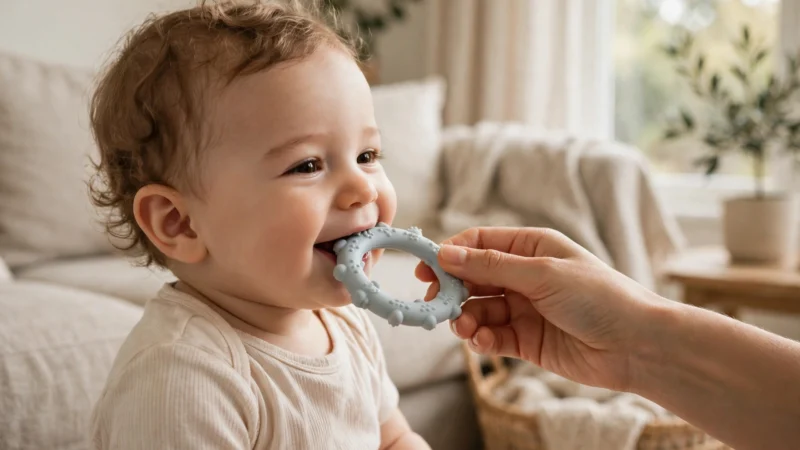
Teething does not cause eczema, but the drooling that comes with it can irritate the skin around the mouth and chin and make existing eczema worse. A barrier of petroleum jelly and gentle wiping is usually enough. Our baby teething remedies guide covers safe relief.
How to Treat Baby Eczema at Home: The Daily Routine
Most baby eczema can be managed at home with a consistent daily routine. It does not need expensive products — the most effective moisturiser for many babies is plain petroleum jelly. The routine has three parts: bathe smart, moisturise immediately, and protect the skin through the day.
Step 1: Bathe smart — short, lukewarm, gentle
Daily baths are fine for babies with eczema, and they can actually help. The Mayo Clinic advises a short lukewarm bath every day or every other day, using a mild, nonsoap cleanser labelled fragrance-free and hypoallergenic. Keep baths to 5 to 10 minutes — longer soaks strip the skin’s natural oils. Use lukewarm water, never hot, and skip bubble baths and harsh soaps. Plain water alone is fine for most of the body; use the cleanser only on dirty areas.
When the bath is done, rinse completely, then pat your baby dry with a soft towel. Do not rub — rubbing irritates sore skin. Leave the skin slightly damp: that dampness is the point of the next step.
Step 2: “Soak and seal” within 3 minutes
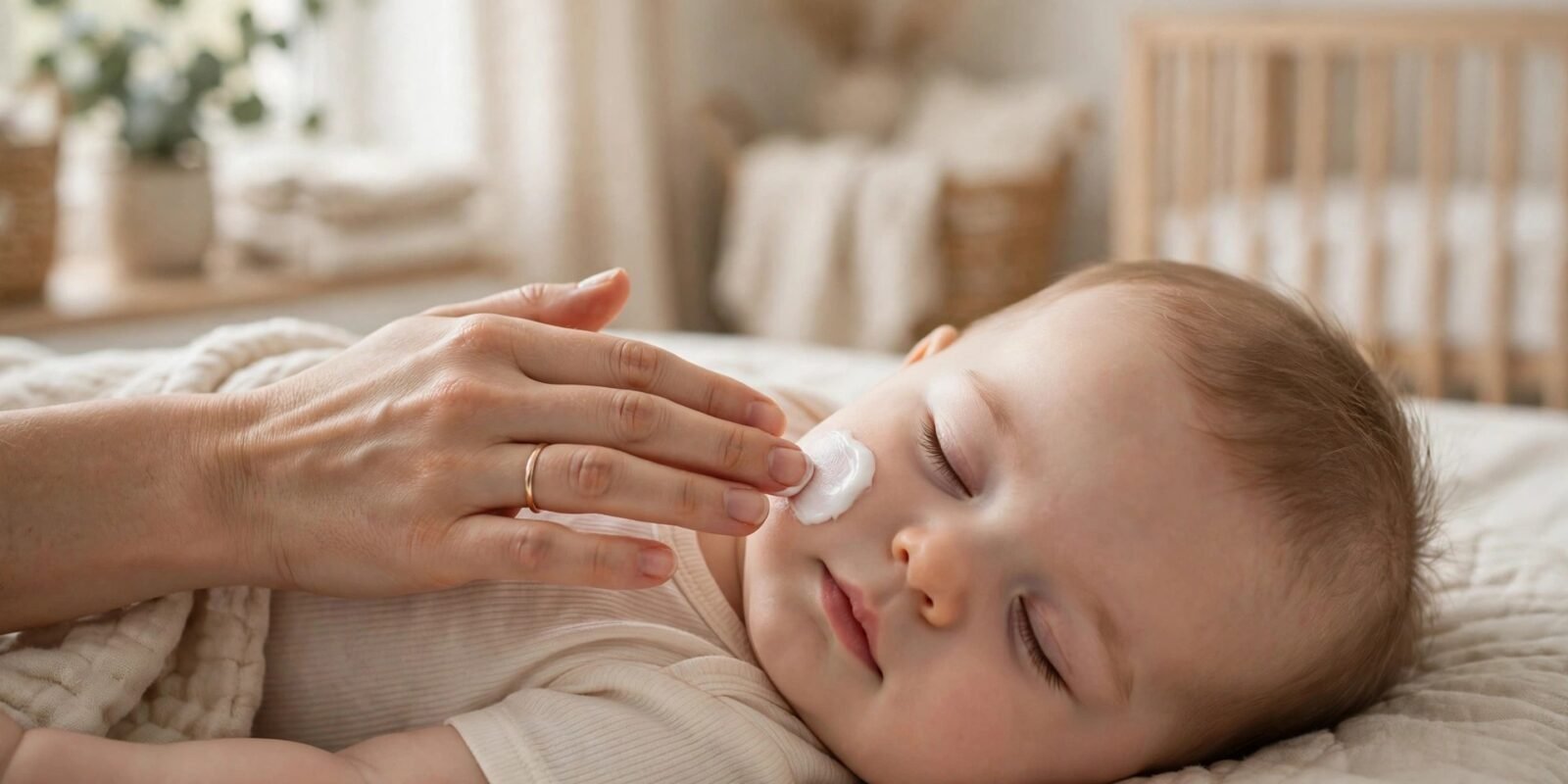
This is the single most important habit in eczema care — dermatologists call it “soak and seal”. Within 3 minutes of getting out of the bath, while the skin is still damp, smooth a thick, fragrance-free cream or ointment over your baby’s whole body. The moisturiser traps the water in the skin before it evaporates.
Be generous with it. Pay extra attention to the spots that flare most: cheeks, neck, elbow and knee creases, wrists and ankles. And keep moisturising even when the skin looks clear — stopping when things look good is how flares sneak back.
Step 3: Choose the right moisturiser
As a rule, the thicker the product, the better it protects eczema-prone skin:
- Ointments (such as plain petroleum jelly): the most moisturising, and the best choice during flares. They feel greasy, but the skin soaks them up.
- Creams: a good everyday choice, easier to spread over large areas than ointments.
- Lotions: the least moisturising, and the most likely to sting on sore skin. Most dermatologists advise against them for eczema.
Whatever type you choose, it should be fragrance-free, dye-free and hypoallergenic — test any new product on a small patch first. Check the label for food-based ingredients too: creams containing coconut, milk, almond, peanut or oat can raise the risk of developing a food allergy when rubbed into dry or broken skin, especially if your baby has not started eating those foods yet.
Step 4: Protect the skin through the day
Moisturise at least twice a day, and more often if the skin still feels dry — a quick application at each nappy change works well. Keep your baby’s nails short, consider soft cotton mittens at night, and dress them in soft cotton. Dab petroleum jelly around the mouth before feeds to guard against drool.
Night-time itching is very common, and it is one of the main reasons eczema disrupts the whole household’s sleep. A solid evening routine — bath, moisturise, mittens, cool room — helps more than most parents expect. If broken sleep is becoming a pattern, our baby sleep schedule by age guide can help.
Creams and Medicines: What Your Doctor May Suggest
When moisturiser alone is not enough to calm a flare, your paediatrician may suggest a medicated cream. This is normal and common — it does not mean you failed at the home routine. It means the inflammation needs a little more help.
Over-the-counter hydrocortisone 1%
For mild flares, the usual first step is hydrocortisone cream 1%, which does not need a prescription in most countries. Apply a thin layer once or twice a day for up to a week. If the rash is not better in a week, or it comes back quickly after you stop, see your paediatrician. Never use high-potency steroid creams on your baby without medical supervision.
The truth about steroid creams
Many parents worry about steroid creams, but the evidence is reassuring. When used as directed, short-term, on the affected areas only, they are safe. Skin thinning from proper use is rare and goes away when you stop. The greater harm comes from leaving eczema untreated: the scratching, infections and lost sleep cause more damage than a properly used steroid cream.
Prescription options for moderate to severe eczema
If flares keep coming back or cover large areas, your paediatrician or a paediatric dermatologist may prescribe:
- Stronger topical corticosteroids: used short-term, only on the spots that need them.
- Calcineurin inhibitors (tacrolimus, pimecrolimus): steroid-free creams that calm inflammation and are gentle on the face and skin folds. Approved for children aged 2 and over.
- Crisaborole (Eucrisa): a non-steroid cream cleared for babies from 3 months old.
- Dupilumab (Dupixent): a newer biologic, now cleared for children as young as 6 months with moderate-to-severe eczema not controlled by creams.
For babies whose eczema flares often, the American Academy of Pediatrics now recommends “proactive” therapy: a steroid cream (or tacrolimus) twice a week on flare-prone areas, even when the skin looks clear. Ask your paediatrician whether it suits your baby.
Wet Wraps and Bleach Baths: Extra Tools for Bad Flares
When a flare is severe — the skin very red, your baby scratching through the night, creams alone not settling it — paediatricians have two extra tools that sound strange at first but are well established. Both should be part of a plan discussed with your baby’s doctor, especially in young infants.
Wet wrap therapy
Wet wraps lock moisture into the skin and calm severe inflammation. After the bath, apply any prescribed cream to the inflamed areas, then a thick layer of moisturiser over the whole area. Then dress your baby in a damp layer — for babies, a damp onesie works well — with dry pyjamas over the top. Harvard Health recommends dampening close-fitting pyjamas with warm water, wringing them out, and putting them on after creams and moisturiser. Wet wraps are usually used for short periods during severe flares, often overnight.
Dilute bleach baths
A bleach bath does not mean sitting your baby in a tub of bleach. It means adding a very small amount of ordinary household bleach to the bath water, so the water ends up similar to a chlorinated swimming pool. The bleach kills bacteria on the skin — eczema-prone skin is easily colonised by bacteria, which worsen inflammation — and helps with the itch. Harvard Health gives the usual amounts: half a cup of regular household bleach for a full tub, or a quarter cup for a half tub. Soak for about 10 minutes in warm, not hot, water, then rinse off, pat dry, and apply prescribed creams and moisturiser straight away. Two or three times a week is usually plenty. Check with your doctor before you start.
What about oatmeal baths?
Colloidal oatmeal baths can soothe itchy skin — soak for 10 to 15 minutes in lukewarm water, then pat dry and moisturise straight away. But avoid them in babies who have not started eating oats: rubbing oat proteins into broken skin may increase the risk of developing an oat allergy.
Baby Eczema and Food Allergies: What’s the Link?
The short answer: food allergies do not cause eczema, but they can make it worse in some babies, and babies with eczema are more likely to develop food allergies later. The two conditions travel together, but one does not simply cause the other.
In the large Australian HealthNuts study, about 1 in 5 babies with eczema had a challenge-confirmed food allergy, compared with about 1 in 25 babies without eczema. The most common food triggers are cow’s milk, egg, peanut, wheat, soy and fish — but most babies with eczema do not have a food allergy at all.
If you suspect a food is worsening your baby’s eczema, talk to your paediatrician about allergy testing before changing anything. Testing may be appropriate for moderate-to-severe eczema that does not respond to good skincare, especially with other allergy signs such as hives. But do not remove foods from your baby’s diet — or your own, if you are breastfeeding — without medical advice. Unnecessary restrictions can cause nutritional problems and may raise the allergy risk.
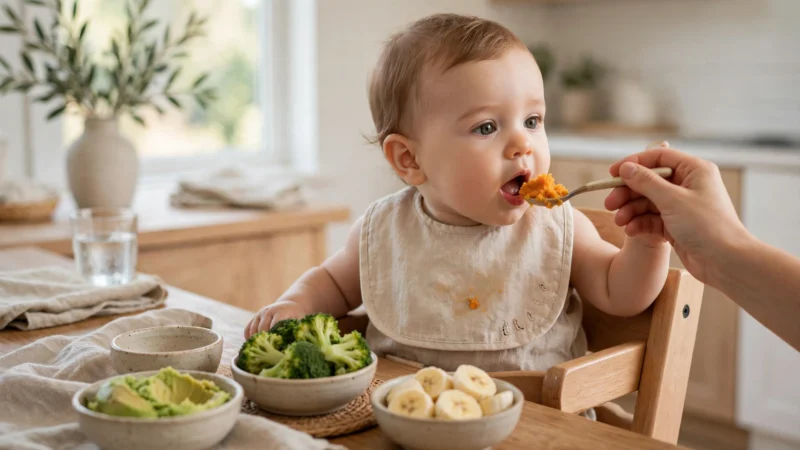
There is one piece of genuinely good news: studies show that giving babies common allergy foods early — peanut and egg, for example — may help prevent allergies from developing. Ask your paediatrician about when and how to start these foods. Our starting solids guide walks through first foods, timing and allergy introduction step by step.
When to Call Your Paediatrician
Most baby eczema can be handled at home. But some signs mean it is time to get medical help — and a few mean you should call the same day.
Call your paediatrician promptly if you notice:
- Signs of infection: oozing, crusting, pus bumps, yellow discharge, warmth, or fever
- Eczema that is not getting better after 1 to 2 weeks of moisturiser and hydrocortisone
- Severe flares covering large parts of the body
- Sleep problems: your baby wakes up a lot from itching
- Eczema that keeps spreading despite treatment
- You think a food might be causing flares
Seek care the same day if: the rash is blistering or weeping heavily, your baby has a fever along with the rash, the skin looks infected and is spreading quickly, or your baby seems unwell or in pain. Only a qualified professional can judge how severe the eczema is — an article cannot examine your baby.
What Recent Research Shows
Three recent developments are worth knowing about.
First, the newest medicines have reached the youngest babies. Dupilumab, a biologic that targets the immune over-reaction behind eczema, is now cleared for children as young as 6 months with moderate-to-severe eczema. For families whose babies have not responded to creams, that is a genuine change — though it is for severe cases, not a first step.
Second, paediatric guidance has shifted from treating flares only when they appear to preventing them. The American Academy of Pediatrics now recommends proactive, twice-weekly treatment on flare-prone areas even when the skin looks clear.
Third, the food allergy picture is getting clearer. The HealthNuts finding — about 1 in 5 babies with eczema had a confirmed food allergy, against about 1 in 25 without — has pushed paediatricians to ask about food allergies earlier in severe cases. On whether good skincare from birth can prevent eczema or allergies later, the evidence is still mixed: current research has not shown a clear preventive effect.
Common Mistakes Parents Make
1. Using lotion instead of cream or ointment. Thin lotions do not protect eczema-prone skin well and can sting on sore patches. Switch to a thick cream for daily use and an ointment during flares.
2. Stopping moisturiser when the skin looks clear. Clear skin is not cured skin, and stopping the routine is the most common reason flares return. Keep moisturising every day.
3. Bathing in hot water, or for too long. Hot water strips the skin’s oils and makes itching worse. Keep baths short — 5 to 10 minutes — and lukewarm.
4. Cutting foods from the diet without medical advice. It is tempting to blame milk or egg when a flare appears, but food allergies rarely cause eczema, and unnecessary restrictions can cause nutritional problems. Test first — and only with your paediatrician’s guidance.
5. Being afraid of steroid creams and leaving flares untreated. Steroid fear is common, but short-term, correctly used steroid cream is safe, and untreated eczema causes more harm through scratching and infection than the cream does. If your paediatrician prescribes one, use it as directed.
Final Recommendations
- Build the routine first. Short lukewarm baths, moisturiser within 3 minutes, twice-daily moisturising.
- Choose thick and fragrance-free. Creams and ointments beat lotions.
- Keep a trigger log. A few notes a week will show your baby’s patterns.
- Treat flares early. A thin layer of hydrocortisone 1% for up to a week calms most mild flares.
- Protect sleep. Mittens, a cool room, and a solid evening routine of bath and moisturiser make the nights easier.
- Do not go it alone on food. Suspected food triggers deserve a conversation with your paediatrician and, if needed, allergy testing — not a home elimination diet.
This content is for educational purposes only and does not replace professional medical advice. Always consult your paediatrician before making health decisions for your baby.
Frequently Asked Questions
Baby eczema has no single cause. It comes from a mix of genetics and a weak skin barrier: many babies with eczema are born without enough filaggrin, a protein that keeps moisture in and irritants out. A family history of eczema, asthma or hay fever raises the risk, and triggers such as scented soaps, dry air, heat and drool can set off flares. It is not caused by poor hygiene, and it is not contagious.
It usually appears as dry, rough, itchy patches. In babies under 6 months it is most often on the cheeks, forehead and scalp; after 6 months it moves to the elbow and knee creases, wrists and ankles. On lighter skin it looks red or pink; on darker skin it may look brown, grey or purple, or show up as rough bumps with little redness.
The foundation is a daily routine: a short 5 to 10 minute lukewarm bath with a gentle fragrance-free cleanser, then a thick fragrance-free cream or ointment applied within 3 minutes while the skin is still damp — the 'soak and seal' method. Moisturise at least twice a day, use soft cotton clothing, keep nails short, and avoid scented products. For mild flares, hydrocortisone 1% for up to a week can help.
No. Baby eczema is not contagious at all. You cannot catch it from another child, and your baby cannot pass it to siblings or playmates by touch or sharing toys. It comes from a mix of genes and an over-reactive immune system, not from a germ. The one exception is infected eczema: if the skin is weeping or crusted, the infection itself can spread, so see your paediatrician promptly.
Most likely, yes. Most children outgrow baby eczema by 3 to 5 years of age, and about 6 in 10 see big improvements by the time they start school. Babies more likely to keep it longer include those whose eczema covers large areas, started before 3 months, or who have food allergies or asthma in the family.
Food allergies do not cause eczema, but they can make it worse in some babies. In the Australian HealthNuts study, about 1 in 5 babies with eczema had a confirmed food allergy, compared with about 1 in 25 without eczema. Cow's milk, egg, peanut, wheat, soy and fish are the most common triggers. Never cut foods without medical advice. Ask your paediatrician about allergy testing if flares do not respond to good skincare.
The best moisturiser is a thick, fragrance-free cream or ointment — not a thin lotion. Ointments such as plain petroleum jelly are the most moisturising and work best during flares; creams are a good everyday choice. Look for fragrance-free, dye-free and hypoallergenic on the label, and test any new product on a small patch first.
Conclusion
Baby eczema is exhausting — for your baby, who itches, and for you, who watches it happen. But it is one of the most manageable conditions in early childhood: most babies improve a great deal by school age, and many outgrow it altogether.
The plan is simple. Short lukewarm baths. A thick, fragrance-free moisturiser within 3 minutes. Twice-daily moisturising, even when the skin looks clear. Fragrance-free everything. A simple trigger log. Early treatment for flares, and a call to your paediatrician when the warning signs appear. That is the whole routine — and for most families, it is enough.
Start tonight. Give your baby a short lukewarm bath, pat the skin dry, and smooth on a generous layer of cream while the skin is still damp. Then keep doing it tomorrow, and the day after. Small daily habits calm eczema down. See also our baby and toddler care basics guide.
If your baby’s skin is not improving after a week or two of steady home care, or if you see any warning signs in this guide, do not wait it out. Book an appointment, take a photo of the rash at its worst, and bring your trigger log. Your paediatrician can confirm the diagnosis and adjust the treatment.
References
- Mayo Clinic — How to treat baby eczema — https://www.mayoclinic.org/diseases-conditions/atopic-dermatitis-eczema/expert-answers/baby-eczema/faq-20450999
- Cleveland Clinic — Baby Eczema: Causes & Treatment — https://my.clevelandclinic.org/health/diseases/23408-baby-eczema
- National Eczema Association — Eczema in Children — https://nationaleczema.org/children/
- Harvard Health Publishing — 3 things you can do when your child’s eczema gets bad — https://www.health.harvard.edu/blog/3-things-you-can-do-when-your-childs-eczema-gets-bad-2017011010996
- Blueberry Pediatrics — Baby Eczema: Everything Parents Need to Know — https://www.blueberrypediatrics.com/health-tips/baby-eczema-the-ten-things-every-parent-should-know
- Telebaby (Dr Sam) — How to Treat Eczema in Babies and Children: A Paediatrician’s Guide — https://telebaby.com.au/articles/how-to-treat-eczema-in-babies-and-children