
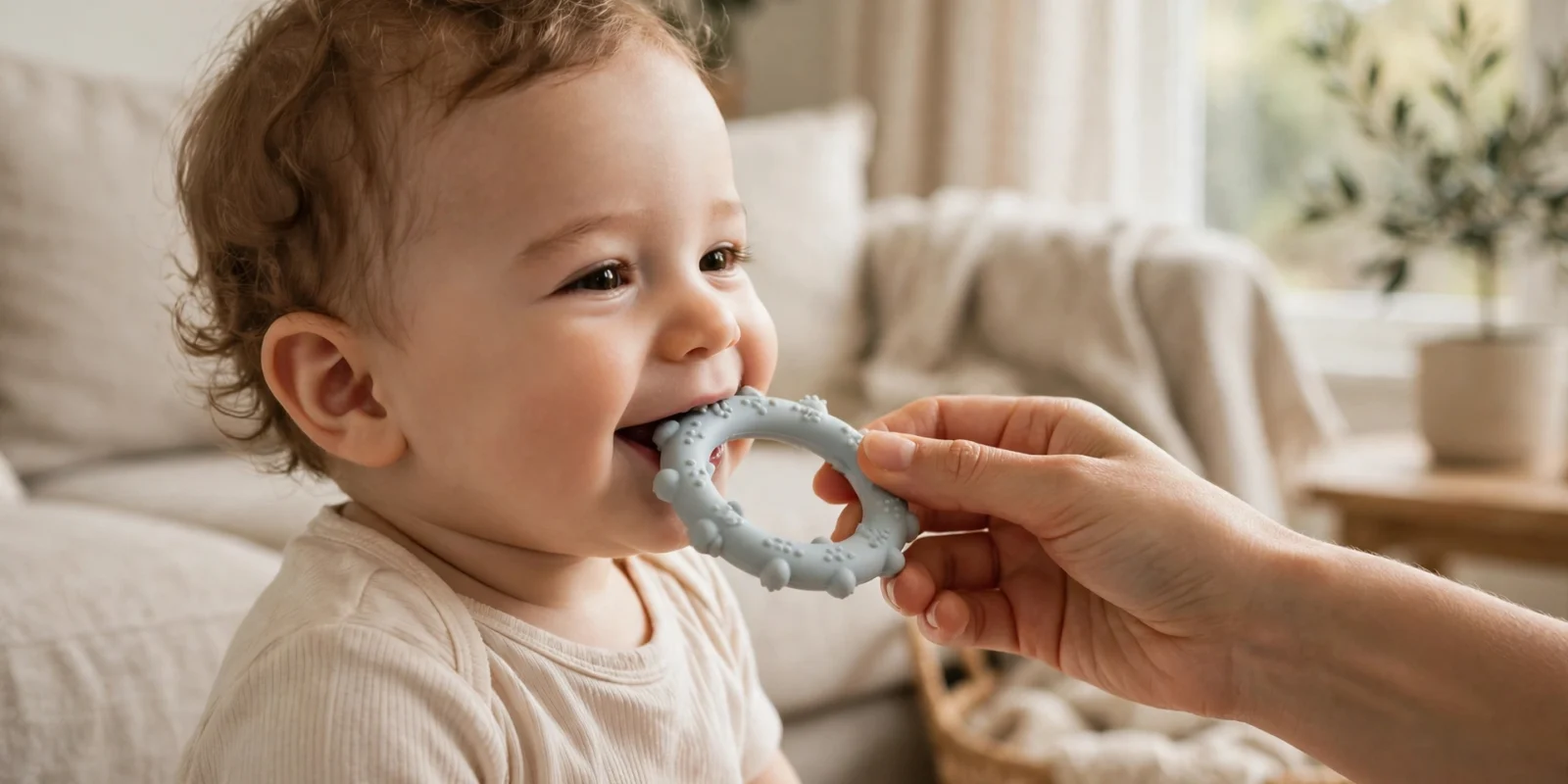
It is 2 a.m., your baby is crying, and nothing you try seems to settle them. Their cheek is flushed, they are drooling through their third bib of the day, and they keep gnawing on anything they can reach — including your finger. If this sounds familiar, you are probably in the middle of teething, and you are not alone in wondering what actually helps.
Teething is one of those milestones every parent dreads a little. It is also one of the most misunderstood. Shops are full of gels, necklaces and tablets promising relief, yet the safest, most effective baby teething remedies are often the simplest — and some of the most heavily marketed products are the ones experts warn against.
Written by Md Masud Rana based on published expert sources. This article has not been professionally reviewed. See our sources below.
In this guide, you will learn when teething usually starts, which symptoms are genuinely caused by it (and which are not), the remedies paediatric and dental bodies actually recommend, and the products to steer clear of. Everything here is drawn from guidance published by the American Academy of Pediatrics (AAP), the UK’s NHS, and the Oral Health Foundation — so you can act with confidence instead of guesswork.
Quick Answer
Most babies start teething at around 6 months, and the safest baby teething remedies are a gentle gum massage with a clean finger, a firm teether chilled in the fridge (never frozen), a cold damp washcloth, and comfort and distraction. Teething does not cause a true fever or diarrhoea — if your baby has either, contact your doctor. Avoid benzocaine gels, homeopathic teething tablets and amber teething necklaces.
Contents
- When Do Babies Start Teething?
- What Are the Real Signs of Teething?
- Teething or Something Else?
- Baby Teething Remedies That Actually Help
- What to Avoid: Gels, Tablets and Necklaces
- Looking After Those First Teeth
- What Recent Research Shows
- Common Mistakes Parents Make
- Final Recommendations
- Frequently Asked Questions
When Do Babies Start Teething?
Most babies get their first tooth at around 6 months, though the range is wide. Some babies are born with a tooth already through, others do not cut one until after their first birthday, and both ends of that range can be perfectly normal. The American Academy of Pediatrics notes that most babies develop teeth between 6 and 12 months, and that around 3 months babies begin exploring the world with their mouths — which parents often mistake for early teething.
The first teeth to appear are almost always the lower front teeth, the lower central incisors. After that, teeth tend to arrive in a fairly predictable order: top front teeth, then the teeth either side of them, then first molars, canines, and finally second molars. NHS guidance gives a rough timeline for this order, from bottom incisors at around 5 to 7 months through to second molars at 20 to 30 months. Most children have their full set of 20 baby teeth by about two and a half years old.
Here is the part many parents find reassuring: not every tooth causes trouble. Some babies sail through teething with barely a grizzle, while others are unsettled for days before each tooth breaks through. A common real-world pattern is that the first few teeth and the molars — which are bigger and broader — cause the most fuss. If your baby seems fine, there is nothing to fix. Teething only needs managing when your baby is clearly uncomfortable.
Does teething follow a set schedule?
Not exactly. The timeline above is an average, not a deadline. A baby who gets their first tooth at 4 months is not ahead, and one who waits until 13 months is not behind. Genetics plays a big role — if you or your partner teethed late, your baby may too. What matters more than timing is that teeth are coming through in a reasonable order and that you mention any real concerns at your baby’s regular check-ups.
What if no teeth have appeared by 12 months?
It is worth raising at a routine appointment, but it is rarely a cause for alarm on its own. Some babies simply take longer. Your paediatrician or dentist can check the gums and, if needed, reassure you that everything is developing as it should. The AAP recommends a first dental visit by your baby’s first birthday in any case, which is a natural moment to ask.
What Are the Real Signs of Teething?
So how do you know teething is actually happening? The signs are usually local — centred on the mouth — rather than whole-body illness. The Oral Health Foundation lists the typical signs: sore or red gums where the tooth is coming through, more dribbling than usual, a desire to chew or bite things, being more unsettled or fretful, sleeping less well, rubbing an ear or cheek, a mild temperature, a slightly flushed cheek, and a mild facial rash caused by dribbling.
Look inside your baby’s mouth if they will let you. The gum where a tooth is about to emerge often looks swollen, red or slightly raised, and you may feel a hard ridge under the surface. Drooling tends to increase noticeably — some babies soak through several bibs a day — and that constant moisture is what causes the rash around the mouth and chin. Many parents also notice their baby suddenly wants to chew on everything: fists, toys, the cot rail, your shoulder.
Sleep is often the first thing to go. A baby who was sleeping in longer stretches may start waking more often, and feeding can become fussy too — some babies nurse or bottle-feed less eagerly because sucking puts pressure on sore gums, while others want to feed more for comfort. Both reactions are normal. If sleep disruption is becoming a nightly battle, our guide to baby sleep schedules by age can help you tell a teething phase apart from a routine that needs adjusting.
The drool rash problem
Extra saliva is harmless in itself, but skin that stays wet gets sore. Gently pat your baby’s chin and cheeks dry through the day rather than rubbing, and change damp bibs and clothes promptly. A thin layer of plain barrier cream on the chin can protect the skin. If the rash becomes cracked, weepy or spreads, that is worth a word with your doctor — it may need more than a bib change.
Teething or Something Else? The Fever and Diarrhoea Myths
This is the section that matters most, because getting it wrong can mean missing a real illness. Teething is blamed for all sorts of symptoms, but the evidence does not support most of them.
NHS guidance is clear: some people think teething causes diarrhoea and fever, but there is no evidence to support this. A baby’s temperature may rise slightly while teething, but a mild temperature means less than 38°C. Anything at or above 38°C (100.4°F) is a true fever, and it points to an infection or illness that needs attention — not to a tooth.
The AAP makes the same point, citing a 2016 study published in Pediatrics which found that a true fever is not associated with teething. The reason the myth persists is timing: babies start teething at around the same age they begin putting everything in their mouths and meeting more germs, so colds, ear infections and stomach bugs frequently coincide with new teeth. The tooth gets the blame; the virus is the culprit.
| Symptom | Caused by teething? | What to do |
|---|---|---|
| Drooling, chewing, sore gums | Yes | Use the remedies below |
| Mild temperature under 38°C | Possibly | Monitor; keep baby comfortable |
| Fever of 38°C or higher | No | Contact your doctor |
| Diarrhoea or vomiting | No | Contact your doctor, especially if dehydration signs appear |
| Refusing feeds or fewer wet nappies | No | Seek medical advice promptly |
The early signpost is simple: if your baby is miserable in a way that feels out of proportion, has a fever, is unusually sleepy or hard to wake, is feeding poorly, or has fewer wet nappies than usual, do not wait it out as teething. Call your paediatrician, GP or local health line. In the UK, NHS 111 can advise; elsewhere, your baby’s doctor is the first call. Trust your instincts — you know your baby best, and a quick call is never a waste of anyone’s time.
Baby Teething Remedies That Actually Help
The good news is that the remedies with the best support behind them cost almost nothing. Work through them in order, starting with the gentlest, and you will usually find one or two that suit your baby. Every baby is different — what soothes one child may leave another unimpressed — so a bit of trial and error is normal.
1. Gum massage with a clean finger
This is the single most recommended remedy across every major guideline, and it is free. Wash your hands, then gently rub the sore area of your baby’s gum with a clean finger. The counter-pressure eases the ache, and many babies will happily gnaw on your finger themselves. The AAP lists gum massage first among its recommended approaches, and it works at any age — even before your baby can hold a teether.
2. A firm teether, chilled in the fridge
A solid rubber or plastic teething ring gives your baby something safe to bite down on, and chilling it in the fridge adds a soothing cold sensation. Choose a solid ring, not a liquid-filled one, which can split and leak under determined chewing. The Oral Health Foundation warns against putting teethers in the freezer — a frozen ring becomes too hard and can bruise delicate gums. Fridge-cold is the sweet spot. Always supervise your baby with a teether, and never tie one around their neck.
3. A cold, damp washcloth
Twist a clean washcloth, wet it, chill it in the fridge, and let your baby gnaw on it. It combines cold, pressure and texture, and it is often the remedy babies accept most readily. Some parents tie a knot in one end to give little hands something to grip. Keep a few in rotation so there is always a cold one ready, and wash them frequently — they collect drool fast.
4. Cold foods — once solids have started
For babies over 6 months who are eating solids, cold soft foods can help: a chilled slice of melon, a cold piece of banana, or a refrigerated teething biscuit under close supervision. Stay with your baby the whole time — chunks can break off and become a choking hazard, and the AAP cautions that teething biscuits are not very nutritious and often contain sugar and salt. If you are still at the early stages of weaning, our guide to starting solids and first foods covers which textures are safe at each stage.
5. Comfort, cuddles and distraction
Do not underestimate the low-tech option. Extra cuddles, a new toy, a walk outside, a bath — distraction genuinely helps because some of the distress is frustration, not just pain. A baby who is miserable in the evening may be a different child after a change of scene. This is also the remedy that helps parents most: doing something beats sitting helplessly beside a crying baby.
6. Pain relief medicine — only when needed
If your baby is clearly distressed and the physical remedies are not cutting it, a sugar-free infant pain reliever may help. The AAP advises asking your paediatrician for a weight-appropriate dose of acetaminophen (paracetamol), or ibuprofen if your baby is over 6 months. The Oral Health Foundation notes paracetamol can be used from 2 months and ibuprofen from 3 months (and above 5 kg) in the UK, but always follow the label for your baby’s age and weight, and check with a pharmacist or doctor if you are unsure. Use medicine for rough patches, not as a nightly routine — and never give aspirin to a child under 16.
What to Avoid: Gels, Tablets and Necklaces
Some of the best-known teething products are the ones experts most firmly advise against. This is where a quick check before buying can genuinely protect your baby.
Benzocaine gels
Gels containing benzocaine, a local anaesthetic, are sold to numb sore gums. The problem is that they wash out of a baby’s mouth within minutes, so they offer little benefit — and they carry a serious risk. The US Food and Drug Administration (FDA) warns that over-the-counter oral benzocaine products should not be used in children under 2 years, because benzocaine can cause methemoglobinemia, a rare but potentially fatal condition in which the blood carries far less oxygen. The FDA has urged manufacturers to stop marketing these products for teething altogether. If you have an old tube at home, throw it away.
Homeopathic teething tablets and gels
These are marketed as natural, but “natural” is not the same as safe. The FDA has cautioned against certain homeopathic teething tablets after reports of serious adverse events, and some products have been found to contain inconsistent amounts of belladonna, a toxic plant. The Oral Health Foundation states there is no reliable evidence that homeopathic teething products work. A chilled teether does the job without the gamble.
Amber teething necklaces and beads
Amber necklaces are claimed to release pain-relieving oils when warmed by the skin. There is no research supporting that claim, and the risks are real: necklaces around an infant’s neck pose a strangulation risk, and beads can break off and become a choking hazard. The AAP explicitly recommends against them, and the FDA has received reports of deaths and serious injuries linked to teething jewellery. A teether your baby holds — not wears — is the safe alternative.
Frozen teethers, hard foods and sugary rusks
As noted above, a frozen-solid teether can damage gums; fridge-cold is enough. Hard foods like raw carrot sticks are a choking risk for babies who cannot yet manage them, and rusks are best avoided because most contain sugar, which promotes tooth decay even in brand-new teeth. If you are baby-proofing the house for a newly mobile, newly chewing baby, our baby-proofing checklist covers choking hazards room by room.
Looking After Those First Teeth
The moment a tooth appears, its care begins. Baby teeth matter far more than their temporary status suggests: they help your child eat and speak clearly, and they hold space for the adult teeth that follow. Decay can start as soon as a tooth is in the mouth.
Start brushing twice a day as soon as the first tooth emerges, using a soft, small toothbrush and a smear of fluoride toothpaste about the size of a grain of rice. The AAP advises brushing twice daily with that rice-grain smear, and moving to a pea-sized amount at age 3. Brush after the last feed of the day, and never put your baby to bed with a bottle — milk or formula pooling around teeth overnight is a classic cause of early decay.
Book the first dental visit within 6 months of the first tooth appearing and no later than your baby’s first birthday. Both the AAP and the American Academy of Pediatric Dentistry recommend establishing a “dental home” by age one. The first appointment is usually quick and gentle — a check of how teeth are developing, advice on brushing and fluoride, and a chance to ask questions before problems start. If your baby does not yet have a dentist, your paediatrician can often apply fluoride varnish at a well-child visit and point you to a children’s dentist.
One more habit to build early: water between meals. The AAP recommends against juice for babies under 12 months, and sugary drinks are the fastest route to decay in small teeth. Plain water in a sippy or straw cup from around 6 months keeps your baby hydrated and rinses the mouth — a small habit with a long payoff.
What Recent Research Shows
Teething research is thinner than parents might expect, which is part of why myths persist. The most-cited recent evidence is a 2016 study published in Pediatrics, which analysed symptoms in teething infants and found that a true fever — 38°C or higher — was not associated with teething. That finding underpins the AAP’s current position and is the reason guidelines draw such a firm line at 38°C.
Evidence on the remedies themselves is largely consensus-based rather than trial-based: paediatric bodies agree on gum massage, cold teethers and comfort measures because they are low-risk and consistently reported as helpful, not because large trials have ranked them. On the other side, the evidence against benzocaine gels and amber necklaces is safety evidence — adverse-event reports and risk assessments — which is why regulators have acted even without efficacy trials.
One honest gap: studies disagree on how common symptoms like irritability and disturbed sleep really are during teething, partly because parents and researchers record them differently. The practical takeaway is not to obsess over whether a symptom “counts” as teething, but to treat the discomfort in front of you and seek advice for anything that looks like illness. If the evidence shifts, the guidance will follow — and this guide will be updated to match.
Common Mistakes Parents Make
1. Assuming every fever is teething. This is the most dangerous mistake on the list. A temperature of 38°C or higher, diarrhoea, vomiting or unusual sleepiness is not teething — it is illness until proven otherwise. Call your doctor rather than reaching for a teether.
2. Reaching for benzocaine gel first. It is on the shelf, it promises numbness, and it is heavily marketed. But it washes away in minutes and carries a rare but serious blood-disorder risk in under-2s. Start with a clean finger and a chilled teether instead.
3. Freezing teethers solid. A rock-hard ring can bruise or cut sore gums. Chilled in the fridge is soothing; frozen is too much. The same goes for ice and frozen foods pressed directly against gums.
4. Buying an amber necklace. There is no evidence it relieves pain, and strangulation and choking risks are documented. It looks gentle and natural; the safety record says otherwise.
5. Leaving a baby unsupervised with food or a teether. Biscuits crumble, rings break, and a baby who is chewing hard can choke quickly. Stay within arm’s reach whenever your baby is gnawing on anything.
6. Skipping tooth care until there are “enough” teeth. One tooth is enough to brush, enough to decay, and enough reason to book a dental visit. Starting the routine now makes it normal by the time your toddler has opinions about toothbrushes.
7. Using medicine every night “just in case”. Pain relief has its place on genuinely rough nights, but nightly dosing without a clear need masks symptoms and adds unnecessary medicine. If your baby seems to need it every night, that pattern itself is worth discussing with your doctor.
Final Recommendations
If you take one approach away from this guide, make it this: start simple, stay safe, and know when to call for help.
- Keep a clean finger and a fridge-chilled solid teether ready — these two cover most teething days.
- Use a cold damp washcloth as your backup; it is cheap, effective and always available.
- Offer cold soft foods only once solids have started, and always supervise eating.
- Pat drool away through the day and use a barrier cream to prevent a sore chin.
- Reserve infant pain relief for genuinely rough patches, at the right dose for your baby’s weight, and ask your doctor if you are unsure.
- Skip benzocaine gels, homeopathic teething tablets and amber necklaces entirely.
- Start brushing from the very first tooth and book a dental visit by your baby’s first birthday.
- Treat fever of 38°C or higher, diarrhoea, vomiting or poor feeding as illness, not teething, and seek advice promptly.
Teething is a phase, not a problem to solve perfectly. Some days the teether works, some days only a cuddle does, and some days nothing seems to help for long. That is normal, and it passes — usually within a few days of each tooth breaking through. For a broader look at this stage of your baby’s first year, our baby and toddler care basics guide covers feeding, sleep and development in one place.
Frequently Asked Questions
Most babies start teething at around 6 months, though some begin as early as 4 months and others after their first birthday. The lower front teeth usually appear first, followed by the top front teeth. Most children have all 20 baby teeth by about two and a half years old. Timing varies widely and is not a sign of a problem on its own.
The safest remedies are a gum massage with a clean finger, a firm solid teether chilled in the fridge, a cold damp washcloth, and comfort and distraction. For babies over 6 months eating solids, chilled soft foods like melon can help. If your baby is clearly distressed, ask your paediatrician about a weight-appropriate dose of infant paracetamol or, over 6 months, ibuprofen.
Teething may cause a slight temperature rise, but a true fever of 38°C (100.4°F) or higher is not caused by teething, according to the American Academy of Pediatrics, citing a 2016 study in Pediatrics. If your baby has a fever, it is likely an infection or illness, and you should contact your doctor rather than assuming it is a tooth.
No. There is no evidence that teething causes diarrhoea, according to NHS guidance. Babies often pick up stomach bugs at the same age teeth arrive, because they put everything in their mouths. If your baby has diarrhoea, especially with signs of dehydration such as fewer wet nappies, contact your doctor.
Gels containing benzocaine are not recommended for children under 2 years. The US Food and Drug Administration warns they can cause methemoglobinemia, a rare but potentially fatal blood condition, and they wash out of the mouth within minutes so they offer little benefit. UK guidance similarly notes limited evidence for teething gels and advises trying teethers or infant pain relief first.
No. The American Academy of Pediatrics advises against amber teething necklaces because they pose strangulation and choking risks, and there is no research showing they relieve teething pain. The FDA has received reports of deaths and serious injuries linked to teething jewellery. Use a solid teether your baby holds instead of anything worn around the neck.
No — chill it in the fridge instead. A frozen teether becomes too hard and can bruise or damage your baby's delicate gums, according to the Oral Health Foundation. A fridge-chilled solid ring, not a liquid-filled one, gives the soothing cold without the risk. Always supervise your baby while they use it.
Book the first dental visit within 6 months of the first tooth appearing and no later than your baby's first birthday. Both the American Academy of Pediatrics and the American Academy of Pediatric Dentistry recommend establishing a dental home by age one. Start brushing twice a day with a rice-grain smear of fluoride toothpaste as soon as the first tooth emerges.
This content is for educational purposes only and does not replace professional medical advice. Always consult a qualified paediatrician before making health decisions for your baby.
Conclusion
Teething asks a lot of parents and very little of anyone else: patience, a clean finger, a cold teether, and the judgement to know when something is more than a tooth. The remedies that work best are the simplest ones, and the products to avoid are the ones that sound most convincing on the shelf. That is not a coincidence — the safest options have survived decades of paediatric scrutiny, while the risky ones keep being sold on hope.
Keep your approach calm and layered. Start with massage and cold, add comfort and distraction, and keep infant pain relief for the nights that genuinely need it. Start brushing from tooth one, book that first dental visit before the first birthday, and hold one firm line: fever, diarrhoea and poor feeding are never “just teething”. A quick call to your doctor costs nothing and can catch something that matters.
Your baby will not remember teething. What they will carry forward is a mouthful of healthy teeth and a parent who learned, early on, to check the evidence before trusting the packaging. That is a good trade for a few sleepless nights — and the nights, like the teeth, do eventually come through.
References
- American Academy of Pediatrics — Baby’s First Tooth: 7 Facts Parents Should Know — HealthyChildren.org — https://www.healthychildren.org/English/ages-stages/baby/teething-tooth-care/Pages/Babys-First-Tooth-Facts-Parents-Should-Know.aspx
- NHS 111 Wales — Baby Teething Symptoms — NHS Wales — https://111.Wales.nhs.uk/livewell/pregnancy/Teethingteethemerge/
- Oral Health Foundation — Teething Tips for Babies — https://www.dentalhealth.org/teething
- US Food and Drug Administration (via Drugs.com) — Oral Over-the-Counter Benzocaine Products: Drug Safety Communication — https://www.drugs.com/fda/oral-over-counter-benzocaine-products-safety-communication-risk-serious-potentially-fatal-blood-14164.html