
Written by Md Masud Rana based on published expert sources. This article has not been professionally reviewed. See our sources below.
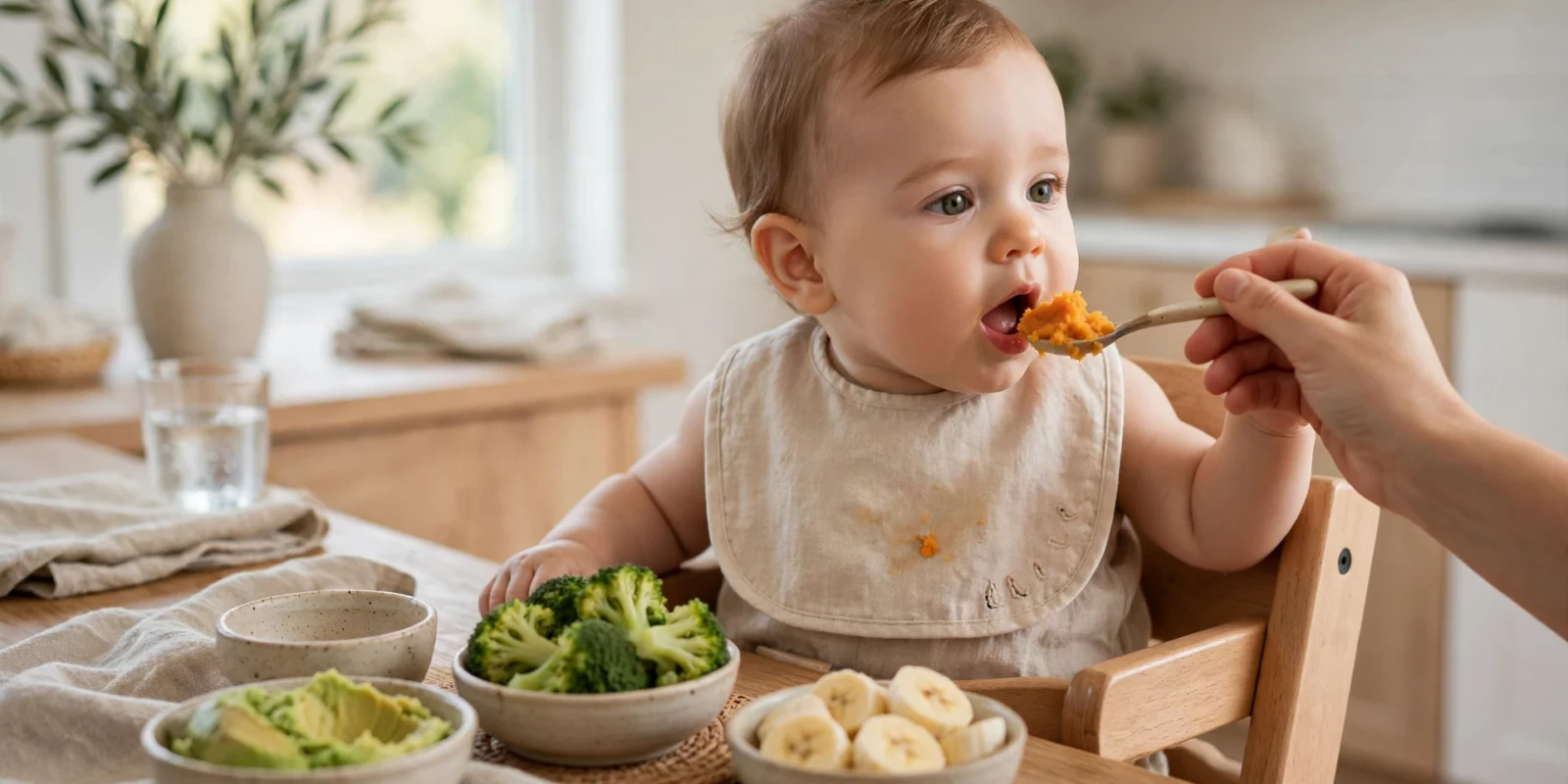
The high chair is assembled, the bibs are washed, and your baby is watching your dinner plate like it holds the secrets of the universe. Starting solids feels like a finish line — but for most parents it lands like a starting gun with no map. Rice cereal or avocado? Purées or finger foods?
Here is the short version: most babies are ready around six months, when they can sit up, hold their head steady, and swallow food instead of pushing it out. First foods need no magic order — but they should be iron-rich, introduced one at a time a few days apart, and always alongside continued milk feeds. This guide covers the rest: the readiness signs that matter (and the fake ones), what to serve first, how to introduce allergens like peanut and egg, how textures should change month by month, and the foods to keep off the tray. Every claim is tied to current guidance from the AAP, CDC and NHS.
Quick answer: Start solids around six months, once three signs appear together: sitting with head control, bringing food to the mouth, and swallowing rather than spitting it out. Begin with small amounts of iron-rich single foods, one new food every 3–5 days, allergens early rather than late, and milk feeds continuing as the main nutrition through the first year. Most feeding in the first weeks is practice, not nutrition.
Contents
- When Is Your Baby Actually Ready? The Three Real Signs
- What Should Your Baby’s First Foods Be?
- Starting Solids: A Calm Plan for the First Two Weeks
- Introducing Allergens Early: What the Research Actually Says
- Textures, Finger Foods and Baby-Led Weaning
- Foods to Avoid in the First Year
- Milk, Vitamins, Cups and the Daily Rhythm
- What Recent Research Shows
- Common Mistakes (and What to Do Instead)
- Final Recommendations
- Frequently Asked Questions
- Conclusion
- References
When Is Your Baby Actually Ready? The Three Real Signs
The calendar is a guide, not a gate
The CDC’s infant nutrition FAQ cites the Dietary Guidelines for Americans and the AAP: complementary foods around six months, or when the baby is developmentally ready — CDC. The NHS puts it plainly: starting solids should happen when your baby is “around 6 months old” — milk has carried them well until then, and their bodies need time to mature — NHS.
That “around” matters. Some babies are ready a touch early; others need a few weeks more — what the body can do counts more than the calendar. Premature babies should be judged on corrected age; ask your paediatrician or health visitor about timing — NHS.
The three signs that actually count
Both the NHS and the Breastfeeding Network describe the same trio of readiness signs, and they need to appear together:
- Sitting and head control. Stay in a sitting position and hold their head steady — supported is fine at first.
- Hand-eye-mouth coordination. Look at food, pick it up with their fingers, and bring it to their own mouth.
- Swallowing instead of spitting. Food goes in and stays in, not pushed straight back out by the tongue.
These are the NHS’s three clear signs, appearing together from around six months — NHS. The CDC describes the same milestones: sitting with support, head and neck control, opening the mouth for food, and swallowing rather than pushing food out — CDC.
The fake signs that fool almost everyone
Many parents get tripped up here. The NHS is explicit that three common behaviours are not readiness signs: chewing fists, waking in the night more than usual, and wanting extra milk feeds — normal baby behaviour, not a request for porridge — NHS. The Breastfeeding Network adds that night waking in a younger baby is often misread as hunger for solids, when it usually is not — Breastfeeding Network.
And the big myth: solids will not make your baby sleep through the night — the NHS states this directly, and the CDC adds that cereal in a bottle will not lengthen sleep and may raise choking risk — NHS, CDC. If broken nights are the real problem, our baby sleep schedule guide is the better tool for that job.
What Should Your Baby’s First Foods Be?
Forget the magic order
The old advice was wrong about this: there is no required sequence. The CDC, quoting the AAP, says plainly that “you do not need to introduce your baby to foods in a certain order” — CDC. What matters is that by seven or eight months your baby eats a variety of foods from different food groups — vegetables, fruits, meat or other proteins, dairy without added sugars, whole grains — CDC.
Lead with iron
If one nutrient deserves top billing, it is iron. Around six months babies begin to need extra iron from food — which is why UCSF Benioff Children’s Hospitals names iron-fortified baby cereal a good first food, mixed smooth with milk or water — UCSF Benioff Children’s Hospitals. Other iron-rich options: puréed or finely minced meat, mashed lentils and beans. One caution from the CDC: rotate oat, barley and multigrain cereals rather than serving only rice cereal, to limit arsenic exposure — CDC.
A starter list that actually works
The NHS suggests single vegetables and fruits — mashed or soft-cooked sticks of parsnip, broccoli, potato, yam, sweet potato, carrot, apple or pear — NHS. One detail worth stealing: deliberately include vegetables that are not sweet, such as broccoli, cauliflower and spinach, so your baby meets a range of flavours early — NHS. Many parents find that early flavour variety makes later fussiness less likely, though every child differs.
Beyond produce: soft-cooked egg, flaked boneless fish, soft meat, pulses like beans and lentils, and plain full-fat yoghurt — all suitable from around six months per the NHS — NHS. Cows’ milk can go into cooking from six months, but not as a main drink until one year — NHS.
The takeaway a skimmer must not miss: there is no perfect first food — there is a perfect first pattern: iron-rich, varied, one new food at a time, and heavy on vegetables that are not sweet.
Starting Solids: A Calm Plan for the First Two Weeks
Set the scene, then lower your expectations
Picture a Tuesday evening: baby strapped into the high chair, a teaspoon of mashed sweet potato, a wipe-clean mat on the floor, and optimism that lasts roughly ninety seconds. Most of the food lands on the bib, the tray, and — somehow — behind the baby’s ear. This is not failure. As NHS Highland puts it, the early goal is exploration: “we’re not aiming for perfect meals” — NHS Highland.
Setup matters more than the menu: baby safely upright in a fitted harness, an unhurried session, no screens — NHS. Offer solids when your baby is calm and content, not starving or overtired — and always stay with your baby while they eat, which every authority repeats — Breastfeeding Network.
One food at a time, a few days apart
The AAP recommends one food at a time, waiting three to five days before the next, so reactions are easy to spot — CDC. Watch for skin rash, diarrhoea, constipation or vomiting — UCSF Benioff Children’s Hospitals. Once tolerated, keep offering each food regularly — this matters especially for allergens.
How much? Barely any at first — a few teaspoons or pieces, since the point is learning tastes and textures, not calories — NHS. One honest difference between sources: the NHS suggests food before the usual milk feed so the baby is interested; UCSF advises milk before solids so milk stays the priority — NHS, UCSF Benioff Children’s Hospitals. Either way, milk feeds continue as before; solids are a side project for now.
A two-week rhythm you can actually follow
| When | What to do | Why it helps |
|---|---|---|
| Days 1–3 | One single food (e.g. mashed sweet potato or iron-fortified cereal), 1–2 teaspoons once a day | Baby learns spoon mechanics; clean baseline for reactions |
| Days 4–7 | Increase the same food slightly; add a second food if the first is tolerated | Portion grows with confidence; variety begins |
| Week 2 | Two foods a day; add a soft finger food to hold | Textures widen; self-feeding practice starts |
| Ongoing | New food every 3–5 days; build toward 2–3 small meals a day by 8–9 months | Variety compounds; family meals come into reach |
Baby eating almost nothing? Completely normal. Keep offering, keep milk feeds going, trust your child’s appetite — some days more, some days less — NHS Highland.
Introducing Allergens Early: What the Research Actually Says
The old advice was backwards
For years, parents were told to delay peanut, egg and fish — the thinking being that waiting would prevent allergies. The evidence went the other way. The landmark 2015 Learning Early About Peanut Allergy (LEAP) trial showed that introducing peanut products in infancy substantially reduced the risk of peanut allergy in high-risk children, and the guidance reversed course — AAP. In 2017 the National Institute of Allergy and Infectious Diseases (NIAID) issued addendum guidelines recommending early peanut introduction, endorsed by the AAP and others — AAP. The payoff is now visible in real-world data: peanut allergies in children aged 0–3 fell by 27.2% in the years after the guidance changed, according to a study in the November 2025 issue of Pediatrics — AAP.
How to introduce allergens in practice
The NHS guidance is reassuringly simple: foods containing allergens — peanuts, hens’ eggs, gluten and fish — can be introduced from around six months, one at a time and in small amounts so you can spot any reaction — NHS. FARE, the US food-allergy research and education body, reports that early and regular consumption of infant-safe peanut foods reduced peanut-allergy risk by over 80% in the LEAP study — FARE.
Practical and safe ways to do it:
- Peanut: thin smooth peanut butter with milk or warm water, or stir peanut powder into porridge. Never whole peanuts or spoonfuls of thick nut butter — choking hazards. Crushed nuts and thinly spread peanut butter are fine from six months — NHS.
- Egg: well-cooked scrambled egg or omelette strips — fine from six months — NHS.
- Fish and dairy: flaked boneless fish and plain yoghurt — fine from six months — NHS.
- Keep offering them. One taste is not the programme — early and regular exposure is what the research supports — FARE.
If allergies run in the family
If food allergies run in the family, talk to your GP, health visitor or paediatrician before introducing nuts — NHS. Babies with severe eczema or an existing egg allergy are higher-risk — the NIAID guidelines recommend testing first, so get individual medical advice — AAP.
Know the warning signs
Watch for hives or rash, swelling of the face, lips or tongue, repeated vomiting, or difficulty breathing after a new food. Mild symptoms warrant a prompt call to your paediatrician or GP; breathing difficulty or facial swelling is an emergency — call 999 (UK) or 911 (US) immediately. Only a qualified professional can diagnose an allergy — no article can do that for your child.
Textures, Finger Foods and Baby-Led Weaning
Move textures along — this is the part parents most often stall
Smooth purées are a starting point, not a destination. The NHS advises moving on to mashed, lumpy or finger foods as soon as your baby can manage them — chewing practice that also supports later speech development — NHS. Babies starting around six months may skip smooth purées entirely — NHS.
A common pattern: parents stay on purées for months, then worry when the baby rejects texture at nine months. Introduce lumps early.
Spoon-feeding or baby-led weaning?
Baby-led weaning means offering only finger foods for self-feeding from the start. Neither method is officially preferred; many families mix both. The NHS is direct: “There’s no right or wrong way. The most important thing is that your baby eats a wide variety of food and gets all the nutrients they need” — NHS.
| Spoon-feeding (purées) | Baby-led weaning | |
|---|---|---|
| How food is offered | You offer smooth or mashed food on a spoon | Baby picks up soft finger foods and feeds themselves |
| Starting texture | Smooth or blended, moving to lumps | Soft finger foods from the start |
| Self-feeding practice | Comes later, as finger foods are added | Practised from the very beginning |
| Mess level | Usually less | Usually more (protect the floor) |
| Safety | Same rules: upright, supervised, soft shapes — no extra choking risk with self-feeding — NHS | |
By nine to twelve months, most babies are on minced and chopped family meals in small portions, self-feeding with fingers and a spoon. Follow your baby’s pace, not a timetable.
Gagging is not choking — but know both
The sound that terrifies every new parent is usually gagging, not choking. Gagging is noisy — coughing, spluttering, watery eyes, the tongue pushing food forward: the body’s practice mechanism. Choking is silent — a baby who cannot cry or cough and struggles to breathe. NHS Highland contrasts them directly: gagging means coughing and watery eyes; choking means silence, inability to cough, difficulty breathing, blue or pale skin — NHS Highland.
If your baby is gagging, stay calm and let them work it out. If truly choking — silent, unable to cry or cough, struggling to breathe — call 999 (UK) or 911 (US) immediately. Prevention: always stay with your baby while they eat, keep them upright, offer stage-appropriate foods — NHS Highland.
NHS finger-food examples: soft-cooked vegetables, slices of soft fruit, avocado, cooked potato or pasta, pulses, boneless fish, boiled egg, boneless meat, sticks of pasteurised hard cheese — NHS. Quarter small round foods like grapes; avoid hard foods — whole nuts, raw carrot or apple — to reduce choking risk — NHS.
Foods to Avoid in the First Year
The non-negotiables
Honey — none until after the first birthday. Honey can contain bacteria that cause infant botulism, a very serious illness — NHS. This covers all honey, including in cooked foods. UCSF is equally blunt: no honey for the first year — UCSF Benioff Children’s Hospitals.
Salt — none added. Babies’ kidneys cannot handle much salt: do not add it to food or cooking water, and skip stock cubes and gravy — NHS. Remove the baby’s portion before seasoning family food — NHS. Avoid bacon, sausages, crisps, ready meals and takeaways — NHS.
Sugar and sweeteners — none needed. The NHS advises avoiding sugary food and drink for under-fours, including honey, syrup, fruit juice and smoothies — NHS. Babies under twelve months should have no juice at all, per the AAP — CDC.
The “not yet” list
- Cows’ milk as a main drink — not until one year — NHS.
- Whole nuts (not under five), whole grapes, raw carrot chunks, popcorn, spoonfuls of thick nut butter — choking hazards — NHS, UCSF Benioff Children’s Hospitals.
- Mould-ripened and unpasteurised cheeses — avoid brie, camembert and blue-veined cheese (listeria risk); pasteurised hard cheeses are fine from six months — NHS.
- Raw or lightly cooked shellfish — best avoided because of food-poisoning risk — NHS.
- Shark, swordfish and marlin — avoid under sixteen; mercury can affect the developing nervous system — NHS. For other fish, choose lower-mercury options — CDC.
- Rice drinks — children under five should not have them as a milk substitute because they may contain too much arsenic — NHS.
Once the high chair is in daily use and your baby is grabbing at everything in reach, it is also a good moment to make sure the room around it is safe — our baby-proofing checklist covers the kitchen and dining danger zones.
Milk, Vitamins, Cups and the Daily Rhythm
Milk is still doing most of the work
The most reassuring fact of weaning: solids supplement milk, not replace it. UCSF states breast milk or formula remains the main nutrition for the first year — UCSF Benioff Children’s Hospitals; the NHS notes babies still get most energy from milk well into the weaning months — NHS, NHS Highland.
Longer term, the Dietary Guidelines for Americans, the AAP and the WHO recommend exclusive breastfeeding for about six months, then complementary foods while continuing breastfeeding until two or longer — CDC. Keep your milk routine; layer food on top; let the balance shift gradually. There is no switch-flip day.
Vitamins: the one supplement question nearly every parent has
Guidance differs slightly by country here, so follow your local advice and your paediatrician:
- UK (NHS): breastfed babies or those on less than 500ml of formula daily need 8.5–10 micrograms of vitamin D from birth, plus vitamins A and C from six to twelve months. Babies on 500ml or more of formula daily need no supplements — formula is fortified — NHS.
- US (CDC/AAP): vitamin D supports bones, but sunlight is unreliable and babies under six months should stay out of direct sun — ask your child’s doctor about vitamin D — CDC.
Do not improvise supplement doses — ask your paediatrician or health visitor what applies to your baby.
Introduce a cup, and settle into a rhythm
From six months, introduce a cup — the NHS recommends an open or free-flow cup without a valve — and build from tiny once-a-day tastes toward genuine variety by seven to eight months — NHS, CDC. Eat together when you can — babies copy what they see — NHS.
Follow the baby, not the chart
The thread through every authority’s guidance is responsive feeding. Hunger cues: hands to mouth, rooting, sucking noises. Fullness cues: slowing down, turning the head, closing the mouth — CDC. The NHS version: wait for the open mouth, stop at the closed one, never force a feed — NHS. Pressure-free meals are how babies learn to regulate their own eating.
What Recent Research Shows
The science of starting solids has moved fast in the last decade, and the direction is consistent: earlier variety, earlier allergens, less fear.
The headline finding: after the 2017 NIAID guidelines, peanut allergies in US children aged 0–3 fell 27.2% — reported in the November 2025 Pediatrics — AAP. The original LEAP trial showed early, regular peanut consumption cutting allergy risk by over 80% in high-risk infants, and North American allergy bodies (AAAAI, ACAAI, CSACI) issued a joint 2021 consensus supporting early introduction — FARE.
Sobering footnote: a 2024 study found only 76% of paediatricians and 52% of family physicians knew the 2017 NIAID guidelines — FARE.
On timing, the AAP, CDC and NHS consensus holds steady at around six months, with readiness signs as the final arbiter. What has changed is confidence: early variety, including allergens, is now the mainstream, evidence-backed position — not the edgy one. For your baby’s wider daily rhythms, see our baby and toddler care basics guide.
Common Mistakes (and What to Do Instead)
1. Starting at four months because the baby “seems hungry.” Fist-chewing, night waking and extra milk feeds are normal behaviours, not readiness signs — NHS. Why it matters: gut and swallowing coordination usually need until around six months, and early solids displace superior milk nutrition. Better: wait for the three real signs; offer extra milk meanwhile.
2. Delaying peanut and egg out of fear. Understandable — but the evidence runs the other way: early, regular introduction cuts allergy risk substantially. Waiting buys no safety; it may cost protection. Better: introduce allergens from six months, one at a time, in infant-safe forms — with medical advice first for severe eczema or known egg allergy.
3. Pressuring the baby to finish. Aeroplane noises, “one more bite,” spoon-chasing a turned head. Why it matters: pressure teaches babies to ignore fullness cues and turns meals into battles. Better: offer, watch, stop at the first “done” signal. There is always the next meal.
4. Seasoning the baby’s food like an adult’s. A pinch of salt “for taste,” honey “because it’s natural.” Why it matters: babies’ kidneys cannot handle salt, sugar harms teeth and trains sweet preference, honey can cause botulism. Better: remove the baby’s portion before seasoning. Herbs and mild spices are fine; salt, sugar and honey are not.
5. Staying on smooth purées for months. Purées feel safe, so the lumpy stage keeps getting postponed. Why it matters: the chewing-learning window is widest in the second half of the first year; late textures link to fussier eating. Better: introduce mashed and lumpy textures within weeks; finger foods as soon as your baby shows interest.
6. Cutting milk feeds too fast. Three meals appear; milk feeds quietly vanish. Why it matters: milk remains the main nutrition through most of the first year. Better: keep milk feeds steady and let food grow around them.
Final Recommendations
- Wait for the three signs together — sitting with head control, hand-to-mouth coordination, and swallowing rather than spitting — usually around six months.
- Keep milk central through the first year; treat solids as practice that gradually becomes nutrition.
- Start with iron-rich single foods — iron-fortified cereal, puréed meat, lentils, or soft vegetables — and build variety from there.
- Introduce one new food every 3–5 days at first, so any reaction is easy to trace.
- Bring allergens in early, not late — peanut, egg, fish and dairy from around six months, in infant-safe forms, and keep offering them regularly.
- Follow your baby’s pace and cues — offer, watch, stop at “done.” Never force a feed.
- Move textures along — from smooth to mashed to lumpy to finger foods and family meals across the 6–12 month window.
- Keep honey, added salt and added sugar out entirely in the first year; no juice under twelve months.
- Supervise every bite — upright seating, age-appropriate foods, and you in the room. Learn the difference between gagging and choking before you need it.
- Ask your paediatrician, health visitor or GP about anything individual — prematurity, eczema, reactions, supplements. This guide summarises published guidance; it cannot assess your baby.
Frequently Asked Questions
Around six months, when three signs appear together: sitting with steady head control, bringing food to the mouth, and swallowing rather than spitting it out. The AAP, CDC and NHS all point to around six months. Premature babies should be assessed on corrected age — ask your paediatrician or health visitor.
Not without medical advice. The AAP, CDC and NHS advise waiting until around six months and the readiness signs. Earlier starts do not improve sleep or growth — the CDC notes cereal in a bottle will not lengthen sleep and may raise choking risk. Considering starting sooner? Talk to your paediatrician first.
No required order, but iron-rich foods are a smart start: iron-fortified cereal, puréed or minced meat, mashed lentils and beans. The NHS also suggests single vegetables and fruits — sweet potato, broccoli, parsnip, pear — including non-sweet ones for flavour range. One new food at a time, a few days apart.
Both work, and many families mix them. The NHS: no right or wrong way — what matters is variety, nutrients, and texture progression from smooth to lumpy to finger foods. Baby-led weaning means soft finger foods from the start; spoon-feeding starts with purées and adds finger foods later. Supervise closely either way.
From around six months, one at a time in small amounts. The LEAP trial showed early, regular peanut introduction substantially cut allergy risk; 2017 NIAID guidelines, endorsed by the AAP, recommend it. Use infant-safe forms — thinned peanut butter or peanut powder — never whole peanuts. Severe eczema or egg allergy? Get medical advice first.
Usually not. Gagging is noisy — coughing, spluttering, watery eyes — and it is how babies learn to manage food. Choking is silent: the baby cannot cry or cough and struggles to breathe — an emergency needing an immediate call to your local emergency number. Always stay with your baby while they eat, keep them upright, offer age-appropriate textures.
Very little at first — a few teaspoons or pieces once a day, since milk remains the main nutrition through most of the first year. Build gradually; by seven or eight months most babies eat varied foods from different food groups — CDC. Follow hunger and fullness cues, not charts.
No. The AAP, CDC, NHS and WHO all advise continuing milk feeds alongside solids — milk remains the main nutrition well into the first year, with breastfeeding supported until two or longer — CDC. Solids complement milk; they do not replace it. Keep your milk routine steady and let solid food grow around it gradually over the coming months.
Disclaimer: This content is for educational purposes only and does not replace professional medical advice. Always consult your paediatrician before making feeding decisions for your baby.
Conclusion
Starting solids looks simple and feels anything but. The evidence-backed core is calm: wait for the three readiness signs around six months, keep milk feeds strong, start with iron-rich single foods, introduce allergens early, move textures with your baby’s pace, and keep honey, salt and sugar off the menu for the first year.
Two habits beat any schedule: follow your baby, not the chart — and keep mealtimes pressure-free. Babies allowed to explore, refuse and retry develop healthier food relationships than babies who are coaxed. A rejected broccoli floret is not a verdict — the NHS notes it can take ten or more tries.
This week’s action steps: check for the three signs, pick one iron-rich first food, clear an unhurried twenty minutes. If anything here raised a question specific to your baby — prematurity, eczema, a suspected reaction, supplements — take it to your paediatrician, health visitor or GP. That is what they are for.
For the rest of the first-year journey, our baby sleep schedule guide and baby and toddler care basics pick up where feeding leaves off.
References
- CDC — Frequently Asked Questions: Infant and Toddler Nutrition — CDC — 2026 — https://www.cdc.gov/infant-toddler-nutrition/faqs/index.html
- AAP — Peanut Allergies Declined Following Recommendation for Early Introduction — American Academy of Pediatrics — 2025 — https://www.aap.org/en/news-room/news-releases/pediatrics2/2025/peanut-allergies-declined-following-recommendation-for-early-introduction/
- NHS — Your baby’s first solid foods — NHS — https://www.nhs.uk/conditions/baby/weaning-and-feeding/babys-first-solid-foods/
- NHS — Foods to avoid giving babies and young children — NHS — https://www.nhs.uk/baby/weaning-and-feeding/foods-to-avoid-giving-babies-and-young-children/
- Breastfeeding Network — Starting Solids — The Breastfeeding Network — https://www.breastfeedingnetwork.org.uk/breastfeeding-information/continuing-the-breastfeeding-journey/starting-solids/
- NHS Highland — Starting solids (weaning) — NHS Highland — 2026 — https://www.nhshighland.scot.nhs.uk/your-services/all-services-a-z/maternity-and-neonatal/after-you-ve-had-your-baby/infant-feeding/starting-solids-weaning/
- UCSF Benioff Children’s Hospitals — Starting Solid Foods — UCSF — 2026 — https://www.ucsfbenioffchildrens.org/en/education/starting-solid-foods
- FARE — The Proof Is in the Peanut! — Food Allergy Research & Education — https://www.foodallergy.org/fare-blog/proof-peanut