Written by Md Masud Rana based on published expert sources. This article has not been professionally reviewed. See our sources below.
Most of us never think twice about the bathroom. It is the room we use half-asleep at 3am and barely notice. For an older adult, though, that same room quietly becomes the most dangerous one in the house. Wet floors, hard edges, tight corners, and the simple act of stepping over a bath rim or standing up from a low toilet — each one is a small test of balance. And balance, as the years pass, is not something anyone should take for granted.
Bathroom safety for seniors is not about turning a home into a hospital ward. It is about a handful of practical changes, most of them cheap, that keep a person bathing, dressing and moving around independently for longer. This guide walks through every zone of the bathroom — the shower, the toilet, the floor, the lighting, the water temperature, the door — with the measurements and the reasoning behind each fix, drawn from the CDC, the National Institute on Aging, the National Council on Aging, and occupational therapy guidance. You do not need a remodel. You need the right fixes in the right places.
Quick Answer
Bathroom safety for seniors comes down to grip, seating, lighting and temperature. Install wall-mounted grab bars anchored into studs beside the toilet and in the shower, add a shower chair or transfer bench, use non-slip mats, set the water heater to 120°F (49°C), and light the path with motion-sensor night lights. Most of these fixes cost little and need no remodel — and together they address the room where most serious home falls happen.
Contents
- Why the Bathroom Is the Riskiest Room
- Grab Bars: Where They Go
- Shower and Tub: Chairs and Sprayers
- The Toilet: Height and Frames
- Floors and Surfaces
- Water Temperature: Preventing Scalds
- Lighting and Night-Time Trips
- Doors and Getting Help
- What Recent Research Shows
- Common Mistakes to Avoid
- Final Recommendations
- Frequently Asked Questions
Why the Bathroom Is the Riskiest Room in the House
Picture this. It is 2am, dark, and someone gets up to use the bathroom. Half-asleep, barefoot, they step onto cold tile, reach for a towel rail that was never meant to hold weight, and their foot finds a damp patch near the bath. That is how most bathroom falls happen — not during anything dramatic, but during an ordinary movement in ordinary conditions.
The numbers explain why this room deserves attention. Around one in four Americans aged 65 and older falls each year, according to the CDC, and falls are the leading cause of both fatal and non-fatal injuries in that age group. The National Council on Aging reports that in 2021, falls caused 38,000 deaths among Americans aged 65 and over, with emergency departments recording around 3 million visits for older adult falls. A CDC analysis found the rate of deaths from falls rose 31% between 2007 and 2016 — fastest among people aged 85 and over.
Why the bathroom, specifically? It concentrates every fall ingredient into a few square feet. As one home-safety guide puts it, the bathroom combines wet, slick surfaces, hard fixtures at head height, tight turning space, and transfers that require balance on one leg. Add nighttime trips, medication side effects and rushing, and the risk multiplies. Healthline notes that falls in the bathroom are most likely during transitions — sitting down or standing up from the toilet, or getting in and out of the shower.
There is good news. Falls are not an unavoidable part of ageing. The CDC’s guidance stresses that falls among adults 65 and older can be prevented, and home modifications are one of the most effective tools available. The NCOA points out that home hazards — clutter, poor lighting and a lack of supports such as grab bars — are modifiable risk factors, and addressing them reduces falls risk. A bathroom that supports the three movements that actually happen there — walking in, transferring safely, and reaching without twisting — lets someone stay independent longer.
When a fall needs urgent attention
If someone falls and hits their head, they should see a doctor straight away, even if they feel fine — head injuries after a fall are not always obvious immediately. The same urgency applies if someone cannot get up, has severe pain, cannot bear weight, or notices new confusion or weakness. Keep a phone or a wearable alert device within reach of the floor, not just on the counter. Our guide to medical alert systems for seniors explains the options, including systems with automatic fall detection.
Grab Bars: Where They Go and How to Install Them
If you do one thing in the bathroom, make it this. Grab bars are the single most recommended safety feature in every source consulted for this guide — the CDC, the NIA, Mayo Clinic, Healthline, and occupational therapy guidance all agree on them. They are cheap, quick to install, and they work because they give the hands something solid to hold at the exact moments when balance is most at risk.
The first thing to understand is what a grab bar is not. It is not a towel rail, and it is not a suction-cup bar stuck to the tile. It is a metal bar anchored into wall studs or solid blocking, rated to hold a person’s full body weight. MedlinePlus guidance is blunt: do not use towel racks as grab bars, because they cannot support your weight. HomeCareHub’s safety checklist warns that suction-cup bars can release without warning and should never be used for weight bearing.
Where to place them
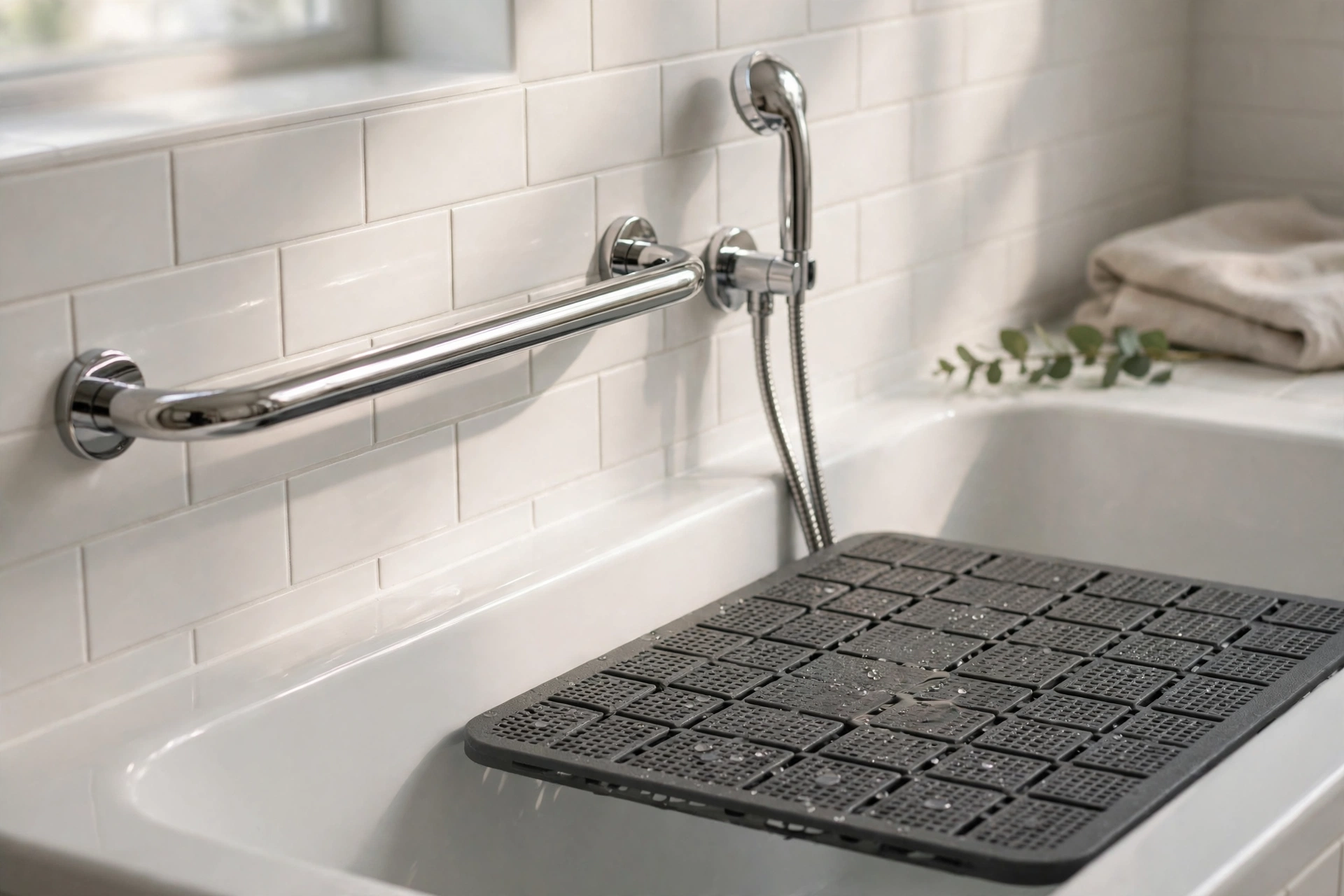
Placement matters as much as having bars at all. The places that matter are where the body changes position: beside the toilet, at the shower or tub entrance, and along the shower or tub wall. Mayo Clinic’s guide recommends a horizontal grab bar on the side wall next to the toilet, which supports sitting, standing and controlled lowering, plus a rear wall bar behind the toilet. For the shower, it suggests a vertical bar near the entrance and a horizontal bar along the side or back wall.
For a tub-shower combination, the pattern is similar: a vertical or angled entry bar near the tub edge, and a horizontal bar along the long wall. MedlinePlus recommends two bars as a minimum — one for getting in and out of the tub, and another for standing from a sitting position. If wall-mounted bars are not possible, for example in a rental home, a toilet safety frame or a raised toilet seat with armrests can provide support without drilling. Have the bars fitted by someone who knows how to find studs — a professional installer can mount a bar in under an hour.
Height, size and strength
The measurements most often cited come from the 2010 ADA Standards for Accessible Design — standards for public buildings, but the reference figures everyone borrows. Horizontal grab bars are commonly placed 33 to 36 inches above the floor. A circular bar should be 1.25 to 1.5 inches in diameter, with a textured surface for grip, and the gap to the wall about 1.5 inches. The strength figure is the one to remember: bars should withstand a 250-pound force. That is why anchoring into studs or solid blocking is non-negotiable — a bar screwed only into plasterboard will pull out exactly when it is needed most.
The Shower and Tub: Chairs, Benches and Handheld Sprayers
Stepping over a bath rim is one of the hardest everyday movements an older body faces: standing on one leg, lifting the other over a high edge, and landing on a wet surface — all while turning. Add arthritis, neuropathy, poor vision or leg weakness, and it becomes genuinely risky. The fix is simple in concept: sit down instead of standing.
Shower chair or transfer bench?
The answer depends on the bathroom. A shower chair is a small seat with rubber-tipped, adjustable legs that sits inside the shower, suiting a walk-in shower where the person can step in safely but should sit while bathing. A transfer bench is longer: part sits outside the tub and part inside, so the person sits down outside and slides across. Mayo Clinic’s guide puts it plainly: choose a transfer bench when stepping over the tub is unsafe, painful or tiring, and a shower chair when the person can safely enter the shower but should sit while bathing.
Whichever you choose, adjust the seat so the person’s feet rest flat on the floor, with hips and knees close to a 90-degree angle. Too low, and standing requires more strength; too high, and the feet may not touch the floor securely. A chair with a backrest helps anyone with balance concerns. Healthline also suggests a clamp-on tub bar for extra support and, where a glass shower door makes entry awkward, replacing it with a shower curtain.
The handheld showerhead
A handheld showerhead on a flexible hose lets a person direct water exactly where it is needed while seated, which means less twisting, reaching and standing. Mayo Clinic recommends a hose at least 60 inches long, with the controls placed where they can be reached from a seated position. Pair it with a shower caddy at seated height and a long-handled sponge, so nobody has to bend or twist on a wet floor.
The Toilet: Height, Frames and Sitting Down Safely
The toilet is one of the most important places to add support, and one of the most overlooked. Sitting down and standing up require leg strength, balance and joint control — and a low toilet makes all three harder. A seat that is too low forces the hips and knees into a deeper bend, which strains joints and makes standing back up a real effort.
Raised seats and comfort-height toilets
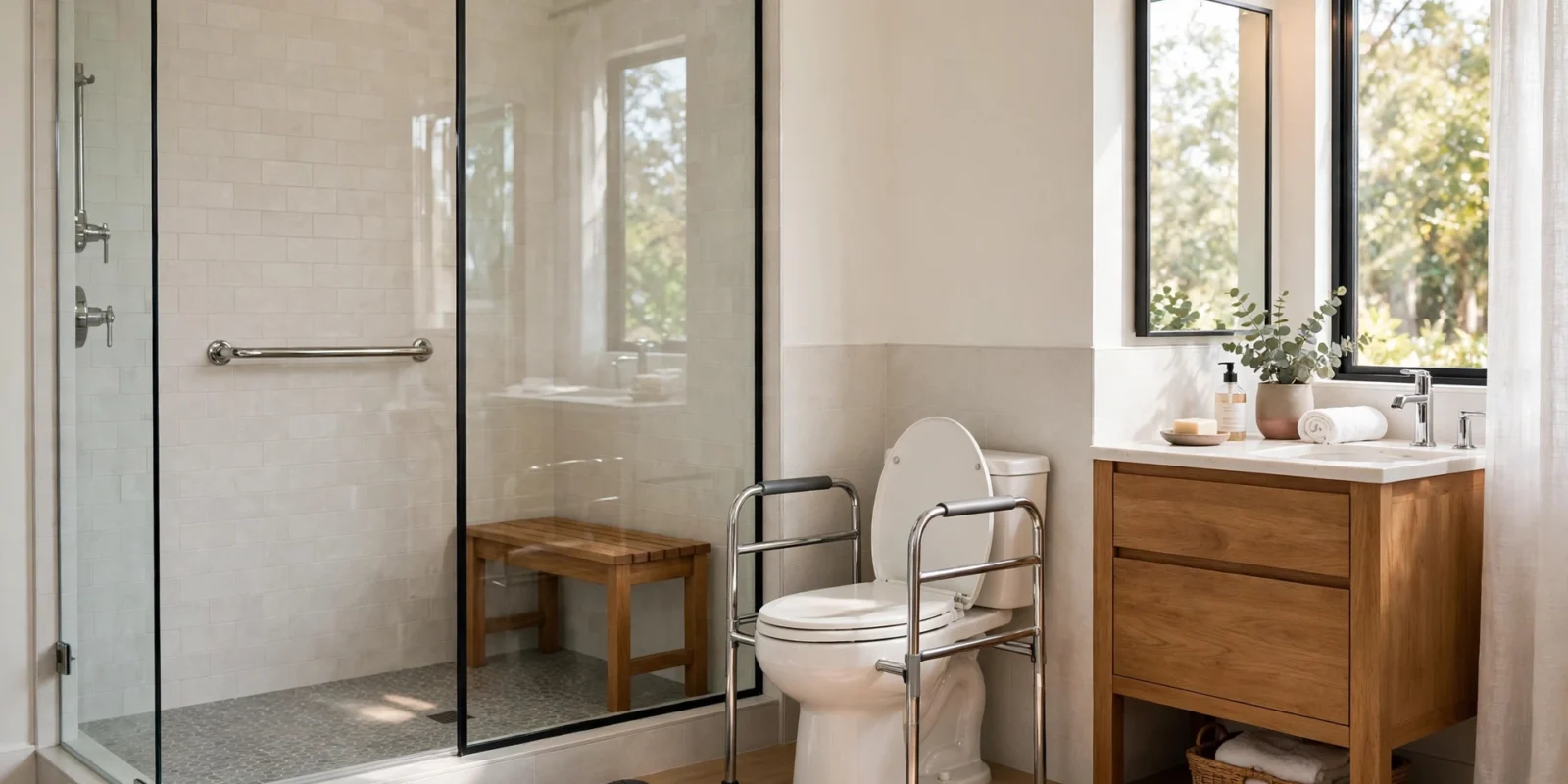
The standard fix is a raised toilet seat, which typically adds two to four inches of height, or a comfort-height toilet, where the seat sits 17 to 19 inches from the floor. A raised seat reduces the depth of the squat and the effort of standing back up, and it clips onto the existing toilet, so it needs no plumber. But height is not a case of “higher is better”. Mayo Clinic warns that the safest height allows the person’s feet to rest flat on the floor; if the feet dangle, the seat is too high.
Frames and grab bars at the toilet
A toilet safety frame sits around the bowl and gives two armrests. It needs no drilling, which makes it a good option for renters. A raised seat with armrests does a similar job. Where drilling is possible, a wall-mounted grab bar beside the toilet is stronger — and the combination of a raised seat and a grab bar is better than either alone. Healthline’s guidance on getting on and off the toilet is worth reading as technique, not just equipment advice: stand close enough that the backs of the legs touch the toilet, reach back for a grab bar, and lower slowly — then reverse the steps to stand.
Small habits that help
Two small habits cost nothing. First, do not get up suddenly after urinating — MedlinePlus advises always urinating sitting down and not getting up suddenly, since a quick change in position can cause light-headedness. Second, keep a phone or alert device within reach of the toilet area, and keep a walker close to the toilet rather than parked outside the door.
Floors and Surfaces: Stopping Slips Before They Start
The floor is where a bathroom fall actually happens. Glossy tile, loose rugs, worn bath mats and a puddle by the bath are the four usual suspects — and three of them are free to fix.
Rugs, mats and clutter
Loose throw rugs are a trip hazard in any room, and in a wet room they are worse. Remove them where possible, or replace them with rugs that have a non-slip rubber backing and lie flat. Inside the tub or shower, use non-slip suction mats, rubber decals or adhesive strips. Outside the tub, a non-skid bath mat gives firm footing for the step out. Mayo Clinic warns against bath mats that float or bunch — adhesive strips or a mat that stays flat and is cleaned regularly are safer. Avoid bath oils, which leave a slick film on the tub floor.
Clutter matters too. Laundry baskets, scales, bins and cords in the walking path are all things a foot can catch on in the dark. Keep the path from the bedroom to the bathroom clear, dry and well lit — a clear hallway is part of bathroom safety, not a separate job.
Footwear and the step out
Bare feet, socks and loose slippers all increase slipping on wet tile, so non-skid house shoes or water-safe shower footwear are worth considering. Sit on the edge of the bath or on a shower chair to dry off and dress, rather than standing on a wet floor to do it. Keep a towel within reach, but not on the floor where it can slide — and wipe up water straight away, because “later” is often when the next person walks in barefoot.
Water Temperature: Preventing Scalds at 120°F
Falls are not the only bathroom danger. Scalds are a quieter risk, and one that grows with age: older skin burns faster, and reduced sensation means hot water is noticed later. A tap that feels merely hot to a younger hand can scald an older person in seconds.
The fix is free and takes five minutes. MedlinePlus guidance is to set the water heater to 120°F (49°C) to prevent burns, and HomeCareHub’s checklist repeats the same figure. Do not rely on the heater dial alone — run the hot tap for a few minutes and measure with a kitchen thermometer, then adjust until it reads 120°F or below. A single-lever faucet makes temperature control easier than separate hot and cold taps, and an anti-scald valve limits sudden swings. The cost is zero and the benefit is immediate, so there is no reason to leave it for later.
Lighting and Night-Time Trips
Poor lighting turns a safe bathroom into a risky one. Water on the floor, a threshold, a change in floor level — all easy to miss in dim light, and hardest to see at exactly the time most bathroom trips happen: the middle of the night, half-asleep, in the dark.
The goal is bright, even lighting throughout the bathroom, especially around the shower, toilet and vanity, with no dark corners and no harsh glare. Replace dim bulbs with brighter ones and add overhead lighting in the shower area if there is none. But the change that matters most is for nighttime: motion-sensor night lights along the path from the bedroom, in the hallway and in the bathroom itself. Mayo Clinic’s guide recommends night lights or motion-sensor lighting for nighttime trips, and Healthline lists adding nightlights among the simplest changes anyone can make.
Two details are easy to miss. Switches should be easy to reach — ideally just inside the door, not across a dark room. And anyone who wears bifocals should take extra care looking down at thresholds, because the lens change can affect depth perception. Our guide to smart lighting for seniors covers motion sensors and voice-controlled lights that switch on without fumbling for a switch in the dark.
Doors, Privacy and Getting Help After a Fall
The bathroom door is a detail almost nobody thinks about until it matters. A door that swings inward can block access if someone falls inside against it — help cannot get in, and the person inside cannot get out. For people with significant balance or mobility concerns, an outward-swinging door, a pocket door or an emergency-access hinge is worth discussing with a contractor. At minimum, remove door locks that cannot be opened from outside. HomeCareHub’s checklist makes the same point: make sure the door opens outward or can be unlocked from outside, so a person who falls does not block their own rescue.
Getting help is the other half of this section. A fall in the bathroom is more likely to result in a serious injury than a fall in the living room, because there is very little cushioning and plenty of hard, sharp edges. Keep a phone or a wearable alert pendant within reach of the floor, and consider a help button in the bathroom itself — Healthline lists installing an emergency help button among the bigger upgrades for a reason. Fall detection devices for seniors can call for help automatically if the person cannot. Finally, unplug electrical appliances when not in use and keep them away from water.
What Recent Research Shows
The evidence on bathroom safety has been building steadily, and the direction is consistent: home modifications work, and they work best when they target the specific movements that cause falls.
The most important recent finding is about scale. The CDC’s analysis of fall deaths from 2007 to 2016 found the death rate from falls rose 31% over the decade, fastest among people aged 85 and over. The CDC’s conclusion was not that falls are inevitable, but that they are preventable — and that screening for fall risk and intervening on modifiable risk factors, including home hazards, should happen during routine care.
More recent data underlines the cost of doing nothing. The NCOA, citing 2020 data, reports the total healthcare cost of non-fatal older adult falls at $80 billion per year, up from $50 billion in 2015, with Medicare paying about two-thirds. Against that, the fixes in this guide — grab bars, a shower chair, a handheld sprayer — are strikingly cheap. As HomeCareHub’s checklist notes, those three items together cost less than a single emergency room visit.
Research also supports the occupational therapy angle. A systematic review and meta-analysis cited by the NCOA found that home hazard modification programmes reduce falls in older adults — the evidence base for the room-by-room approach this guide follows. The CDC’s STEADI initiative gives healthcare providers tools to identify patients at risk and select interventions. Raising bathroom safety at an annual wellness visit is a reasonable, evidence-backed step — the CDC’s own report recommends exactly that conversation.
Common Mistakes to Avoid
1. Grabbing the towel rail instead of a grab bar. Towel rails, toilet paper holders and pedestal sinks are not designed to hold body weight — they pull out of the wall when leaned on hard. If the hand naturally reaches for something, make sure it is a properly anchored grab bar.
2. Trusting suction-cup grab bars. They look reassuring and are easy to fit, which is exactly the problem. Suction cups lose their seal over time, especially in steam, and can release without warning under full body weight. Never use them as primary support.
3. Mounting grab bars into plasterboard instead of studs. A bar is only as strong as what it is anchored into. Screwed into plasterboard alone, it will fail when it matters most. Bars need wall studs or solid blocking, and the fixings need to match the 250-pound strength standard.
4. Setting the toilet seat too high. Higher is not always better. A seat so high that the feet dangle reduces balance and makes standing harder. The test is simple: feet flat on the floor, knees and hips comfortable.
5. Leaving the water heater at its factory setting. Many heaters arrive set well above 120°F. Older skin scalds faster and reduced sensation delays reaction, so this is a genuine burn risk. Test the tap with a thermometer; do not trust the dial.
6. Relying on a loose rug for grip. A rug without a non-slip backing slides, bunches and catches underfoot — it creates the hazard it was meant to prevent. Remove loose rugs, or replace them with flat, rubber-backed mats.
7. Ignoring the night-time trip. Most bathroom safety work happens in daylight, but many falls happen at night, half-asleep, in the dark. If the path from the bed to the bathroom is not lit, the daytime fixes only solve half the problem.
8. Waiting for a fall before making changes. The most common mistake is also the most human one: treating bathroom safety as something to think about after the first fall. But a previous fall doubles the risk of falling again, according to the NCOA. Making changes before a fall is not overcautious — it is the point.
Final Recommendations: A Room-by-Room Plan
Here is the plan in the order that makes sense — cheapest and most effective first.
Today, for free: set the water heater to 120°F and test it with a thermometer. Remove loose rugs and clutter from the bathroom path. Move soap, shampoo and towels within easy reach. Remove or disable door locks that cannot be opened from outside.
This week, for a small cost: install wall-mounted grab bars beside the toilet and in the shower, anchored into studs. Add non-slip mats in the tub and on the floor. Fit motion-sensor night lights in the bedroom, hallway and bathroom. Add a shower chair or transfer bench, a handheld showerhead, and a raised toilet seat or safety frame.
When you are ready, the bigger jobs: brighter lighting with overhead lights in the shower, a comfort-height toilet, a single-lever faucet, and — the biggest step — a walk-in shower. If you rent, focus on the no-drilling options: a toilet safety frame, a shower chair, non-slip mats and night lights need no landlord permission.
And the step that ties it together: ask a doctor or occupational therapist for a home safety assessment, especially if there has already been a fall, or if balance, vision or medication side effects are a concern. A therapist can look at the actual room and the actual person and recommend the right equipment in the right places — something no guide can do from a distance. For the wider home, our guide to smart home devices for seniors covers lighting and voice control, and medication reminders for seniors can help with the dizziness some medicines cause.
Frequently Asked Questions
Typically 33 to 36 inches above the floor, mounted horizontally into wall studs or solid blocking so it can support at least 250 pounds. A rear wall bar behind the toilet can also help. Placement should suit the person's height and reach.
No, not as a primary support. Suction-cup bars can release without warning as steam and time weaken the seal, and they should never be relied on to hold body weight. Use a wall-mounted bar anchored into studs instead.
Set the water heater to 120°F (49°C) and check it with a kitchen thermometer at the tap, since heater dials are often inaccurate. Older skin burns faster and reduced sensation means hot water is noticed later. A single-lever faucet and an anti-scald valve give extra protection.
It depends on the bathroom. A shower chair suits a walk-in shower where the person can step in safely but should sit while bathing. A transfer bench is better for a tub-shower combination, because the person sits outside the tub and slides across instead of stepping over the rim. Either way, adjust the seat so the feet rest flat on the floor.
Outward, or with a lock that can be released from the hallway. An inward-swinging door can be blocked by someone who has fallen inside, which delays help. If changing the door is not practical, at least remove locks that cannot be opened from outside.
Often, yes. Most effective fixes need no remodel at all: grab bars, a shower chair or transfer bench, non-slip mats, a raised toilet seat, a handheld showerhead, night lights and a lower water temperature. A walk-in shower is the biggest single improvement, but it is not a precondition for a much safer bathroom.
A seat 17 to 19 inches from the floor suits most people — either a comfort-height toilet or a raised seat clipped onto the existing one. The real test is the person's feet: they should rest flat on the floor. If the feet dangle, the seat is too high.
Start with the free fixes: set the water heater to 120°F, remove loose rugs and clutter, and add night lights. Then add grab bars beside the toilet and in the shower, a shower chair or transfer bench, and a raised toilet seat. Watch how your parent actually moves through the room — where they reach for support tells you where the bars should go. If they have fallen or feel unsteady, ask their doctor for an occupational therapist referral.
This content is for educational purposes only and does not replace professional medical advice. Always consult a qualified healthcare professional before making health decisions for yourself or a loved one.
Conclusion
The bathroom will never be a room without risk. Water, hard surfaces and the movements of getting clean will always demand a little balance. But the gap between a bathroom that invites a fall and one that forgives a wobble is surprisingly small — a bar on the wall, a chair in the shower, a mat that stays put, a light that switches itself on at 2am, a water heater turned down to a safe temperature.
None of these changes asks anyone to give up independence. Quite the opposite: they are what independence looks like in practice. A person who can bathe safely on their own keeps a daily routine, a sense of privacy and a measure of confidence that no amount of help can replace. The fixes in this guide are not about ageing or frailty. They are about a room doing its job properly — supporting the person in it, rather than testing them.
Start today, and start small. Turn the water heater down. Take the loose rug out of the bathroom. Put a night light in the hallway. Then, this week, fit the grab bars and the shower chair. If you are making these changes for a parent, do it with them rather than for them: ask where they reach for support, and let their habits decide the placement. And if there has already been a fall, bring in an occupational therapist — a short visit now can prevent a much longer recovery later.
A safer bathroom is not a project to finish and forget: mats wear out and needs change. But the first pass — the one in this guide — is the one that matters most, and most of it can be done in a weekend. That is a small price for the room where it counts most.
References
- Centers for Disease Control and Prevention — Deaths from Falls Among Persons Aged ≥65 Years, United States, 2007–2016 — MMWR 2018 — https://www.cdc.gov/mmwr/volumes/67/wr/mm6718a1.htm?s_cid=mm6718a1
- National Council on Aging — Get the Facts on Falls Prevention — https://www.ncoa.org/article/get-the-facts-on-falls-prevention/
- Healthline — How to Use a Bathroom in Older Age Safely — https://www.healthline.com/health/senior-health/bathroom-safety-for-elderly
- National Institute on Aging — Home Safety Tips for Older Adults — https://www.nia.nih.gov/health/aging-place/home-safety-tips-older-adults
- HomeCareHub — Bathroom Safety Checklist for Seniors — https://www.homecarehub.org/tools/bathroom-safety-checker
- Mayo Clinic — Guide to Preventing Falls in the Bathroom — https://store.mayoclinic.com/education/guide-to-preventing-falls-in-the-bathroom/
- MedlinePlus / Florida HealthFinder — Bathroom Safety for Adults — https://quality.healthfinder.fl.gov/health-encyclopedia/HIE/60/000021