Written by Md Masud Rana based on published expert sources. This article has not been professionally reviewed. See our sources below.
Picture this: it is 2 a.m., the house is dark, and you need the bathroom. You swing your legs out of bed, reach for a switch you cannot quite find, and take a few careful steps into a hallway you can barely see. For millions of older adults, that short walk is the most dangerous part of the day — and smart lighting for seniors exists precisely to make it safe.
Here is the blunt truth behind that claim. Falls among adults aged 65 and older caused over 43,000 deaths in 2024, making them the leading cause of injury death for that age group, according to the US Centers for Disease Control and Prevention (CDC). The same CDC page records about 4.5 million emergency department visits for older adult falls in 2024. Not every fall is caused by darkness, of course. But lighting is one of the few risk factors you can fix in an afternoon, without tools, training, or a big budget.
One important note before we go further: if someone has fallen and cannot get up, has hit their head, feels faint, or is in severe pain, call your local emergency number right away — 911 in the US and Canada, 999 in the UK, 000 in Australia, 111 in New Zealand — rather than trying to move them. Lighting prevents falls; it does not treat injuries.
This guide explains, in plain language, how smart lighting works, which types actually help older adults, and how to set it all up room by room. Many families start with a handful of motion-sensor night lights and a couple of smart bulbs, then build from there.
Quick Answer
Smart lighting for seniors means lights that switch themselves on when needed — through motion sensors, timers, or simple voice commands — so nobody has to cross a dark room to find a switch. Start with the bedroom-to-bathroom path, use warm, glare-free light at night and brighter light for tasks, and keep every room evenly lit. Done well, it is one of the cheapest, simplest home safety upgrades available.
Contents
- Why Lighting Matters More as We Age
- What Is Smart Lighting, in Plain English?
- The Bedroom-to-Bathroom Path: Start Here
- Room by Room: Where to Put the Light
- Choosing Brightness and Colour Without the Confusion
- Voice Control and Simple Setups
- Light, Sleep, and Daytime Brightness
- What Recent Research Shows
- Common Mistakes to Avoid
- Final Recommendations
- Frequently Asked Questions
Why Lighting Matters More as We Age
Ageing changes the eyes in ways that are easy to underestimate. The lens yellows and lets in less light, the pupil opens less widely in the dark, and the eyes take longer to adjust when moving between bright and dim rooms. The result is not blindness — it is a quiet, gradual loss of contrast and detail. A rug edge, a step, or a pet toy that a younger person spots instantly can simply blend into shadow.
That is why guidance aimed at older adults consistently calls for more light, not just nicer light. A senior-safety lighting guide published by StillWell Health notes that ageing eyes may need two to three times more light than younger eyes to see clearly, and that poor lighting contributes to a large share of home falls. Treat that as a rule of thumb rather than a personal prescription: the right amount depends on the room, the person’s vision, and advice from their own eye professional.
The fall statistics give this urgency. A 2024 review in American Family Physician reports that falls affect more than 27% of adults aged 65 and older, and lists home and environmental safety factors among the components of fall prevention, alongside medication review, strength and balance work, and vision correction (Coulter et al., 2024). The CDC’s own fall-prevention programme, STEADI (Stopping Elderly Accidents, Deaths, and Injuries), takes the same broad view: lighting is one piece of a bigger safety picture, not a magic fix on its own.
Shadows are the real enemy
Many people assume a brighter bulb solves everything. It does not. A single harsh ceiling light can create deep shadows and glare at the same time — bright pools in the middle of the room, dark corners at the edges, and a painful dazzle when you look up. Older eyes struggle with exactly that contrast. The fix is even, layered light: several gentler sources spread around the room instead of one fierce one.
A common real-world pattern
Many families describe the same story: an older parent insists the house is fine, then a daughter or son visits after dark and realises the hallway to the bathroom is pitch black, the stair light has been burnt out for weeks, and the bedside lamp is too far from the bed to reach without standing. Nobody is at fault. Lighting fades gradually — bulbs dim, eyes change — and nobody notices until something goes wrong. A ten-minute walk through the house at night usually reveals every problem at once.
What Is Smart Lighting, in Plain English?
Strip away the marketing and “smart lighting” means lights you can control without walking to a switch. That is the whole idea. The technology underneath varies, but for an older adult’s home, only a few types genuinely matter.
Smart bulbs
These screw into ordinary lamps and fixtures, just like normal bulbs. Once set up, they can be dimmed, switched on and off, or scheduled from a phone app or a voice speaker. Some can change colour temperature — warm in the evening, brighter during the day. They are the easiest starting point because nothing needs rewiring.
Motion-sensor lights
These switch on automatically when they detect movement, and switch off after a set time. They come as plug-in night lights, battery-powered stick-on bars, or bulbs with built-in sensors. For senior safety, these are arguably the single most useful type: no switch to find, no app to open, no remembering anything at 2 a.m. A lighting guide from Brio Living Services recommends placing them along hallways, bathrooms, and stairs for safer night-time navigation.
Smart switches and plugs
A smart switch replaces a wall switch and lets existing ceiling lights be controlled by voice or schedule. A smart plug sits between an outlet and an ordinary lamp and does the same job for table and floor lamps. These suit people who like their current lamps but want them to come on automatically at dusk or with a voice command.
Voice speakers and hubs
A voice speaker lets someone say “turn on the hallway light” instead of getting up. Our companion guide to smart speakers for seniors covers choosing and setting one up in detail. You do not need a whole smart home system to benefit — one speaker and two or three smart bulbs is a complete, useful setup.
What you do not need
You do not need coloured party lighting, app-controlled scenes for every mood, or a hub that requires a subscription. If a product needs a smartphone for basic on-and-off control, it is the wrong product for someone who mainly wants to walk safely to the bathroom. The best setup for an older adult is the one that works when nobody touches anything at all.
The Bedroom-to-Bathroom Path: Start Here
If you do only one thing from this guide, light the path from the bed to the bathroom. Night-time bathroom trips combine every risk factor at once: eyes not yet adjusted to the dark, a body still half asleep, and a route that is usually unlit. It is also the route people are most reluctant to light properly, because bright light at night feels disruptive.
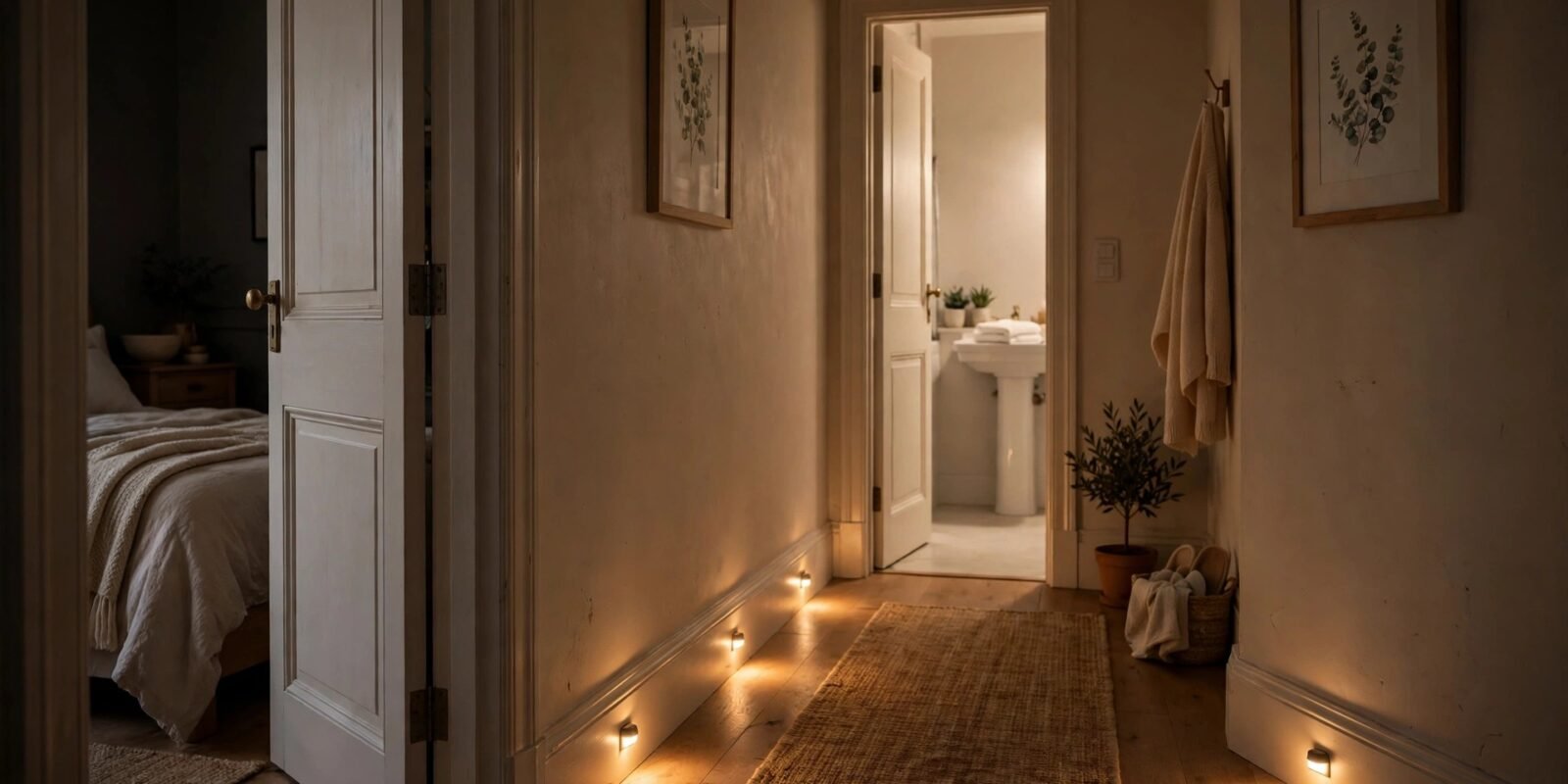
The answer is dim, warm, automatic light — just enough to see where your feet are going, not enough to wake you fully. Here is a practical sequence that works in most homes:
- A motion-sensor night light beside the bed. It should come on the moment feet hit the floor, at a low, warm brightness.
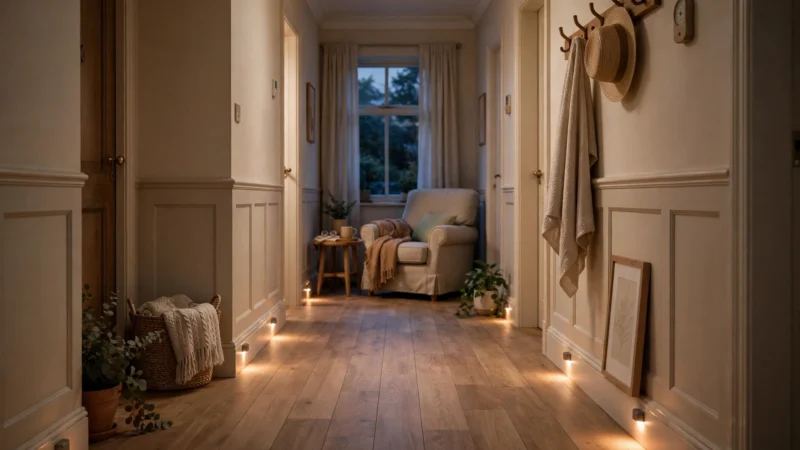
- One or two more along the hallway. Spaced so there is never a dark stretch between the bedroom door and the bathroom door.
- A low light in the bathroom itself. A plug-in motion night light or a sensor bulb, so nobody has to grope for a switch with wet hands.
- Light that switches itself off again. Most sensor lights have a timer; a few minutes is plenty, and it means nobody has to remember anything on the way back to bed.
Keep the brightness low and the colour warm at night — the Brio guide suggests warm, bright LEDs around 2700–3000K for comfortable, easy-on-the-eyes light. Bright white or blue-toned light at 2 a.m. is harder on the eyes and more disruptive to sleep, which we cover in the sleep section below.
One more detail that gets missed: the bedside lamp itself. It should be reachable without standing up, and easy to switch on by touch. If the current lamp fails that test, move it closer or replace it with a touch lamp or a voice-controlled bulb before buying anything else.
Room by Room: Where to Put the Light
Every room has a different job, so every room needs different light. A useful rule of thumb from the StillWell guide is the 60/40 rule: roughly 60% of a room’s light from ambient sources such as ceiling fixtures, and 40% from task lighting such as reading lamps and under-cabinet strips. The balance keeps rooms evenly lit without harsh shadows or glare.
| Room | What to prioritise | Watch out for |
|---|---|---|
| Bedroom | Bedside lamp within reach; motion night light for the bathroom path | Overhead light that dazzles when you sit up |
| Bathroom | Bright, even light at the mirror; motion night light for night visits | Glare bouncing off wet tiles and mirrors |
| Kitchen | Bright task light over counters, sink, and stove; under-cabinet strips | Shadows cast by your own body onto the worktop |
| Living room | Layered light: ceiling fixture plus lamps; a reading lamp by the favourite chair | Dark corners and a single harsh overhead bulb |
| Hallways and stairs | Even light top to bottom; switches at both ends; motion path lights | A dark landing or a single bulb that leaves steps in shadow |
| Entryways and outdoors | Motion lights at doors, lit porch steps, path lights to the driveway | Coming in from bright daylight into a dark hall, or vice versa |
Kitchen: the task-lighting room
Kitchens deserve the brightest task lighting in the house. Chopping, reading labels, and handling hot pans all need clear contrast. Under-cabinet LED strips are the classic fix: they throw light directly onto the worktop instead of onto the back of the person standing there.
Stairs: no half measures
Stairs need even light from top to bottom, with a switch at both ends — or, better, motion sensors that handle it automatically. A light that only covers the top half of a staircase hides the bottom steps in shadow. If the stairs have a runner or patterned carpet, good lighting matters even more: patterns can disguise the edge of a step.
Outdoors: the forgotten zone
Porch steps, garden paths, and the walk from the car are part of the home too. Motion-sensor outdoor lights and solar path lights cost little and switch themselves on at dusk. The Brio guide makes the same point: outdoor lighting improves security and cuts the chance of a fall when coming or going after dark, especially in winter when the days are short.
Choosing Brightness and Colour Without the Confusion
Shopping for bulbs confronts you with two numbers: lumens and kelvin. Both matter, and neither is complicated once you know what they mean.
Lumens: how much light
Lumens measure total light output — higher means brighter. The StillWell guide suggests the following whole-room totals as a starting point for senior-friendly homes, framed as general guidance rather than a rule for any individual:
| Room | Suggested total brightness |
|---|---|
| Bedroom | 2,000–4,000 lumens |
| Bathroom | 4,000–8,000 lumens |
| Kitchen | 5,000–10,000 lumens |
| Hallway | 1,200–2,500 lumens |
| Living room | 3,000–6,000 lumens |
You rarely need to hit these numbers exactly. A room’s total is the sum of all its bulbs, so two lamps plus a ceiling fixture often get you there. If a room still feels dim after adding light, check for the real culprits first: a single shaded bulb doing all the work, dark lampshades absorbing light, or one burnt-out bulb nobody noticed.
Kelvin: how warm or cool the light looks
Kelvin (K) describes colour, not brightness. Lower numbers look warmer and more yellow; higher numbers look cooler and more blue-white. For most of the home, the StillWell guide recommends warm white (2700–3000K) in bedrooms and living rooms, neutral white (3500–4000K) in kitchens and bathrooms where contrast matters, and advises against cool daylight bulbs (5000K+) in living spaces, where they can feel harsh and cause eye strain.
For night-time path lighting, stay warm and dim. For reading, cooking, and detailed tasks, go brighter and slightly cooler. Smart bulbs that let you shift colour temperature through the day make this easy: bright and neutral in the morning, warm and dim in the evening.
Glare: the hidden problem
Glare deserves its own mention because it is the most common complaint about “better” lighting. Exposed bulbs, shiny worktops, and light bouncing off a television screen all create it. The fixes are simple: use shades or diffusers so you never see a bare bulb, and position lamps so light falls on the task rather than into the eyes. If new lighting makes someone squint, it is not better lighting — it is just more of it.
Voice Control and Simple Setups
For someone with stiff hands, poor balance, or simply a long walk to the nearest switch, voice control is less a luxury than a safety feature. Saying “turn on the bedroom light” from bed beats crossing a dark room. It also helps people who use walkers or wheelchairs, for whom every trip to a switch is effort.
Keeping it simple matters more than choosing the “best” system. A sensible starter setup looks like this:
- One voice speaker in the room where the person spends the most time.
- Two or three smart bulbs in the lamps that matter most — bedroom, living room, hallway.
- Motion-sensor night lights on the bedroom-to-bathroom path, which need no voice commands at all.
- One routine, if wanted: for example, “good night” switching off the living room lights and switching on the hallway night lights.
Set it up once, write the useful phrases on a card by the speaker, and test them together. If the person cannot remember the exact phrase, it does not matter much — motion sensors cover the critical path, and a simple remote or a rocker switch by the bed covers the rest. Our guide to smart home devices for seniors covers the wider safety picture, from fall detection to door sensors, for readers who want to go further.
When technology gets in the way
Be honest about this: some setups fail because they demand too much. If the lights only work through a phone app, if the Wi-Fi drops and takes the lights with it, or if a voice assistant misunderstands accents, the system is not helping. Keep a normal switch or a remote in the loop for every critical light, so the house still works when the clever parts do not.
Light, Sleep, and Daytime Brightness
Light does more than prevent trips. It also sets the body’s internal clock. Bright light in the morning signals wakefulness; dim, warm light in the evening signals wind-down. Older adults who spend most of the day indoors — because of mobility, weather, or poor eyesight — often get too little daytime light, and that can quietly worsen sleep.
Research published in 2026 gives this real weight. In the Europe-wide ENLIGHTENme project, researchers at the University of Surrey gave bright light therapy lamps to more than 200 adults aged 63 to 92 in three cities, asking them to use the lamp within an hour of waking and to switch it off at least four hours before bedtime. Participants who started light supplementation earlier in the morning were significantly more active during the day and had less disrupted rest-activity rhythms, and those who finished earlier in the evening showed less fragmented rest (University of Surrey, 2026).
You do not need a therapy lamp to apply the basic idea. Practical steps that follow from the same principle:
- Brighten the daytime rooms. Open curtains, sit near a window for morning activities, and keep living areas well lit during the day.
- Dim the evenings. Switch smart bulbs to warm and low an hour or two before bed, and let motion night lights handle the rest.
- Keep nights dark. Night lights should be dim and warm, not bright white — enough to walk safely, not enough to fully wake the brain.
Light is not a treatment for sleep disorders, and anyone with persistent sleep problems should talk to their doctor. But as a daily habit, brighter days and darker nights cost nothing and support the same rhythm that smart lighting already manages for safety. Readers who want the wider sleep picture can also see our sleep health basics guide.
What Recent Research Shows
Three recent findings are worth knowing, because they move this topic beyond common sense into evidence.
AI ceiling lights cut falls in care homes
In Lancashire and South Cumbria in the UK, 800 AI-powered ceiling lights were installed across 80 residential and nursing homes over two years. An independent evaluation by Lancaster University found the lights reduced the likelihood of experiencing a fall by about 32%, cut ambulance callouts by 23%, and brought average response times to a bedroom fall under three minutes (NHS Lancashire and South Cumbria Integrated Care Board). These were care-home systems with fall detection built in, not ordinary home bulbs — but they show how powerful well-designed lighting can be when it is automatic, responsive, and always on duty.
Daytime light supports healthy ageing
The 2026 ENLIGHTENme study described above is the first real-world test of its kind: earlier evidence came mostly from laboratories. Its message is encouraging and practical — ordinary indoor light, timed well, measurably improved activity and sleep quality in older adults living at home. The researchers suggest structured indoor light could eventually feature in community care frameworks and care-home guidelines.
Falls prevention works best as a package
The 2024 American Family Physician review is a useful corrective to any single-solution thinking. Its authors describe multicomponent prevention — home and environmental safety checks plus medication review, strength and balance work, and vision and hearing correction — as the approach that reduces fall risk. Lighting belongs in that package, not instead of it. If an older adult has fallen before, feels unsteady, or worries about falling, the CDC’s STEADI screening questions are a good prompt to raise the subject with their doctor, who can assess the full picture properly.
Common Mistakes to Avoid
1. One bright bulb per room. A single harsh ceiling light creates glare and shadows at the same time. Layer the light instead: ceiling fixture plus lamps, with task light where detail work happens.
2. Lighting only the rooms, not the routes. Hallways, landings, and the bedroom-to-bathroom path are where people walk in the dark. If the route is unlit, the room lighting barely matters.
3. Bright white night lights. Cool, bright light at 2 a.m. dazzles eyes that have adjusted to darkness and disrupts sleep. Night lighting should be warm, dim, and automatic.
4. Forgetting the switches. A beautifully lit room is useless if the switch is behind furniture, too high, or at only one end of the stairs. Rocker switches, glow-in-the-dark covers, and switches at both ends of stairs are cheap fixes the Brio guide recommends.
5. Buying tech that needs a phone for basic control. If the lights cannot be switched on without an app, they will fail the person who needs them most. Motion sensors and voice control should be the default; the app is a bonus.
6. Setting it up once and never checking again. Bulbs dim and die, sensor batteries run out, and furniture moves block a sensor’s view. A quick monthly check — walk the night-time route and confirm every light still triggers — takes two minutes.
7. Treating lighting as a substitute for medical advice. Lighting reduces one risk factor. It does not diagnose balance problems, fix vision, or replace a medication review. Recurring falls, dizziness, or unsteadiness always deserve a conversation with a doctor.
Final Recommendations
- Walk the house at night first. With the lights off, follow the usual routes — bed to bathroom, kitchen to bedroom, front door to living room — and note every dark spot before buying anything.
- Start with the bedroom-to-bathroom path. Motion-sensor night lights there give the biggest safety return for the smallest effort.
- Layer every room. Aim for ambient plus task light, and eliminate single-bulb rooms and dark corners.
- Go warm at night, brighter by day. Warm white (2700–3000K) for evenings and night paths; brighter, neutral light for daytime tasks.
- Add voice control for the main rooms. One speaker and a few smart bulbs let someone control lights without crossing a dark room.
- Keep a manual fallback. Every critical light should also work from a switch or remote, so the house stays safe if the Wi-Fi or voice system fails.
- Check the setup monthly. Test sensors, replace dead bulbs, and clear anything blocking a sensor’s view.
- Pair lighting with the wider safety picture. Combine it with the steps in our smart home starter guide for seniors — and if falls, dizziness, or unsteadiness recur, talk to a doctor about a full fall-risk assessment.
Frequently Asked Questions
The best setup is the simplest one that works without anyone touching anything: motion-sensor night lights on the bedroom-to-bathroom path, plus a few smart bulbs in the main rooms that can be controlled by voice. Avoid systems that need a phone app just to switch a light on. Automatic, warm, dim light at night and brighter light for daytime tasks covers almost every need.
Lighting is one proven part of fall prevention, not a guarantee. The CDC's STEADI programme includes home and environmental safety checks among its fall-risk measures, and a Lancaster University evaluation of AI ceiling lights in care homes found falls reduced by about 32%. At home, automatic path lighting removes the specific risk of walking in the dark, a common and fixable hazard.
Warm white light around 2700–3000K is generally easiest on ageing eyes in bedrooms and living rooms, because it is soft and low-glare. Kitchens and bathrooms benefit from slightly cooler neutral white (3500–4000K), which improves contrast for tasks. Cool daylight bulbs above 5000K tend to feel harsh in living spaces and are best kept for garages or workspaces.
Older eyes typically need noticeably more light than younger eyes, so rooms should feel clearly brighter than you might expect. One senior-safety guide suggests whole-room totals of roughly 2,000–4,000 lumens for bedrooms, 4,000–8,000 for bathrooms, and 5,000–10,000 for kitchens, reached by combining several sources rather than one harsh bulb. Even, shadow-free light matters as much as raw brightness.
Yes, for most homes. Motion lights give you light exactly when you move, then switch off again, so they save energy and keep the house dark enough for sleep. Leaving lights on all night can disturb sleep and still leaves gaps if a hallway bulb is in the wrong place. Sensors placed along the full bedroom-to-bathroom route, with a few minutes of run time, cover the journey without anyone remembering a switch.
Absolutely. Motion-sensor lights need no phone at all — they switch on when they sense movement. Voice speakers let someone control smart bulbs by speaking, and many smart bulbs also work with a simple remote control. A smartphone is only needed for the initial setup, which a family member can do once. After that, the system should run itself.
Most smart bulbs still work as ordinary bulbs from the wall switch if the Wi-Fi drops — you just lose voice and app control until the connection returns. Motion-sensor night lights and battery-powered sensor bars are unaffected by Wi-Fi entirely, which is why they are the best choice for the critical night-time path. Keeping a manual switch or remote for every important light means the house stays safe whatever happens to the network.
It is one of the cheapest home safety upgrades. A sensible starting point — a few motion-sensor night lights and two or three smart bulbs — costs far less than most people expect, and LED bulbs use far less energy and last far longer than old incandescent bulbs. Start with the bedroom-to-bathroom path, then add rooms one at a time rather than trying to automate the whole house at once.
This content is for educational purposes only and does not replace professional medical advice. Always consult a qualified professional before making health or safety decisions for yourself or a loved one.
Conclusion
Smart lighting for seniors is not really about technology. It is about removing one small, daily risk — walking through a dark house — with tools that switch themselves on and off without being asked. The evidence behind it is solid without being exaggerated: falls are a leading cause of injury and death among older adults, home and environmental safety is a recognised part of prevention, and recent research shows that well-designed lighting can cut falls substantially in care settings and improve sleep and activity at home.
The practical path is simple, and it is worth repeating because it is so easy to overcomplicate. Walk the house at night. Light the bedroom-to-bathroom path first. Layer the light in every room, keep nights warm and dim, and keep days bright. Add voice control for the rooms that matter, keep a manual switch as backup, and check the sensors once a month. That is the whole system, and it works whether the house has three smart bulbs or thirty.
If this guide was useful, the next step is our smart home starter guide for seniors, which covers the rest of the safety picture — from fall detection to door sensors — in the same plain language.
References
- Centers for Disease Control and Prevention — About Older Adult Fall Prevention — 2026 — https://www.cdc.gov/falls/about/index.html
- Coulter, J. S., et al. — Falls in Older Adults: Approach and Prevention — American Family Physician, 2024 — https://www.aafp.org/afp/2024/0500/falls-older-adults
- NHS Lancashire and South Cumbria Integrated Care Board — AI ceiling light reduces falls — https://www.lancashireandsouthcumbria.icb.nhs.uk/news-and-media/latest-news/ai-ceiling-light-reduces-falls
- Brio Living Services — Lighting Hacks That Make a Home Safer and Easier to Navigate — 2026 — https://mybrio.org/lighting-hacks-that-make-a-home-safer-and-easier-to-navigate/
- StillWell Health — Lighting Safety Guide for Seniors — 2026 — https://stillwellhealthcare.com/resources/lighting-safety-guide/
- University of Surrey / MedicalXpress — Boosting indoor light could help support healthy aging in older adults in urban areas — 2026 — https://medicalxpress.com/news/2026-09-boosting-indoor-healthy-aging-older.html