
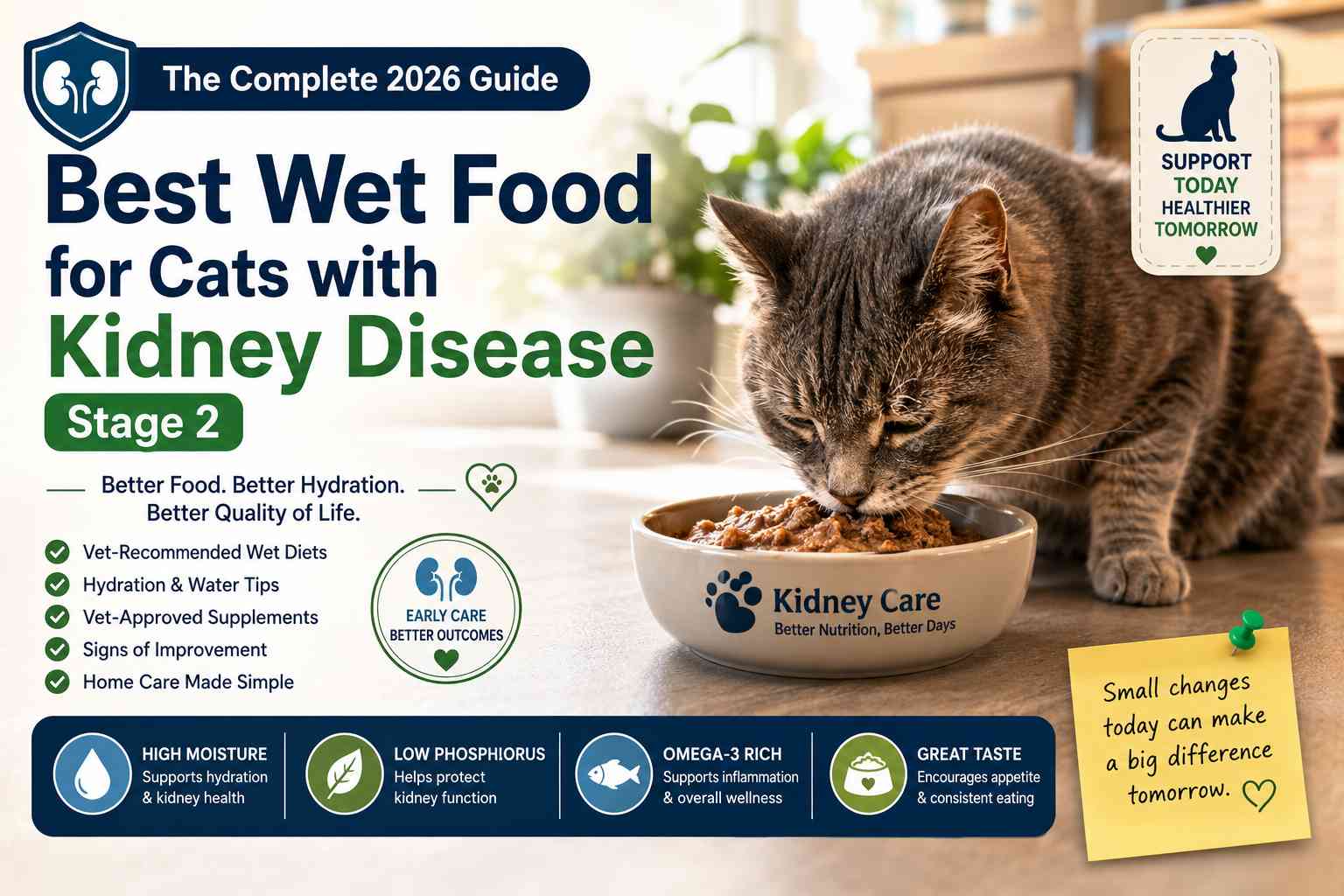
Best Wet Food for Cats with Kidney Disease Stage 2: The Complete 2026 Guide
By Md Masud Rana · Updated June 2026
Written by Md Masud Rana based on published veterinary and behavioral sources. This article has not been clinically reviewed by a veterinarian. See our sources below.
Hearing that your cat has stage 2 chronic kidney disease (CKD) is unsettling, especially when your vet hands you a printout of dietary changes and you’re left standing in the pet food aisle wondering what actually belongs in the bowl. The short version: most cats at this stage do best on a vet-recommended wet renal diet that’s restricted in phosphorus, moderate in highly digestible protein, and enriched with omega-3 fatty acids — but the food itself is only one piece of a bigger picture.
Stage 2 matters because it’s widely considered the best window for intervention. Cats at this point often look and act close to normal, which makes it tempting to wait and see. Many owners describe noticing a slightly thirstier cat, or bigger clumps in the litter tray, months before anyone suspects kidney disease at all.
This guide walks through what genuinely helps a cat at stage 2: choosing and transitioning to the right wet food, how much water your cat actually needs, which supplements have real evidence behind them, what “improving” looks like in both lab numbers and daily behavior, and how to build a home-care routine you can sustain for years. Sources are linked throughout so you can read the original research for yourself.
Quick answer: For most cats in IRIS stage 2 chronic kidney disease, vets generally recommend a wet renal diet that’s restricted in phosphorus, moderate in high-quality protein, and supplemented with omega-3s — these therapeutic diets are usually only available through a veterinarian. Wet food’s higher moisture content (commonly 70–80%) supports hydration, which matters as much as the exact formula. Always confirm the right diet and transition timeline with your cat’s vet before switching.
Table of Contents
- Understanding Stage 2 CKD in Cats
- Best Wet Food for Cats with Kidney Disease Stage 2
- How Much Water Should a Cat with Kidney Disease Drink
- Kidney Support Supplements: What’s Actually Vet-Approved
- Signs Kidney Disease Is Improving in Cats
- Home Care for a Cat with Chronic Kidney Disease
- Managing Common CKD Complications
- What Recent Research Shows
- Common Mistakes to Avoid
- Final Recommendations
- Frequently Asked Questions
- Conclusion
Understanding Stage 2 CKD in Cats
Chronic kidney disease is staged using a system developed by the International Renal Interest Society (IRIS), an independent panel of veterinary nephrology specialists. Staging is based mainly on blood creatinine and a newer marker called SDMA, measured while the cat is stable and well hydrated. Stage 2 sits between mild, often invisible Stage 1 disease and the more symptomatic Stages 3 and 4.
How Vets Determine IRIS Stage 2
According to the Cornell Feline Health Center, blood creatinine typically doesn’t rise until a cat has lost most of its functioning kidney tissue, while SDMA can flag a problem earlier, when roughly 40% of kidney function is gone. Staging is only meaningful once dehydration and other temporary causes of high creatinine have been ruled out, which is why your vet may ask for repeat bloodwork two to four weeks apart before confirming a stage.
Common Signs at This Stage
Cats at stage 2 may show no symptoms, or only subtle ones: drinking a bit more, slightly larger urine clumps, or a coat that’s not quite as glossy. International Cat Care notes that around two-thirds to three-quarters of total kidney function is typically lost before any signs appear at all, which is exactly why routine senior bloodwork matters more than waiting for obvious illness.
Why Stage 2 Is the Best Time to Act
Veterinary nutritionists writing for the American College of Veterinary Nutrition note that IRIS specifically recommends starting nutritional management at stage 2, partly because cats who still feel reasonably well tend to accept a new diet more easily than cats who are already nauseated or uremic. If your cat’s case is complex or doesn’t respond as expected, ask your regular vet about a referral to a feline-medicine specialist; the ACVIM’s VetSpecialists directory covers the US, Canada, the UK, Australia, and New Zealand.
Best Wet Food for Cats with Kidney Disease Stage 2
There’s no single “best” brand of wet food for stage 2 CKD — the right choice depends on your individual cat’s bloodwork, appetite, and what your vet has access to. What matters more than any specific product is the nutrient profile and whether your cat will actually eat it consistently.
What Makes a Renal Diet Different
Therapeutic kidney diets are formulated around a few key changes. The most important is phosphorus restriction: typical maintenance cat foods contain more than 1.5 grams of phosphorus per 1,000 kilocalories, while renal diets for cats generally fall between 0.8 and 1.35 grams, according to nutrition specialist Martha Cline, DVM, DACVN, writing in Today’s Veterinary Practice. Renal diets are also usually moderate (not extremely low) in highly digestible protein, supplemented with omega-3 fatty acids, and higher in potassium and B vitamins, since both can be lost through increased urination.
The evidence behind this approach is reasonably strong for cats specifically. In a study cited by Cline, cats with naturally occurring stage 2–3 CKD fed a therapeutic kidney diet had a median survival of 633 days, compared with 264 days for cats eating a regular maintenance diet. A separate trial found that none of the cats on a renal diet experienced a uremic crisis over two years, versus roughly a quarter of cats on a standard diet.
Why Wet Food Specifically Matters
Moisture is the other half of the equation. The Cornell Feline Health Center and International Cat Care both recommend feeding tinned or pouched renal food rather than dry kibble wherever possible, since cats with CKD struggle to concentrate their urine and are more prone to dehydration, which can accelerate kidney damage. Most therapeutic diets are sold in both wet and dry formats; choosing wet, or at least making it the bulk of the diet, gives your cat a head start on hydration before you even think about water bowls.
Wet Food vs. Dry Food for a Cat with Stage 2 CKD
👍 Pros
- Higher moisture content (often 70-80%) supports hydration
- generally softer texture suits cats with mouth discomfort or reduced appetite
- easier to mix in water or warm slightly to boost palatability
👎 Cons
- Spoils faster once opened so needs more frequent fridge management
- can be messier to portion for free-feeding households
- some cats simply prefer the texture of dry food and resist switching
Transitioning Your Cat to a New Food
Cats are notorious for forming strong food preferences, and a low-protein renal diet is often less immediately appealing than a regular food. International Cat Care recommends transitioning over at least 7 to 14 days: offer both foods in separate bowls side by side, gradually shift the ratio, and consider warming the new food slightly to body temperature to make it more appetizing. Critically, avoid introducing the new diet for the first time while your cat is hospitalized or feeling unwell, since cats can form a lasting aversion to a food they associate with illness.
How Much Water Should a Cat with Kidney Disease Drink
There’s no single “correct” volume of water that applies to every cat, since intake depends on body weight, diet, and climate. But there is a useful rule of thumb to work from.
A Simple Daily Water Target
According to the Cornell Feline Health Center, healthy cats need roughly 4 ounces (about 120 ml) of water per 5 pounds (2.3 kg) of lean body weight per day, meaning a typical 10-pound (4.5 kg) cat needs around one cup (240 ml) total — from both food and drinking. Cats eating mostly wet food, which can be up to 80% water, will naturally drink less from the bowl because they’re already getting a large share of that target through their meals.
Ways to Encourage More Drinking
International Cat Care’s guide on encouraging cats to drink offers several evidence-informed tips: use wide, shallow bowls rather than deep ones, keep water away from food and away from busy doorways, offer several bowls around the house, and experiment with a pet water fountain since many (though not all) cats are drawn to moving water. Adding a splash of water to wet food, or occasionally flavoring water with the liquid from tuna packed in spring water (never brine or stock), can also help.
When to Worry About Dehydration
Signs of dehydration include dry or tacky gums, lethargy, and skin over the shoulders that’s slow to “snap back” when gently lifted, per Cornell’s hydration guidance. If you notice these signs, or if your cat seems to be drinking far more or far less than usual, contact your vet rather than waiting for the next scheduled check-up. In more advanced cases, vets sometimes teach owners to give subcutaneous (under-the-skin) fluids at home a few times a week; this is only appropriate when specifically prescribed and demonstrated by your veterinary team.
Kidney Support Supplements: What’s Actually Vet-Approved
The supplement aisle for kidney disease is crowded, and the evidence behind individual products varies a lot. Here’s what the research actually supports, broken down by category.
Omega-3 Fatty Acids (EPA and DHA)
Omega-3s have some of the better evidence among CKD supplements. A retrospective study cited by Martha Cline, DVM, DACVN, found that cats on a therapeutic kidney diet with a higher EPA content lived longer than cats on other renal diets. A commonly cited feeding target is around 40 mg/kg of EPA plus 25 mg/kg of DHA daily, though most renal diets already include omega-3s, so additional supplementation should be discussed with your vet rather than added automatically.
Potassium, B Vitamins, and Phosphate Binders
Low blood potassium is common in cats with CKD and can worsen muscle weakness and appetite. When diet alone isn’t enough, vets may prescribe potassium gluconate or potassium citrate supplements. Similarly, if phosphorus stays elevated despite a restricted diet, an oral phosphate binder (such as aluminum hydroxide) taken with meals can help, per the same ACVN nutrition guidance. B vitamins, lost through increased urination, are typically already boosted in therapeutic diets.
Probiotics: Promising but Not Proven
This is the category where owners should be most cautious about expectations. A 2024 pilot study published in the journal Animals and indexed on PubMed Central found that a specific Lactobacillus mixture, given as a treat for eight weeks, was associated with stable or slightly reduced creatinine and improved appetite in a small group of CKD cats — encouraging, but based on only six completed cases. By contrast, an earlier controlled trial also indexed on PubMed Central found that a different, commercially available synbiotic capsule (sprinkled onto food rather than given whole, as the label intended) failed to reduce azotemia at all. The honest summary: some gut-microbiome research is promising, but no probiotic should be treated as a substitute for diet and hydration, and research findings are mixed enough that more studies are clearly needed.
Signs Kidney Disease Is Improving in Cats
Because CKD is a progressive, non-reversible condition, “improving” usually means stabilizing or slowing decline rather than reversing damage. Still, there are concrete signs your management plan is working.
Lab Markers Your Vet Will Track
Your vet will typically recheck creatinine, SDMA, phosphorus, potassium, and blood pressure every three to six months for a stable stage 2 cat, per Cornell’s guidance. A creatinine and SDMA that hold steady, or drop slightly, between visits is a genuinely good sign. Phosphorus moving into the target range IRIS recommends for stage 2 (roughly 2.7–4.6 mg/dL) is another marker vets watch closely.
At-Home Signs Worth Watching
Dr. Autumn Harris, a board-certified veterinary internist at NC State’s College of Veterinary Medicine, recommends tracking appetite, body weight, litter box volume, and general energy at home, since small trends over several weeks often matter more than any single day. A cat who is eating more enthusiastically, gaining or holding weight, grooming normally again, and seems more like their usual self is showing real, meaningful improvement, even if a cure was never on the table.
What “Stable” Looks Like vs. “Improving”
It’s worth setting realistic expectations: many cats with well-managed stage 2 CKD simply stay stable for a long stretch rather than improving further, and that stability is itself a successful outcome. According to PetMD, cats diagnosed and treated early at stages 1 and 2 are often monitored for years with a good quality of life, while later-stage disease tends to require more intensive medical support.
Home Care for a Cat with Chronic Kidney Disease
Good day-to-day management is less about any single dramatic intervention and more about consistent, low-stress routines.
Building a Daily Routine
Feeding consistent meal times, keeping fresh water topped up in multiple locations, and giving any prescribed medication at the same times each day all help you (and your vet) notice changes quickly. A simple notebook or phone note logging appetite, water intake, and litter box habits once a day takes under a minute and can be genuinely useful at your next vet visit.
[OWNER EXPERIENCE PLACEHOLDER: Md Masud Rana to add a real first-hand observation, photo of own/borrowed cat, or reader-submitted example of a stage 2 CKD home-care routine here.]
Litter Box and Environment Adjustments
Because CKD increases urine volume, you may need to scoop more often and consider a larger litter box than you’d normally choose. Some owners also notice changes in litter box habits as kidney disease progresses; if you’re seeing accidents outside the box alongside other CKD signs, our guide to litter box problems in cats covers other common causes worth ruling out with your vet.
Multi-Cat Households
If you have more than one cat, feeding the CKD cat separately is important, both so other cats don’t eat the renal diet’s reduced-protein food and so the CKD cat isn’t discouraged from eating by competition. The same logic applies to water bowls: International Cat Care recommends one water source per cat plus an extra, spread around the home so no cat feels they have to compete for access.
Managing Common CKD Complications
Stage 2 CKD often arrives with, or eventually develops, a few related complications. Knowing what to watch for helps you flag problems early.
High Blood Pressure
Roughly 60% of cats with CKD develop hypertension at some point, per Cornell’s research. Untreated high blood pressure can damage the eyes, heart, and kidneys further, so most vets check blood pressure at every CKD recheck and prescribe medication if it’s elevated.
Anemia
Healthy kidneys produce a hormone that stimulates red blood cell production, so cats with more advanced CKD can become mildly anemic, leading to lethargy and pale gums. This is usually monitored through routine bloodwork and treated only if it becomes clinically significant.
Nausea and Appetite Loss
Built-up waste products can make CKD cats feel queasy, which is one of the biggest threats to maintaining body weight. Vets may prescribe anti-nausea medication or an appetite stimulant if a cat is eating poorly; this is also where keeping a home log of appetite trends becomes genuinely valuable, since it helps your vet decide when intervention is needed rather than waiting for a dramatic weight drop.
What Recent Research Shows
Feline CKD research has moved in a few interesting directions recently. One active area is the gut-kidney axis: researchers have observed that cats with CKD tend to have less diverse gut bacteria, and that gut-derived toxins may contribute to disease progression. The pilot probiotic study discussed earlier, available via PubMed Central, is part of this emerging field, though the authors themselves note their sample size was small and call for larger trials before any firm conclusions.
On the diagnostic side, researchers at NC State are currently studying whether newer tools can catch CKD earlier and track it more precisely. Dr. Autumn Harris’s team, described in an interview published by NC State’s veterinary college, is investigating a biomarker called cystatin B, which may indicate active kidney injury earlier than creatinine or SDMA, alongside a non-invasive, “through the skin” method of measuring kidney filtration rate. These tools remain in the research phase rather than routine clinical use, but they point toward more individualized monitoring in the years ahead.
On the nutrition side, the survival-time data behind therapeutic renal diets — cited earlier from research summarized by Martha Cline, DVM, DACVN — remains some of the most consistent evidence in feline CKD management, which is part of why diet change continues to be the first and most strongly recommended step at stage 2.
Common Mistakes to Avoid
1. Waiting for obvious symptoms before changing the diet
Because two-thirds or more of kidney function is often gone before signs appear, waiting until a cat “looks sick” means valuable time has already passed. IRIS specifically recommends starting nutritional management at stage 2, not stage 3 or 4. Once your vet confirms stage 2, ask about starting a renal diet promptly rather than monitoring indefinitely.
2. Switching foods too abruptly
A sudden, forced switch — especially during a hospital stay or illness — risks a permanent food aversion. Transition gradually over at least one to two weeks, offering both foods separately and adjusting the ratio slowly, as International Cat Care recommends.
3. Restricting protein too aggressively without guidance
Some owners assume “less protein is always better” for kidney disease. In reality, under-feeding protein risks muscle wasting (cachexia), which research has linked to shorter survival times. Let your vet or a board-certified veterinary nutritionist set the right protein level based on your cat’s body condition, not general assumptions.
4. Relying mainly on dry food “for dental health”
Dry kibble provides far less daily moisture than wet food, and CKD cats are already at elevated dehydration risk. Make wet food the bulk of the diet and treat dry food, if used at all, as a minor addition rather than the main meal.
5. Giving capsule-based probiotics the “wrong” way
One controlled study found that a specific synbiotic capsule failed to reduce azotemia when sprinkled onto food rather than given whole, as directed. If you and your vet decide to try a probiotic supplement, follow the label’s intended administration method and keep expectations modest.
6. Skipping rechecks once the cat “seems fine”
Stage 2 cats can decline gradually between visits without obvious outward signs. Stick to the recheck schedule your vet recommends, typically every three to six months, so problems are caught while still easily manageable.
Final Recommendations
- Confirm true IRIS stage 2 status with your vet, including a hydration check, before committing to major diet changes.
- Transition to a vet-recommended wet renal diet gradually, over at least one to two weeks.
- Prioritize a food your cat will reliably eat over a theoretically “perfect” formula your cat refuses.
- Only add omega-3 or other supplements with your vet’s input, since most renal diets already include them.
- Track appetite, weight, water intake, and litter box habits at home between visits.
- Keep to the recheck schedule your vet sets, typically every three to six months for stable cats.
- Treat probiotics and “kidney support” products as possible adjuncts, never replacements for diet and hydration.
- Build a calm, predictable daily routine; consistency helps both you and your vet spot meaningful changes early.
Frequently Asked Questions
There's no single best brand; the goal is a vet-recommended therapeutic renal diet that's restricted in phosphorus, moderate in high-quality protein, and enriched with omega-3 fatty acids. Most major veterinary diet brands offer kidney-support wet formulas in several textures, since palatability and your cat's willingness to actually eat the food matter as much as the exact nutrient numbers. Ask your vet which options they stock or can order for your cat's specific bloodwork.
A general guideline is about 4 ounces (120 ml) of water per 5 pounds of lean body weight daily, from food and drinking combined, so a 10-pound cat needs roughly one cup total. Cats eating mostly wet food get a large share of this from their meals already. If your cat seems to be drinking unusually more or less than normal, mention it to your vet.
It's not recommended. Some supplements, like extra phosphate binders or potassium, can be harmful if dosed incorrectly or if your cat doesn't actually need them, and most therapeutic renal diets already contain omega-3s and B vitamins. Always check with your vet before adding any supplement, even ones marketed as natural or vet-formulated.
Look for stable or slightly improving bloodwork (creatinine, SDMA, phosphorus) at rechecks, along with better appetite, steady or increasing body weight, normal grooming, and more typical energy at home. Because CKD is progressive, 'improving' often really means 'stable,' which is itself a strong, meaningful outcome for stage 2 disease.
Veterinary guidelines generally recommend starting nutritional management as soon as IRIS stage 2 is confirmed, since cats who still feel well tend to accept new food more easily than cats who are already nauseated. Discuss timing with your vet, since individual factors like appetite and other health conditions can affect the best approach.
Renal diets are often less immediately palatable because they're lower in protein and phosphorus than typical cat food, and cats are creatures of habit. Try transitioning more slowly, warming the food slightly, offering different textures (pate versus shreds), and avoiding introducing it for the first time while your cat is unwell or hospitalized. If refusal continues, talk to your vet about alternatives or appetite support.
An occasional skipped meal usually isn't an emergency, but cats that go without food for more than a day or two are at risk of a separate, serious liver problem called hepatic lipidosis. If your cat refuses food for more than 24 hours, contact your vet rather than waiting it out, and never withhold food entirely to 'encourage' acceptance of a new diet.
Survival varies a lot by individual cat, but research summarized by veterinary sources suggests many cats diagnosed and managed at stage 2 live for two to three years or longer with good quality of life, compared to shorter timelines at later stages. Regular monitoring and early dietary management are consistently linked to better outcomes.
Conclusion
Stage 2 chronic kidney disease isn’t a crisis, but it is a clear signal to act. The single highest-impact change is switching to a vet-recommended wet renal diet, introduced gradually, alongside steady support for hydration through water bowl placement, fountains, and moisture-rich meals. Supplements like omega-3s have genuine evidence behind them, while others, including most probiotics, remain promising but unproven; treat them as extras rather than essentials.
Equally important is what happens between vet visits: a simple home routine of tracking appetite, weight, water intake, and litter box habits gives you and your vet the information needed to catch problems early and confirm that your management plan is actually working. Many cats diagnosed at this stage go on to live good-quality lives for years.
This content is for educational purposes only and does not replace professional veterinary advice. Always consult your veterinarian before making health decisions for your pet.
Every cat’s case is different, and bloodwork, medication, and dietary needs should always be confirmed individually with your veterinarian or a feline-medicine specialist rather than based on general guidance alone.
References
- Cornell University College of Veterinary Medicine — Chronic Kidney Disease — Cornell Feline Health Center — 2025 — https://www.vet.cornell.edu/departments-centers-and-institutes/cornell-feline-health-center/health-information/feline-health-topics/chronic-kidney-disease
- Cornell University College of Veterinary Medicine — Hydration — Cornell Feline Health Center — 2021 — https://www.vet.cornell.edu/departments-centers-and-institutes/cornell-feline-health-center/health-information/feline-health-topics/hydration
- International Renal Interest Society — IRIS Staging System — IRIS — https://www.iris-kidney.com/iris-staging-system
- International Cat Care — Chronic kidney disease (CKD) in cats — iCatCare — 2026 — https://icatcare.org/articles/chronic-kidney-disease-ckd-in-cats
- International Cat Care — How to encourage your cat to drink — iCatCare — 2025 — https://icatcare.org/articles/how-to-encourage-your-cat-to-drink
- International Cat Care Veterinary Society — The Academy of Feline Practitioners — iCatCare — https://icatcare.org/veterinary-society/academy
- PDSA — Chronic kidney disease (CKD) in cats — PDSA — https://www.pdsa.org.uk/pet-help-and-advice/pet-health-hub/conditions/chronic-kidney-disease-in-cats
- PetMD — Kidney Disease in Cats: Signs, Causes, and Treatment — PetMD — 2025 — https://www.petmd.com/cat/conditions/urinary/kidney-disease-cats
- SPCA Pet Insurance NZ — Kidney disease in cats: Causes, signs, treatment — SPCA Pet Insurance — https://www.spcapetinsurance.co.nz/pet-insurance/the-good-life/cat-chronic-kidney-disease-guide
- RSPCA Australia — What should I feed my cat? — RSPCA Knowledgebase — 2025 — https://kb.rspca.org.au/categories/companion-animals/cats/caring-for-my-cat/what-should-i-feed-my-cat
- Cline, M.G., DVM, DACVN — Nutritional Management of Chronic Kidney Disease in Cats & Dogs — Today’s Veterinary Practice (ACVN Nutrition Notes) — 2016 — https://todaysveterinarypractice.com/nutrition/acvn-nutrition-notesnutritional-management-of-chronic-kidney-disease-in-cats-dogs/
- NC State College of Veterinary Medicine — Catching Kidney Disease Earlier in Cats — NC State CVM News — 2026 — https://cvm.ncsu.edu/news/catching-kidney-disease-earlier-in-cats/
- Tsai, C.W., Huang, H.W., Lee, Y.J., Chen, M.J. — Investigating the Efficacy of Kidney-Protective Lactobacillus Mixture-Containing Pet Treats in Feline Chronic Kidney Disease — Animals (Basel), via PubMed Central — 2024 — https://pmc.ncbi.nlm.nih.gov/articles/PMC10886156/
- Rishniw, M., Wynn, S.G. — Azodyl, a synbiotic, fails to alter azotemia in cats with chronic kidney disease when sprinkled onto food — Journal of Feline Medicine and Surgery, via PubMed Central — 2011 — https://pmc.ncbi.nlm.nih.gov/articles/PMC10832703/
- American College of Veterinary Internal Medicine — VetSpecialists.com: Find a Specialist — ACVIM — https://www.vetspecialists.com/